
If you are searching for a "Post Office bank account," the short answer is that the Post Office no longer offers its own branded current account. It stopped taking new current account customers back in 2019, and the account was fully wound down by 2022. What the Post Office does still offer is something different but genuinely useful: a network of over 11,500 branches where you can bank in person on behalf of 30 UK banks and building societies, plus its own range of savings accounts and ISAs, provided in partnership with Bank of Ireland UK and OneFamily.
This guide breaks down exactly what "Post Office banking" means in 2026: which banks you can actually use at the counter, what the current savings and ISA rates look like, what ID you need to bring, and whether opening a Post Office savings account beats the alternatives. There is a full guide on it: Hampshire Trust Bank Savings.
Does the Post Office have its own bank account?
No, not in the sense of a standalone current account you can apply for today. The Post Office Money current account, which was provided behind the scenes by Bank of Ireland UK, closed to new applicants in 2019 and existing customers were required to switch or close their accounts shortly after. Since then, the Post Office has not relaunched a current account under its own brand. There is a separate guide on this: Atom Bank Instant Saver.
What still carries the Post Office name today falls into two separate categories, and mixing them up is where most of the confusion comes from:
- Everyday banking, which lets you use your existing current account, from almost any UK bank, at a Post Office counter
- Post Office savings accounts and ISAs, which are real Post Office-branded products you can open, run behind the scenes by OneFamily and Bank of Ireland UK
There are also a handful of current accounts built around the Post Office branch network. Reliance Bank, Allied Irish Bank (GB), Allied Irish Bank (NI) and Bank of Ireland each offer a current account that uses Post Office counters as its in-person banking point. These are the partner banks' own accounts, not a Post Office product. The Post Office simply markets them because it hosts the branch access they depend on.
What is Post Office everyday banking?
Everyday banking, sometimes called Post Office Cash Services, is a counter service for customers of participating banks. Pay in cash and cheques, withdraw cash, check your balance, all without visiting your own bank's branch. It runs under the UK Banking Framework, an agreement between the Post Office and the banking industry that has been extended through to 2030.
This matters because the number of physical bank branches in the UK has fallen sharply since 2015, and for many towns the local Post Office is now the only place to do in-person banking at all. Around 95% of UK residents live within a mile of a Post Office branch, and roughly 99% of personal banking customers and 75% of business banking customers are covered by the Banking Framework.
What you can do at the counter
- Deposit cash into your account, with your debit card and PIN or a Post Office Cash Deposit Card
- Deposit cheques, using a personalised paying-in slip and deposit envelope from your own bank
- Withdraw cash from your account
- Check your account balance
- For some business accounts, request change for your till
Cash deposit limits depend on the physical layout of the branch: counters with an open-plan design generally accept deposits up to £4,000, while counters with a security screen can usually take up to £20,000. Some Post Office branches open in the evenings and around a quarter open on Sundays, which is broader access than most high street bank branches now offer.
Which banks can you use at a Post Office branch?
Around 30 UK banks and building societies participate in the Banking Framework. The exact list can change as banks join or adjust their terms, so always check with your own bank before relying on a Post Office branch for a specific transaction. Banks and building societies commonly available at the counter include:
- Barclays, HSBC UK, Lloyds Bank, NatWest, Santander, Halifax
- Bank of Scotland, Royal Bank of Scotland, TSB, Ulster Bank, Danske Bank
- Nationwide, Coventry Building Society, Yorkshire Building Society
- Starling Bank, Monzo (deposits), Virgin Money
- Reliance Bank, Allied Irish Bank (GB and NI), Bank of Ireland
Not every service is available for every bank. Monzo customers, for example, can pay in cash and cheques through the Post Office but cannot withdraw cash there. Business account coverage is also narrower than personal account coverage, and some digital-only providers only support paying in, not full counter banking. If you rely on cash for your business, it is worth confirming directly with your bank which specific Post Office services apply to your account before you open one for that reason. Our guide on how to open a business bank account in the UK covers what to check before you switch.
Post Office savings accounts and ISAs explained
Separate from branch banking, the Post Office sells its own range of savings accounts and cash ISAs. These are genuine Post Office-branded products, not just a counter service for someone else's bank. Savings balances are held with Bank of Ireland UK, and the ISA range is provided by OneFamily.
The current range includes:
- Online Saver, an easy access account you open and manage online, from £1
- Instant Saver, an easy access account for smaller, more frequent savers, from £100
- Online Bond and Growth Bond, fixed-term accounts that lock your money away for a set period at a fixed rate
- Online ISA (Easy Access), a cash ISA split between a variable-rate pocket and a fixed-rate pocket
- Easy Access Cash ISA and Fixed Rate Cash ISA, tax-free savings accounts with different access and rate structures
All of these can be opened online, and most day-to-day management, paying in, checking your balance, viewing statements, is done through the online banking portal rather than at the counter. For the cash ISAs, the 2026/27 tax year allowance is £20,000, in line with the standard UK ISA limit. See our full ISA allowance explainer for how that limit works across different ISA types.
Post Office savings and ISA interest rates
Savings rates change frequently across the whole market, and Post Office rates are no exception. The figures below reflect the fixed introductory bonus each account was paying as of August 2026; always check the live rate on the Post Office website before you apply, since it can move up or down without much notice.
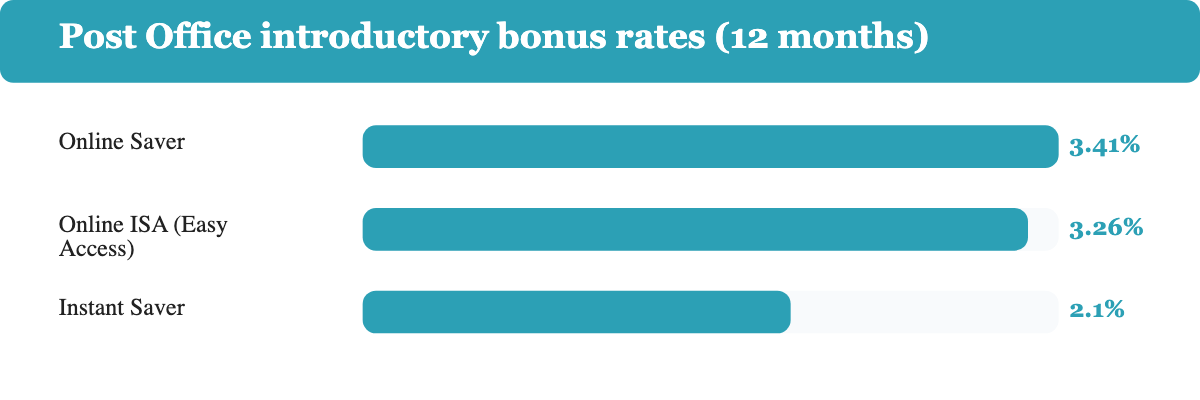
| Account | Introductory bonus rate (12 months) | Minimum opening deposit | Access |
|---|---|---|---|
| Online Saver | 3.41% gross/AER fixed bonus | £1 | Easy access, online |
| Instant Saver | 2.10% gross/AER fixed bonus | £100 | Easy access, online |
| Online ISA (Easy Access pocket) | 3.26% gross/AER fixed bonus | £100 | Easy access, tax-free |
The pattern across all three is the same: the headline rate includes a fixed bonus for the first 12 months, after which the rate drops to the account's standard variable rate unless you switch or move your money. This is a common structure across the UK savings market, not unique to the Post Office, but it does mean you should put a reminder in your calendar to review the rate after a year rather than assume it stays competitive. If you want a wider comparison of what else is on the market right now, our roundup of the best savings accounts in the UK is updated regularly.
Post Office business banking at the counter
Business customers can use Post Office branches much like personal customers do: paying in cash and cheques, withdrawing cash, checking balances, as long as their business bank participates in the Banking Framework. Coverage is narrower on the business side, roughly 75% of customers rather than 99%. Deposit limits still depend on the counter itself, £4,000 for an open-plan design or £20,000 behind a security screen.
For cash-heavy businesses such as shops, cafes and trades, this can be a genuine reason to pick one banking provider over another: a digital challenger bank with strong Post Office deposit support can end up more convenient day to day than a high street bank whose nearest branch has closed. Our guide to the best business savings accounts covers where to put spare cash once it is in the business account.
What ID and documents do you need?
Routine deposits and withdrawals do not need ID. Your debit card and PIN, or a paying-in slip and deposit envelope from your bank, are enough. Opening a new Post Office savings account or ISA is different: it is a new financial product, so it is subject to standard UK anti-money-laundering checks.
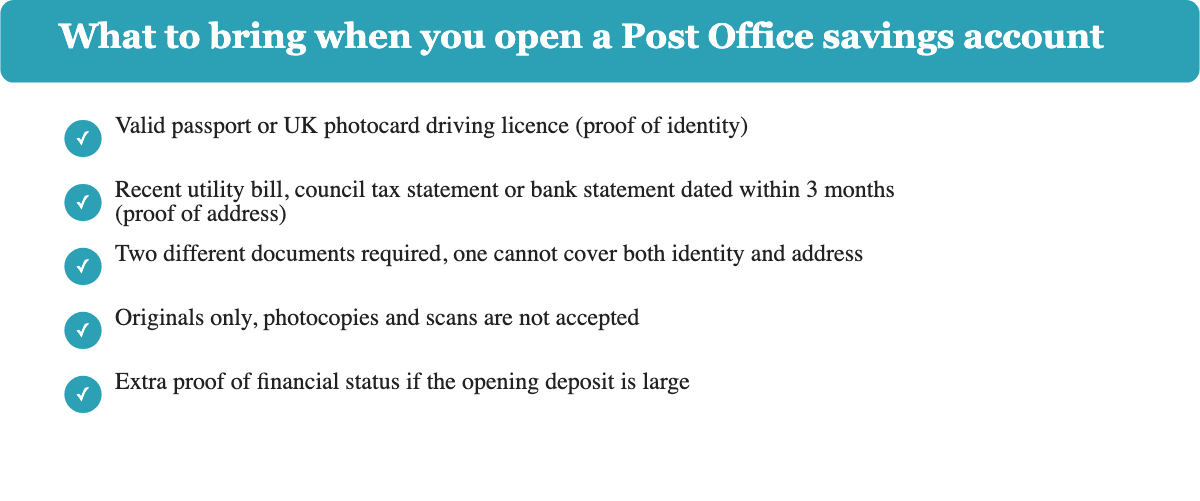
When you apply, expect to provide:
- Proof of identity, such as a valid passport or UK photocard driving licence
- Proof of address, such as a recent utility bill, council tax statement, or bank statement dated within the last three months
- For some accounts, additional proof of financial status if a large opening deposit is involved
You cannot use the same document to prove both identity and address, and documents must be originals, photocopies and scans are not accepted. If part of your application needs to be verified in person, you can usually do this at a local branch that offers document verification, rather than posting original documents away.
Is a Post Office savings account worth it?
Whether it makes sense depends on what you are comparing it to.
Reasons to consider it
- Competitive introductory bonus rates on the Online Saver and Online ISA compared with many high street banks
- Low or no minimum deposit on the easy access accounts
- Familiar, established brand with savings protected under the Financial Services Compensation Scheme (FSCS) up to £120,000, since the money sits with Bank of Ireland UK
- Simple, no-frills account structure with straightforward online management
Reasons to look elsewhere
- The advertised rate is a temporary bonus, not a permanent one, so it needs active management after 12 months
- There is no current account option any more, so this only solves the savings side of your banking, not everyday spending
- Digital-only challenger banks often pay similar or better rates on flexible savings pots with more app-based features
Want to move spare cash into an easy access account paying a decent rate? A Post Office savings account is a reasonable, low-effort choice. Want an everyday bank account with branch access? You will need to open one with a different provider first, then use the Post Office counter to manage it, since the Post Office itself no longer issues one.
Alternatives to consider
If you specifically want branch-style, cash-friendly banking without opening a Post Office savings product, a few UK current accounts are worth comparing directly:
- Starling Bank, a digital current account with strong Post Office deposit and withdrawal support and no monthly fee
- Monzo, which allows Post Office deposits (though not withdrawals) alongside its app-based current account
- Nationwide or a high street bank such as Lloyds or NatWest, if you want a full branch network alongside Post Office counter access
For savings specifically, it is worth comparing the Post Office rates above against Marcus by Goldman Sachs and other easy access savings providers before you commit, since introductory bonus rates across the market shift regularly.
Frequently asked questions
Can I still open a Post Office current account?
No. The Post Office Money current account, provided by Bank of Ireland UK, stopped accepting new applications in 2019 and was fully closed down by 2022. There is no Post Office-branded current account available today.
Can I pay in cash at the Post Office for any bank?
Not for every bank, but for most. Around 30 UK banks and building societies, covering roughly 99% of personal banking customers, participate in the Banking Framework that runs Post Office everyday banking. Always check with your own bank first, since the services available (deposits, withdrawals, or both) can differ by provider.
Is my money safe in a Post Office savings account?
Post Office savings accounts hold deposits with Bank of Ireland UK, which is covered by the UK's Financial Services Compensation Scheme (FSCS) up to £120,000 per person. The FSCS limit rose from £85,000 to £120,000 on 1 December 2025. Post Office cash ISAs are provided by OneFamily.
What is the maximum cash deposit limit at a Post Office counter?
It depends on the branch layout. Open-plan counters generally accept deposits up to £4,000, while counters with a security screen can usually take deposits up to £20,000. Limits are set by the individual bank's agreement with the Post Office and can vary.
Do I need ID to use Post Office everyday banking?
No, not for routine deposits or withdrawals on an existing account, your debit card and PIN or a paying-in slip is enough. ID is only required when opening a new Post Office savings account or ISA, or when your bank asks the Post Office to verify identity documents in branch.