
Hampshire Trust Bank Savings: review 2026
Last updated: 12.10.2026
Contents
Summary
Hampshire Trust Bank is a specialist UK savings bank regulated by the FCA and PRA, offering easy-access, notice and fixed-term accounts with competitive rates up to 4.32% AER. Deposits are protected up to 120,000 GBP per person under the FSCS. It suits savers who are comfortable managing their money online and want dedicated savings products rather than a full-service current account.
Pros
- Competitive easy-access rate of up to 4.32% AER
- FSCS protection covers up to 120,000 GBP per person per bank
- Range of account types including easy-access, notice and fixed-term
- Fully online account management with no branch queues required
- Specialist savings focus means rates are benchmarked against the best in the market
Cons
- Best rates typically require notice or fixed terms, not instant access
- No physical branches for those who prefer face-to-face service
- Some accounts carry a minimum deposit requirement
- No current account, debit card or payment features
Key facts
| Interest on savings account | up to 4.32% AER easy access (variable; best rates often on Notice/Fixed) |
| Deposit protection | £120,000 |
| Online account opening | ✓ |
| Welcome bonus | – |
| Joint account | – |
| Overdraft interest rate | – |
| Savings account | – |
| Rating | 4.0 /5 |
Interest rate comparison
The effective annual rate compared directly with the alternatives.
A closer look
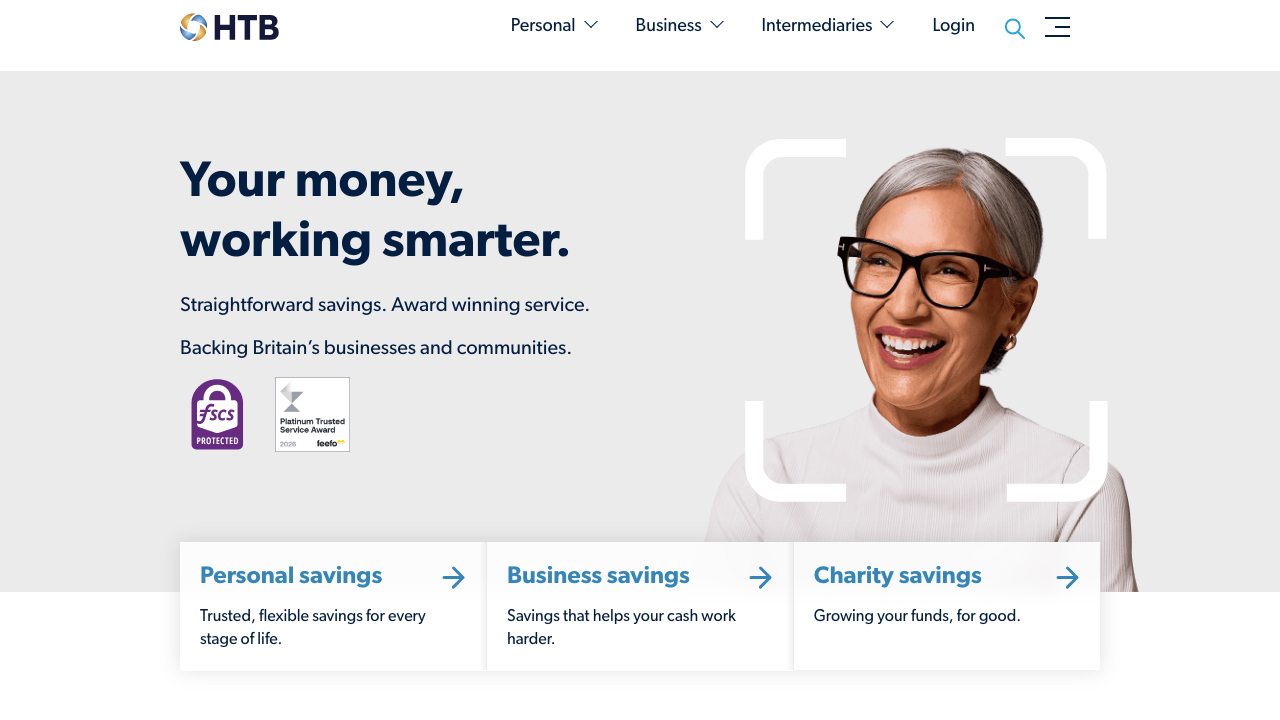
Overview: what Hampshire Trust Bank Savings offers and who it suits
Hampshire Trust Bank (HTB) is a UK-based specialist lender and deposit-taker authorised by the Prudential Regulation Authority and regulated by the Financial Conduct Authority and the PRA. It is not a high-street name, which is precisely why it tends to attract a different kind of saver: one who prioritises rate over brand recognition and has no need to walk into a branch. HTB's savings range spans easy-access accounts, notice accounts and fixed-term deposits, meaning the bank can serve savers at almost every point on the flexibility spectrum.
The bank's core proposition is competitive interest, particularly on notice and fixed-rate products where the headline rates have consistently sat above the high-street average. Easy access is available too, with rates up to 4.32% AER at the time of writing, though the very best numbers generally require you to commit to a notice period or a fixed term. If you are happy to lock money away for six months or longer, or to give 30, 60 or 95 days notice before a withdrawal, HTB regularly competes with the top of the market. Which accounts else are worth a look is covered here: Best joint savings account.
This account is not the right fit for everyone. Savers who want to walk into a branch, speak to an adviser face to face, or hold a current account alongside their savings at the same institution will need to look elsewhere. HTB offers no physical presence and no current account. Those who need instant, unrestricted access every week are also better served by a fully flexible account with a larger digital bank, since the best HTB rates come attached to conditions. If it is not the right fit, we compared the strongest Chip alternatives.
The interest rate explained: easy access, notice and fixed terms
HTB's easy-access rate of up to 4.32% AER is variable, meaning the bank can change it without warning in response to Bank of England base rate movements or its own funding needs. The annual equivalent rate (AER) standardises compounding so you can compare across providers fairly, but be aware the underlying gross rate will be slightly lower. Interest is generally credited to the account on a periodic basis, and the exact crediting schedule matters if you are planning to live off the income, so check the specific account terms before opening. An overview of the Chase alternatives is in a separate article.
Notice accounts typically carry a higher rate than easy access in exchange for the delay before you can withdraw. A 95-day notice account, for instance, means funds are not immediately available in an emergency. Fixed-rate bonds lock the rate for the entire term, which is both a strength and a limitation: your return is guaranteed regardless of what the Bank of England does, but you cannot access the capital early without penalty or, in some cases, at all until maturity.
There are minimum deposit requirements on several HTB products. These vary by account type and change periodically, so verify the current minimum before applying. No ongoing monthly fee is charged for holding a savings account. The account pays no arrangement fee or administration charge on standard retail savings products.
In our test, the online application quoted a clear gross rate alongside AER and specified the interest payment date. The rate disclosure was straightforward, with none of the promotional-versus-revert-rate confusion that some challenger banks deploy.
Taxation of savings interest in the UK
UK residents benefit from the Personal Savings Allowance (PSA), introduced in April 2016. Basic-rate taxpayers (20%) can earn up to 1,000 pounds of savings interest per tax year before paying any income tax on it. Higher-rate taxpayers (40%) have a 500-pound allowance. Additional-rate taxpayers (45%) receive no PSA at all. HTB does not deduct tax at source; the account pays gross interest, and you are responsible for declaring any taxable interest to HMRC, typically via self-assessment or through an adjustment to your tax code.
For most savers in 2026, with rates around 4% and balances below 25,000 pounds, the PSA covers the full annual interest and no additional tax is due. High earners or those with large balances should factor in the tax cost. A 50,000-pound balance earning 4.32% generates roughly 2,160 pounds of interest per year, which would leave a higher-rate taxpayer with around 1,660 pounds above their allowance, taxed at 40%. The Stocks and Shares ISA or Cash ISA route is worth considering for those routinely exceeding the PSA, though HTB's own product range may or may not include an ISA wrapper depending on the current account lineup.
Opening an account: the process step by step
HTB savings accounts are opened entirely online; there is no paper application and no branch visit. The process follows the standard UK digital savings model. You visit the HTB website, select the account type that suits your term and rate preference, and begin the application. You will need a valid UK address, a National Insurance number and, typically, a UK current account from which to fund the savings account. HTB will run standard identity and fraud checks in the background.
Identification is handled digitally. Most applicants are verified automatically using data from credit reference agencies, which means no document uploads are required in straightforward cases. If automated verification cannot confirm your identity, you may be asked to supply a copy of a passport or driving licence and a proof of address. HTB states online account opening is available, and in practice the majority of applications complete in under 20 minutes for straightforward cases.
Once the account is open, you fund it by bank transfer from your nominated current account. The IBAN for HTB accounts uses the standard GB prefix, confirming the holding is in the UK banking system. Notice and fixed-rate products may restrict additional deposits after the opening window closes, so check the terms before transferring in stages. There is no app to download; account management is web-based through HTB's online portal.
Safety: FSCS protection and the institution behind it
Hampshire Trust Bank is a fully authorised UK bank, which means eligible deposits are protected by the Financial Services Compensation Scheme (FSCS) up to 120,000 pounds per person, per institution. The FSCS limit rose from 85,000 pounds to 120,000 pounds on 1 December 2025. Joint accounts benefit from 240,000 pounds of protection. This is the same protection level that applies to Barclays or Nationwide, not a lesser arrangement. The FSCS is funded by levies on the industry and backed by the UK government, making it among the most credible deposit guarantee schemes in Europe.
HTB was founded in 1977 and has operated continuously as a specialist lender. It is not a new fintech or a recently chartered bank; it has decades of regulated operation behind it. The bank's primary business is lending into specialist property and asset finance markets, and retail savings deposits are a core funding mechanism for that lending book. This structure is conventional and well understood by regulators. The PRA supervises HTB's capital adequacy, liquidity and overall safety, adding a further layer of prudential oversight beyond the FCA's conduct standards.
Reputation and real customer experience
Recurring praise in customer reviews centres on rate competitiveness and straightforward account management. Savers consistently note that HTB's rates appear reliably near the top of best-buy tables for notice and fixed-term products. The online portal is described as functional rather than flashy: it does what it needs to do without unnecessary friction. Opening time is cited positively, with most reviewers completing the process without needing to contact support.
The recurring complaints follow a clear pattern. Customers who expected a richer digital experience, an app, or real-time chat support report disappointment. HTB's savings platform is not designed to compete with Monzo or Chase on features; it is designed to hold and pay interest on deposits. Telephone hold times have drawn criticism during periods of high demand, particularly around product launches when many applicants contact support simultaneously. A smaller number of reviews mention delays in account opening when manual ID verification was required, adding days to the process.
There are no widespread complaints about rate reductions being made without communication, and no pattern of complaints about funds being inaccessible or incorrectly credited. The themes are operational rather than fundamental: this is a bank that attracts savers who accept a basic digital interface in exchange for a strong rate, and the dissatisfied customers are generally those who arrived with different expectations.
Verdict: open an HTB account or look elsewhere?
Hampshire Trust Bank is the right choice for a specific type of UK saver. If you have a lump sum, a clear time horizon of at least a few months, and no requirement for a mobile app or branch contact, HTB's fixed-term and notice accounts deserve serious comparison against whatever the top of the best-buy tables looks like at the moment you are reading this. The FSCS protection is full and unambiguous, and the institution has a long operating history.
Easy access at up to 4.32% AER is competitive in the current market, though variable and subject to change. It is a workable option for an emergency fund held outside your main bank, provided you are comfortable with web-only management. In our test, the account opened cleanly and the rate was exactly as advertised with no hidden conditions on standard balances.
Look elsewhere if you want a savings account with daily app notifications, instant transfers back to multiple linked accounts, or any face-to-face service. Chip, Chase or Marcus may suit you better if digital experience matters as much as rate. Savers who routinely hold more than 120,000 pounds in cash savings should also consider splitting across institutions rather than concentrating beyond the FSCS limit at any single bank, HTB included.
How safe is Hampshire Trust Bank Savings?
Hampshire Trust Bank Savings vs alternatives
A direct comparison of the key conditions against the strongest competitors in the market.
 |  |  |  | |
| Rating | 4.0 /5 | 4.0 /5 | 4.0 /5 | 4.0 /5 |
| Interest on savings account | up to 4.32% AER easy access (variable; best rates often on Notice/Fixed) | 2.25% AER variable (Boost: 4.50% AER for 12 months for new customers, requires a Chase current account) | ca. 3.50% AER easy access (Promo Boost: up to 5.01% AER for 6 months for new customers) | ca. 3.75% AER easy access (incl. 0.49% bonus for 12 months) |
| Deposit protection | £120,000 | £120,000 | £120,000 | £120,000 |
| Online account opening | ✓ | ✓ | ✓ | ✓ |
| Welcome bonus | – | ✓ | – | – |
| Joint account | – | ✗ | – | ✓ |
| Overdraft interest rate | – | ✗ | – | – |
| Savings account | – | ✓ | – | – |
How we rate
About the author

Frequently asked questions
You must be a UK resident to apply. Applications are completed online at htb.co.uk, and you will need standard identity and address documents. Some accounts also carry a minimum opening deposit, so check the specific product terms before applying.
Hampshire Trust Bank does not charge a monthly maintenance fee on its savings accounts. You should review the individual product terms for any conditions around early withdrawal from fixed or notice accounts, as penalties may apply if you access funds before the agreed date.
Eligible deposits are protected up to 120,000 GBP per person per bank under the Financial Services Compensation Scheme (FSCS), which is the UK's statutory deposit guarantee scheme. Joint accounts receive up to 240,000 GBP in combined protection.
The entire application process is online via htb.co.uk. You complete an identity check, provide your personal details and fund the account by bank transfer. Most verifications are handled electronically, though you may occasionally be asked to upload supporting documents.
Hampshire Trust Bank holds a full UK banking licence and is authorised by the Prudential Regulation Authority and regulated by the Financial Conduct Authority. Combined with FSCS protection up to 120,000 GBP, this places it on the same regulatory footing as major high-street banks.
Interest is paid gross and counts as income for tax purposes. The Personal Savings Allowance lets basic-rate taxpayers earn up to 1,000 GBP of interest tax-free each year, and up to 500 GBP for higher-rate taxpayers. Interest above your allowance should be declared to HMRC, typically through self-assessment or a PAYE coding notice.