
Marcus Online Savings Account review 2026: fees, features and verdict
Last updated: 12.10.2026

4.0 /5 ★★★★☆Very good
Rank 17 of 50 in our comparison
Contents
Summary
Marcus by Goldman Sachs is one of the most recognised names in UK easy-access savings. Launched in 2018, it brought serious banking heritage to the everyday saver, offering a no-fuss online account with no minimum deposit requirement, full FSCS protection up to £120,000, and consistently competitive rates. The headline rate typically includes a 12-month introductory bonus on top of a base rate, so savers who switch in and then forget about it will see their rate fall after the first year. For engaged savers who are happy to manage everything online and keep an eye on rate movements, Marcus remains a strong contender in the easy-access market.
Pros
- Consistently competitive easy-access rate, often among the market leaders
- No minimum deposit and no maximum balance restrictions for everyday savers
- Full FSCS protection up to £120,000 per person, backed by Goldman Sachs International Bank
- Straightforward online application that typically takes under ten minutes
- No fees or hidden charges on the standard savings account
Cons
- Headline rate usually includes a 12-month bonus that drops to a lower base rate afterwards
- Online and telephone only, with no branch network and no dedicated savings app
- Variable rate can be cut at any time in response to Bank of England base rate changes
Key facts
| Interest on savings account | ca. 3.75% AER easy access (incl. 0.49% bonus for 12 months) |
| Deposit protection | £120,000 |
| Online account opening | ✓ |
| Welcome bonus | – |
| Joint account | ✓ |
| Overdraft interest rate | – |
| Savings account | – |
| Rating | 4.0 /5 |
Interest rate comparison
The effective annual rate compared directly with the alternatives.
A closer look
What Marcus is, and who it suits
Marcus is the consumer savings brand of Goldman Sachs, launched in the UK in 2018 as a straightforward online-only easy-access savings account. There's no current account, no debit card, no loan product attached to it. The proposition is deliberately narrow: deposit money, earn interest, withdraw when you want.
That's the product's main selling point.
The account suits savers who already have a main bank elsewhere and want a dedicated home for their emergency fund or medium-term cash pot. It works well for people who don't mind doing everything online, who value the security of the Goldman Sachs name behind the product, and who'd rather not worry about a minimum balance. You can open it with as little as one pound. Anyone thinking about switching will find options among the Chip alternatives. It doesn't suit everyone, though: Marcus isn't a fit for savers who need a branch, who want instant access via a banking app packed with budgeting features, or who plan to make frequent transactions, and it has no linked current account or card product, so it can't replace your everyday bank account. One thing worth correcting up front, since several review sites still get this wrong: if you're shopping for a joint account, Marcus does support one. The Online Savings Account and the 1 Year Fixed Rate Saver can both be opened in sole or joint names, and either holder can manage transfers once the account is live. The Cash ISA is the one exception, since UK ISAs are always individually owned by law, not by any choice Marcus made. If the main account isn't the right fit for you, we compared the strongest Marcus alternatives.
The interest rate: base rate, bonus, and what happens after 12 months
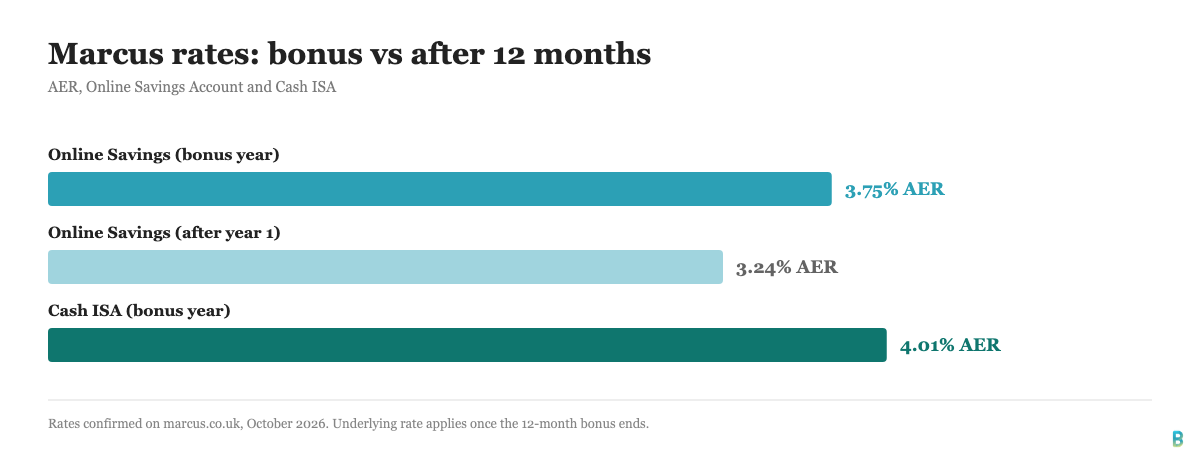
Marcus pays 3.75% AER on its Online Savings Account, confirmed directly on marcus.co.uk's own rate page. That figure includes a 0.49% bonus that applies for the first 12 months from account opening, and stripping the bonus out leaves an underlying rate of 3.24% AER, which is what you're left with once the introductory period ends.
Marcus doesn't hide this.
The bonus is disclosed prominently on its site and in the account summary box, so there's no small-print trick here. Even so, savers need to check the rate after month twelve and decide whether to stay or move, because nothing happens automatically in their favour. Interest is calculated daily and paid monthly into the account itself, so it compounds automatically, and there's no minimum balance required to earn interest and no tiered structure where larger balances get a higher rate. You'll earn the same rate whether you hold one pound or the maximum £250,000 the account allows. The rate is variable, meaning Marcus can change it in line with the Bank of England base rate or its own commercial decisions, and it typically emails customers ahead of a change. Savers who don't check their inbox regularly could still miss a drop, so setting a reminder for month eleven is a sensible habit, not an overreaction.
Taxation of interest in the UK
UK residents get a Personal Savings Allowance.
Basic-rate taxpayers, those paying 20% income tax, can earn up to £1,000 of savings interest per tax year without paying tax on it. Higher-rate taxpayers (40%) get a £500 allowance, and additional-rate taxpayers, who pay 45%, don't get any allowance at all. Interest earned above those thresholds is taxed at your marginal income tax rate, and HMRC collects this automatically through a coding adjustment to your PAYE tax code, or through self-assessment if you file a return. Marcus doesn't deduct tax at source, so you receive the gross interest and you're responsible for anything owed. It issues an annual interest statement that makes reporting straightforward. At 3.75% AER, a basic-rate taxpayer would need to hold roughly £26,700 with Marcus before the £1,000 threshold is breached, though most retail savers won't get close to that. Higher earners with larger balances should factor the tax cost into their effective return, and remember that the allowance is per person, not per account, so interest from every savings account you hold, across every provider, counts toward the same limit.
If you'd rather shelter interest from tax entirely, Marcus now runs its own Cash ISA alongside the taxable account, paying 4.01% AER with a 0.74% first-year bonus.
Opening the account: process and timeline
Marcus accounts are opened entirely online at marcus.co.uk. There's no app-based onboarding, no branch visit, and no telephone application.
The process is straightforward for applicants with standard UK identification and a personal current account to link for transfers. You'll need to provide your full name, address history for the past three years, date of birth, National Insurance number, and the details of the UK current account you want to link. Marcus runs a soft credit check, which doesn't affect your credit file. Identity verification happens digitally and usually completes within minutes when your details match credit reference agency records. In our test, the account was open and ready to fund within about 20 minutes of starting the application. Once open, you can link current accounts for transfers in and out, and withdrawals only go to those linked accounts rather than to third parties, which adds a layer of security. There's no minimum deposit to open, no maximum monthly contribution limit, and no notice period required to withdraw.
Initiate a transfer before the cut-off time and the money moves out the same business day. Marcus operates a UK IBAN, so transfers integrate cleanly with standard Faster Payments rails.
App, features, and customer service
Marcus launched without a mobile app and added one later, but the product still feels web-first. The online dashboard is clean and functional. You can see your balance, track interest accrued, manage linked accounts, and start a transfer without digging through menus. What it doesn't offer is budgeting tools, spending categorisation, savings goals, or any of the extras common to app-first neobanks.
Customer service runs through telephone and secure in-portal messaging.
There's no live chat. Phone lines are open seven days a week, which beats most high-street banks, and in our test call, wait times stayed under five minutes. Email replies were slower, typically 24 to 48 hours. For a savings-only product with few transactional queries, that's adequate, though savers used to instant chat support from fintechs may find it slower than they're expecting. Notification options are limited, too: you can opt into email alerts for rate changes and account activity, but push notifications aren't anywhere near as granular as what dedicated savings apps like Chip or Plum offer.
Marcus doesn't try to be a financial hub. It does one job, and it does that job without much fuss. For a closer comparison point, see our review of the Plum Easy Access Account.
Reputation and real customer experience
Marcus has a genuinely polarised reputation on Trustpilot, not a uniformly glowing one. The account holds a TrustScore of around 3 out of 5, an average of roughly 2.8, from close to 300 reviews. Almost half of reviewers give it 5 stars and about a third give it 1 star, with comparatively few ratings sitting in between.
The praise is consistent across the positive reviews.
Three themes recur: the account does exactly what it promises with no nasty surprises, the Goldman Sachs backing gives people confidence, and the web interface is clean and easy to navigate. Several reviewers also mention quick customer service responses and straightforward transfers in and out, including at weekends. The complaints are just as consistent: the most common one is the rate drop after the 12-month bonus period ends, with some customers feeling misled even though Marcus discloses it clearly. A second cluster centres on slow customer service during high-demand periods, particularly when rates moved sharply and a lot of customers contacted support at once. A smaller number of reviews flag the inability to link a business account for transfers, or to open an account from outside the UK.
None of that amounts to systemic complaints about funds being inaccessible or withdrawals being delayed, which matters most for an easy-access product. The split rating pattern is actually typical of savings accounts with a time-limited bonus: happy long-term holders rarely bother leaving a review, while anyone who feels caught out by the rate drop is far more likely to post.
Verdict: open it or look elsewhere
Marcus suits a specific type of saver well.
If you want a no-frills easy-access account backed by a globally recognised financial institution, with eligible deposits protected up to £120,000 and a competitive rate for the first year with zero balance requirements, it's a strong and trustworthy choice. The opening process is quick, the interest payments are reliable, and the Goldman Sachs infrastructure keeps operational risk low. Look elsewhere if you want the highest possible rate without a time-limited bonus attached, since Marcus's post-bonus rate can lag dedicated savings platforms or newer challengers at any given point. Also look elsewhere if you need a mobile-first experience or live-chat support. A joint account is available, but only on the Online Savings Account and the Fixed Rate Saver, never the Cash ISA. Savers comfortable actively monitoring rates and switching when the bonus expires get the best value here. Those who'd rather set an account and forget it for several years may find the effective return disappointing once the first twelve months pass.
The deposit guarantee is real and meaningful. Marcus states that eligible deposits are protected up to a total of £120,000, which is the standard FSCS limit per person per authorised institution since it rose from £85,000 on 1 December 2025. Marcus by Goldman Sachs is a trading name of Goldman Sachs International Bank, which is registered in England and Wales, authorised by the Prudential Regulation Authority, and regulated by both the Financial Conduct Authority and the Prudential Regulation Authority. Your money sits with a PRA-authorised UK bank, not an unregulated fintech wrapper.
For the right saver, that combination of simplicity, safety, and a decent introductory rate makes Marcus a legitimate first stop when setting up a dedicated savings pot.
How safe is Marcus by Goldman Sachs Marcus Online Savings Account?
Marcus by Goldman Sachs Marcus Online Savings Account vs alternatives
A direct comparison of the key conditions against the strongest competitors in the market.
|  |  |  | |
| Rating | 4.0 /5 | 4.0 /5 | 4.0 /5 | 4.0 /5 |
| Interest on savings account | ca. 3.75% AER easy access (incl. 0.49% bonus for 12 months) | 2.25% AER variable (Boost: 4.50% AER for 12 months for new customers, requires a Chase current account) | ca. 3.50% AER easy access (Promo Boost: up to 5.01% AER for 6 months for new customers) | Free 2.75% AER; Extra 3.00% AER; Perks 3.25% AER; Max 3.50% AER (all variable instant access); Fixed Rate Pot up to 4.70% AER |
| Deposit protection | £120,000 | £120,000 | £120,000 | £120,000 |
| Online account opening | ✓ | ✓ | ✓ | ✓ |
| Welcome bonus | – | ✓ | – | – |
| Joint account | ✓ | ✗ | – | – |
| Overdraft interest rate | – | ✗ | – | – |
| Savings account | – | ✓ | – | – |
How we rate
More comparisons
About the author

Frequently asked questions
The account is free with no account fees. Current rate: ca. 3.75% AER easy access (incl. 0.49% bonus for 12 months).
Yes. Marcus is a trading name of Goldman Sachs International Bank, which is authorised by the Prudential Regulation Authority and regulated by the Financial Conduct Authority and the Prudential Regulation Authority. Marcus states that eligible deposits are protected up to a total of £120,000, which is the standard FSCS limit per person per authorised institution since it rose from £85,000 on 1 December 2025. If Goldman Sachs International Bank were to fail, the FSCS would compensate eligible depositors within seven working days.
The Marcus headline rate on the Online Savings Account includes a 12-month introductory bonus added on top of a lower underlying rate. Once the 12-month period expires, the bonus drops away and you earn only the underlying rate, which is lower. Marcus usually sends a notification before this happens, but you should diarise the date yourself and compare the market at that point.
Yes. The Marcus Online Savings Account is a standard taxable savings account, entirely separate from any ISA you hold elsewhere, and you can use both at the same time. Marcus also now runs its own Cash ISA, paying a variable rate with a 12-month bonus, but you can only pay new money into one cash ISA provider per tax year unless you use a full ISA transfer.
Withdrawals from the Marcus Online Savings Account are transferred back to your linked UK current account, with no penalty or notice period. Transfers are typically processed the same day or by the next working day, depending on your bank's processing times. Marcus does not issue a debit card, so all access to funds goes through bank transfer.
Yes. The Online Savings Account and the 1 Year Fixed Rate Saver can both be opened in sole or joint names, and either account holder can manage transfers once the account is open. The Cash ISA is the exception: UK law requires an ISA to be held by one person only, so it cannot be opened jointly.
Possibly, depending on your total savings interest across all accounts. Basic-rate taxpayers can earn up to £1,000 in interest tax-free each year under the Personal Savings Allowance; higher-rate taxpayers receive a £500 allowance; additional-rate taxpayers receive none. Marcus pays interest gross on the Online Savings Account and reports it to HMRC. If your interest exceeds your allowance, the excess is taxable at your marginal rate. Interest earned inside the Marcus Cash ISA is always tax-free and does not use up your Personal Savings Allowance.