
The ISA allowance for the 2026/27 tax year is £20,000, and you can split it across a Cash ISA, Stocks & Shares ISA, Innovative Finance ISA and Lifetime ISA however you like. Below, we cover how the allowance actually works this year, the separate Lifetime and Junior ISA limits, a few rules that catch people out, and the cash ISA change arriving in April 2027.
What is the ISA allowance for the 2026/27 tax year?
£20,000. That's the full ISA allowance for the 2026/27 tax year, running from 6 April 2026 to 5 April 2027 (see the official gov.uk ISA guidance for the government's own explanation). It's the total you can pay into ISAs during that window, whether you hold one account or five.
HMRC sets the allowance per person, not per account. It resets every 6 April. Any part you don't use by 5 April is simply gone, rather than rolling into the following year. The figure has held at £20,000 for several tax years in a row now, though it's always worth a quick check each April in case a Budget changes it. What you actually pay per month is set out in Monzo fees.
How your £20,000 ISA allowance splits across account types
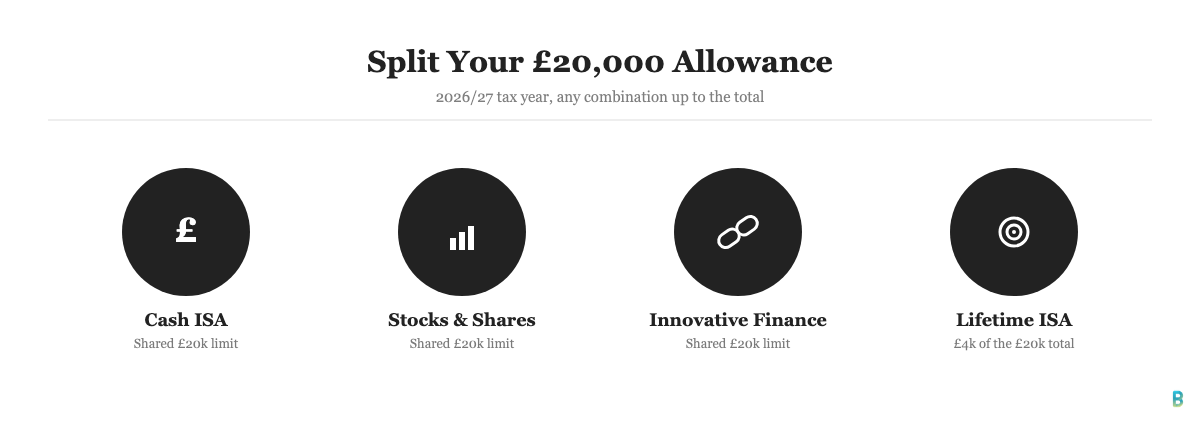
You don't need to put the full £20,000 into one ISA. Instead, split it across four account types in whatever combination suits you, as long as the total stays at or below £20,000 for the year:
- Cash ISA: tax-free interest on cash savings
- Stocks & Shares ISA: tax-free growth and dividends on investments
- Innovative Finance ISA (IFISA): tax-free returns from peer-to-peer lending
- Lifetime ISA (LISA): tax-free savings for a first home or retirement, plus a government bonus
Say you wanted three account types and three providers in one year. You could put £11,000 in a Cash ISA, £5,000 in a Stocks & Shares ISA, and the remaining £4,000 in a Lifetime ISA, all within the same £20,000 limit.
Here's how the 2026/27 allowance breaks down by ISA type:
| ISA type | 2026/27 allowance | Minimum age | Key rule |
|---|---|---|---|
| Cash ISA | Up to £20,000 (shared across ISA types) | 18 | More than one Cash ISA per year has been allowed since April 2024 |
| Stocks & Shares ISA | Up to £20,000 (shared across ISA types) | 18 | Value can fall as well as rise |
| Innovative Finance ISA | Up to £20,000 (shared across ISA types) | 18 | Not protected by the FSCS the way cash savings are |
| Lifetime ISA | £4,000 (counts inside the £20,000 total) | 18-39 to open | Only one LISA payment allowed per tax year |
What is the Lifetime ISA allowance?
£4,000 a year. That's the Lifetime ISA sub-limit, and it counts inside your overall £20,000 allowance rather than sitting on top of it. You need to be between 18 and 39 to open one, though you can keep contributing until you turn 50. On top of what you pay in, the government adds a 25% bonus (worth up to £1,000 a year on the full £4,000), provided the money eventually goes towards a first home or comes out from age 60 for retirement. Unlike a Cash or Stocks & Shares ISA, you can only pay into one Lifetime ISA per tax year. If you're weighing up a Cash ISA against other cash savings options, our Trading 212 Cash ISA review and Moneybox Cash ISA review compare two of the current providers.
Junior ISA allowance: a separate £9,000 limit for children
£9,000. That's the Junior ISA (JISA) allowance for 2026/27, and it sits entirely apart from your own £20,000 adult allowance. A parent or guardian opens the account, but anyone can pay in: parents, grandparents, family friends, as long as the combined total for the tax year doesn't top £9,000. As with a Lifetime ISA, only one Junior ISA of each type can be paid into per child, per year. See our best children's savings account guide if you're comparing Junior ISA providers.
ISA allowance vs Personal Savings Allowance: what's the difference?
These two get mixed up constantly, so here's the short version. Your ISA allowance is how much you can pay into ISAs each year (£20,000). Your Personal Savings Allowance (PSA) is how much interest you can earn tax-free on savings held outside an ISA, and the figure depends on your income tax band:
- Basic-rate taxpayers: £1,000 of savings interest tax-free per year
- Higher-rate taxpayers: £500 of savings interest tax-free per year
- Additional-rate taxpayers: no Personal Savings Allowance (£0)
Interest earned inside an ISA never touches your PSA calculation, no matter your tax band. It's always tax-free, full stop. If you're a higher earner with sizeable savings sitting outside an ISA, using up your ISA allowance first is usually the smarter move for exactly this reason.
ISA allowance rules you need to know
A handful of rules shape how you'll actually use the allowance day to day.
Since 6 April 2024, you can open and pay into more than one ISA of the same type in a single tax year. Before that date, the rule was strict: one Cash ISA, one Stocks & Shares ISA, and so on, per year. Lifetime ISAs and Junior ISAs sit outside this change and stay capped at one per tax year.
Transferring an existing ISA to a new provider costs you nothing in allowance terms. Only fresh money paid in during the tax year counts towards the £20,000 limit.
Unused allowance never carries forward. Pay in £12,000 this year, and the leftover £8,000 doesn't roll into next year's total.
One practical catch: not every provider has adopted the multiple-ISA rule yet. Check with your bank or platform before assuming you can split cash savings across two Cash ISAs in the same year.
What's changing from 6 April 2027: the new cash ISA limit
Here's the change worth planning around now. From 6 April 2027, anyone under 65 will only be able to put up to £12,000 of their allowance into a Cash ISA each tax year. The remaining £8,000 has to go into a Stocks & Shares ISA to use the full £20,000. Announced in the Autumn Budget 2025, the total allowance itself isn't shrinking, only how much of it can sit in cash.
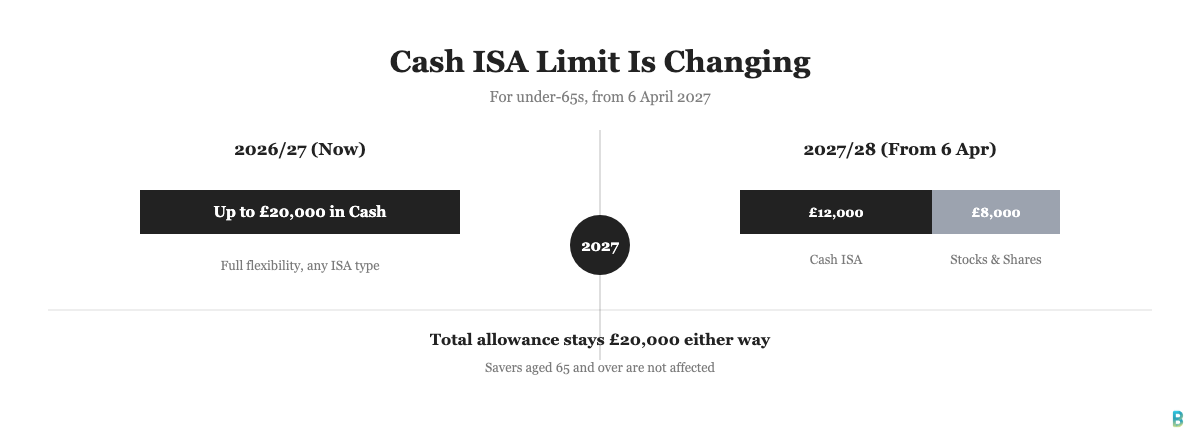
Note the effective date: this rule starts on 6 April 2027, the beginning of the 2027/28 tax year. For the current 2026/27 tax year covered in this guide, the full £20,000 flexible split still applies exactly as described above.
Changes for under-65s
From 6 April 2027, if you're under 65:
- Up to £12,000 of your allowance can go into a Cash ISA
- The remaining £8,000 can only go into a Stocks & Shares ISA
- A Lifetime ISA (within its own £4,000 sub-limit) or Innovative Finance ISA can still be combined alongside these
- Stocks & Shares-to-Cash ISA transfers stop being allowed; Cash-to-Cash, Stocks & Shares-to-Stocks & Shares, and Cash-to-Stocks & Shares transfers all remain fine
No change for savers aged 65 and over
None of this touches you if you're 65 or older. Put your entire £20,000 into a Cash ISA if that's what you want, exactly as you can today. Existing cash ISA balances, along with anything paid in before 6 April 2027, are also expected to stay protected and keep earning tax-free interest regardless of your age.
How to make the most of your ISA allowance this tax year
A few habits make the allowance easier to use well before it resets on 5 April.
First, check how much of the £20,000 you've already used before making a large lump-sum payment. It's an easy way to avoid going over by accident.
If you're under 65 and mostly save in cash, it may be worth shifting some of this year's contributions towards a Stocks & Shares ISA now, ahead of the tighter £12,000 cash limit landing in April 2027.
Got children? The £9,000 Junior ISA allowance runs separately from your own, so use both where you can. If you're still comparing where to hold your cash allowance, see our Monzo Savings Account review for one current option.
And don't leave a big payment until the final days before 5 April. Provider processing times mean a late submission might not land in time to count for that tax year.
ISA allowance FAQ
What happens if I go over my ISA allowance?
HMRC can spot a breach through provider reporting, so an accidental overpayment rarely goes unnoticed. In practice, HMRC or your ISA provider usually corrects the position, and the tax-free status may be stripped from whatever sits over the limit. Keeping a running total across all your ISAs is the simplest way to avoid this.
Does transferring an ISA use up my allowance?
No. Moving money from an existing ISA to a new provider doesn't touch your annual allowance, whatever the transfer amount. Only new contributions made during the tax year count towards the £20,000 limit.
Can I have ISAs with different providers?
Yes. Since the April 2024 rule change, you can hold and pay into more than one ISA of the same type across different providers in one tax year, provided your combined contributions stay within £20,000. Lifetime ISAs and Junior ISAs are the exception, still capped at one per year.
Does interest earned in an ISA count towards my allowance?
No. Interest, dividends, or investment growth earned inside an ISA never counts towards the £20,000 annual limit. Only money you actually pay in during the tax year counts, so your balance can grow well past £20,000 over time without touching your allowance.
Will the £20,000 total ISA allowance change in 2027?
No, the overall figure stays at £20,000. What changes from 6 April 2027 is how much of that total under-65s can put specifically into a Cash ISA, capped at £12,000, not the total amount available to save tax-free each year.