
Last updated:
The best business bank accounts in the UK charge nothing for everyday banking in 2026. Starling, Mettle and HSBC's Small Business Account never charge a monthly fee at all. Limited companies must open one: the Companies Act obliges you to keep company money separate from your own. Sole traders face no such obligation, but most banks, accountants and HMRC guidance recommend it anyway, since it makes tax returns and bookkeeping far simpler. Below is a full, independently compiled comparison of 12 UK business bank accounts: what each one costs, whether your money is FSCS protected, and which account fits your situation.
Contents
What is a business bank account?
A business bank account is a current account opened in the name of your business rather than in your own name, used to receive customer payments, pay suppliers and staff, and keep a clean record of your company's finances separate from your personal spending. Most UK providers offer a business debit card, online and mobile banking, and integrations with accounting software such as Xero, QuickBooks or FreeAgent. Directories such as SaaSBid help you shortlist accounting and invoicing tools before you commit to a bank. Business accounts are available from traditional high-street banks (Barclays, HSBC, Lloyds, NatWest) and from app-only digital challengers (Starling, Tide, Mettle, Monzo), with meaningfully different pricing, features and account-opening speed between the two groups.
Do I need a business bank account?
If you run a limited company, yes. It is a legal requirement. A limited company is a separate legal entity from you personally, and company law obliges its finances to stay apart from your own. Sole traders face no such rule. Once your turnover grows beyond a hobby level, though, it is worth opening one anyway: mixing business and personal transactions makes Self Assessment far more time-consuming and increases the risk of errors on your tax return. We cover it in more depth here: Atom Bank Instant Saver.
- Limited companies (Ltd, LLP): a business account is mandatory; you cannot use a personal account for company transactions.
- Sole traders and freelancers: optional, but recommended for cleaner bookkeeping, easier Self Assessment, and a more professional appearance to clients and suppliers.
- Partnerships: optional too, but almost always used in practice to keep shared business income and expenses auditable.
Best business bank accounts UK 2026: full comparison
We compared 11 of the UK's most-used business bank accounts on monthly fee, free introductory banking, FSCS protection status, and who each account genuinely suits best. Prices and free-period offers below were verified in August 2026 and can change, so always check the provider's own pricing page before applying. More on this is in our guide: Bank of Scotland Classic Account.
| Business account | Monthly fee | FSCS protected | Best for |
|---|---|---|---|
| Starling Bank Business | Free (optional EUR account £2/month) | Yes | Free everyday digital banking |
| Mettle | Free (Mettle+ auto-invoicing £4/month optional) | Yes, via NatWest | Sole traders wanting a totally free account |
| Tide | Free plan free; Plus £9.99/month; Pro £27.49/month | Yes, via ClearBank | Fast onboarding for sole traders |
| Monzo Business | Lite free; Pro £9/month; Team £25/month | Yes | Budgeting tools and app design |
| ANNA Money | Pay as you go free (0.95% on incoming payments); Business £22.90+VAT/month | No (safeguarded) | Invoicing-heavy freelancers |
| Wise Business | No monthly fee; one-off £50 setup for Advanced features | No (safeguarded) | Low-cost international transfers |
| Cashplus (Zempler Bank) | Business Go free; Business Extra £9/month; Business Pro £19/month | Yes, Zempler Bank | Businesses that struggle to get accepted elsewhere |
| Barclays Business | 12 months free for new customers, then £8.50/month | Yes | Startups wanting a high-street free period |
| HSBC Business (Small Business Account) | 12 months free for new/startups, then £10/month; Small Business Account permanently free | Yes | Small businesses wanting a permanently free tier |
| Lloyds Business | 12 months free for new/startups, then £8.50/month | Yes | Startups on the high street |
| NatWest Business | 12 months free for new customers, then £5/month; switchers up to 2 years free | Yes | Switchers wanting the longest free period |
Best business bank accounts by need
The right business account depends far more on how you actually work than on which provider is "best" overall. These four shortlists match the most common situations UK business owners search for.
Best for startups and free banking
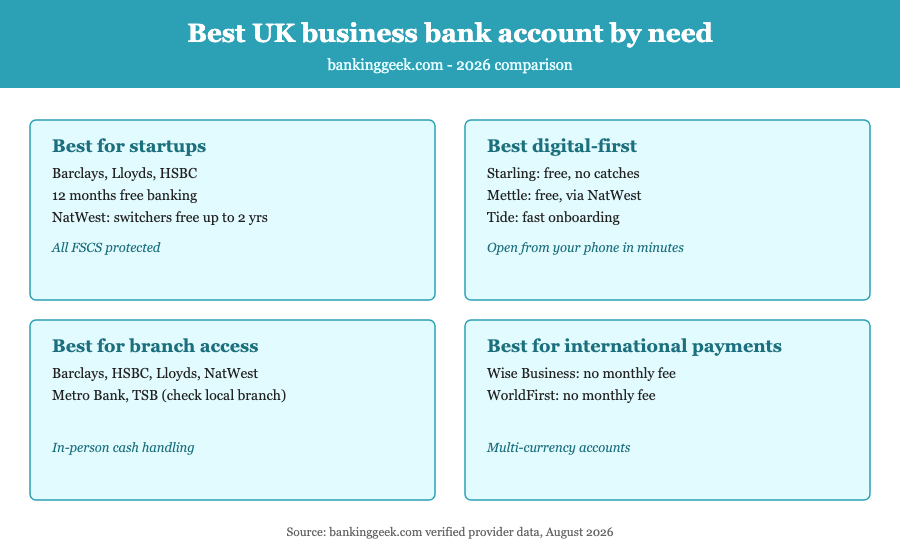
If you have just registered your company and want to keep costs down in year one, the high-street banks' new-business offers are hard to beat. Barclays, Lloyds and HSBC all give new and start-up businesses 12 months of free day-to-day banking, and NatWest currently offers switchers up to two years free. HSBC also runs a permanently free Small Business Account for eligible smaller businesses, so it is worth checking eligibility before your free period from another bank runs out. All four are fully FSCS protected.
- Barclays, Lloyds, HSBC: 12 months free for new customers
- NatWest: up to 2 years free for switchers
- HSBC's Small Business Account: permanently free for eligible businesses
Best digital-first account
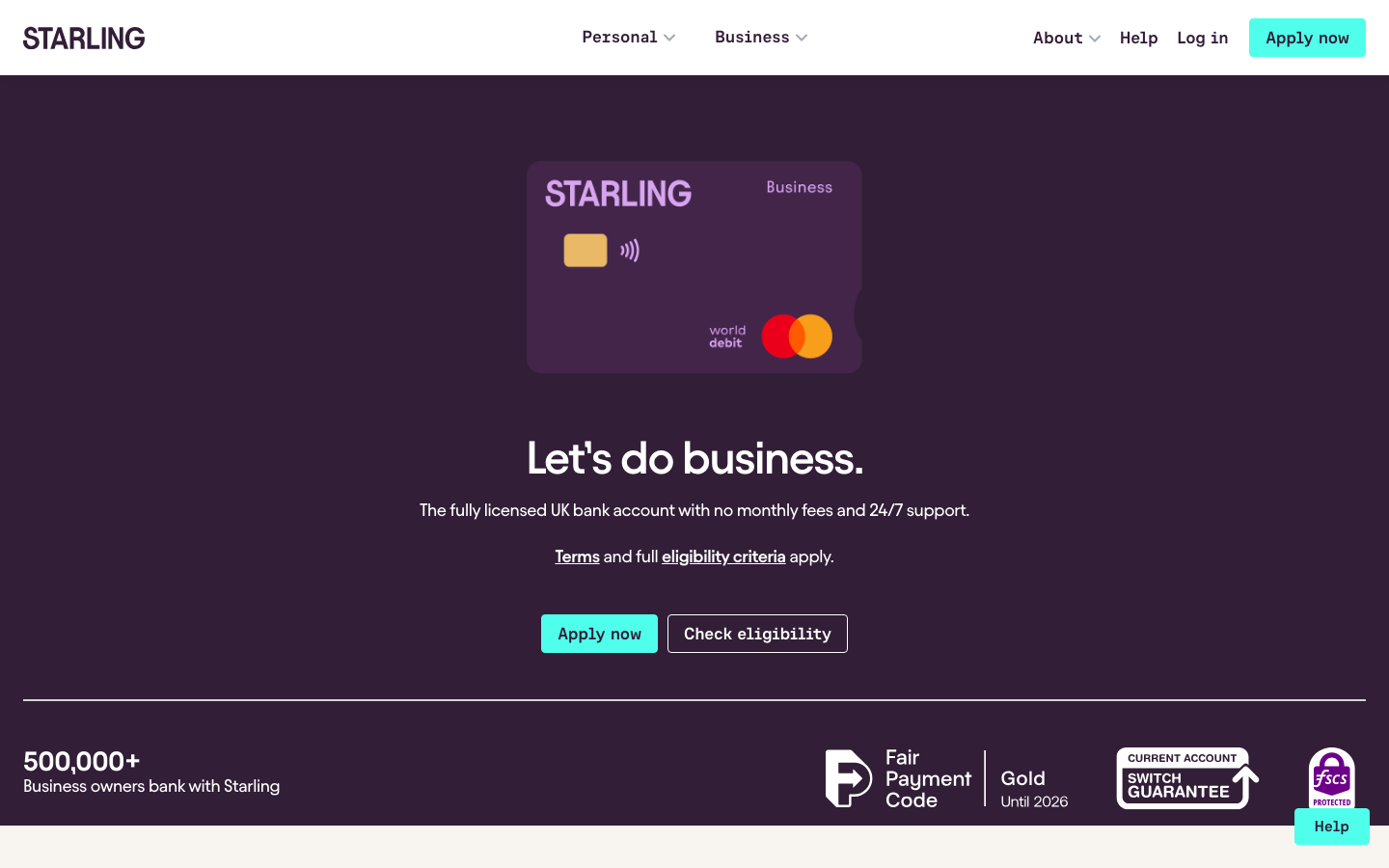
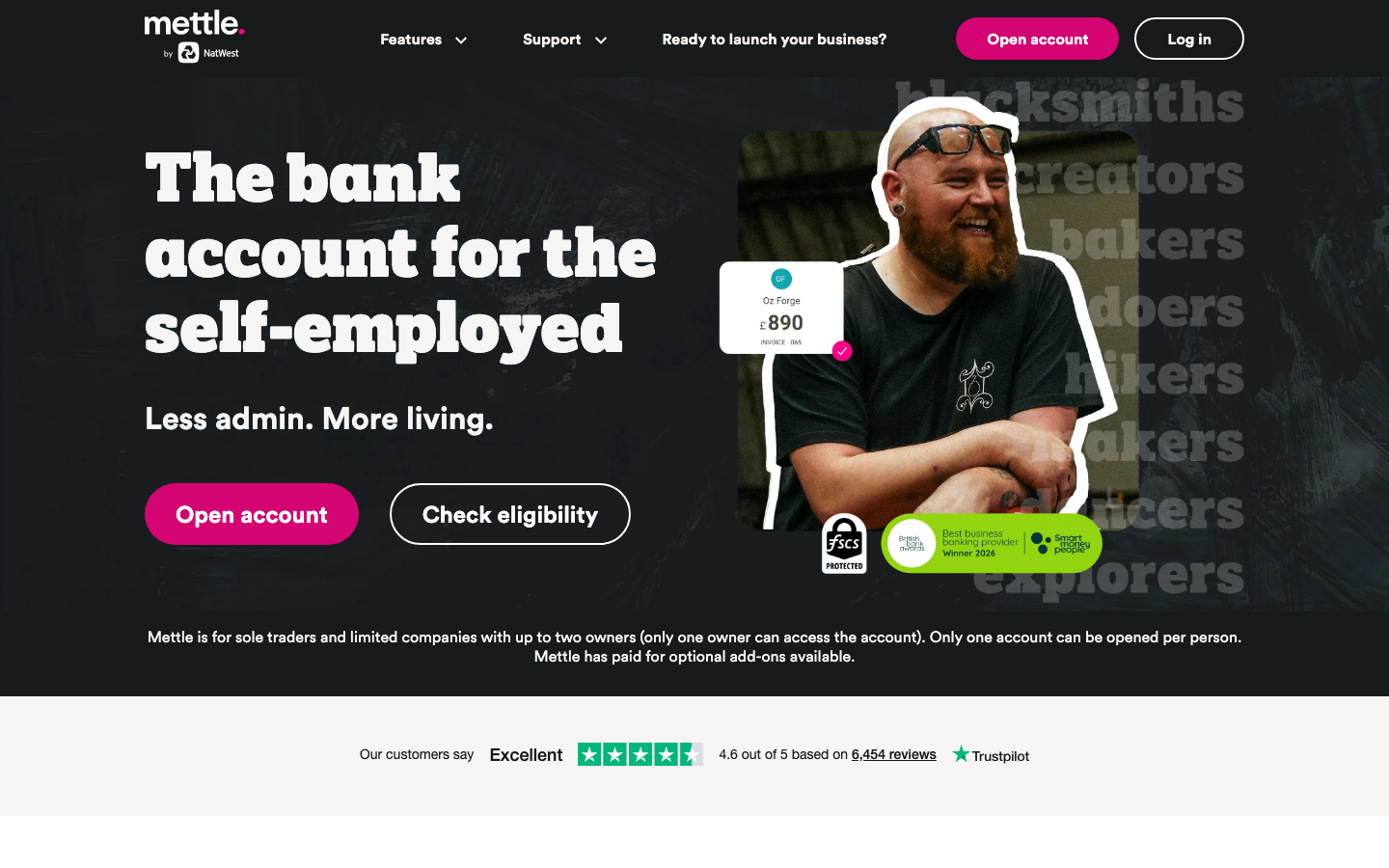
Starling Bank Business and Mettle are the two strongest picks if you want to open an account entirely from your phone in minutes and never pay a monthly fee. Starling is a fully licensed bank, so balances are FSCS protected up to £120,000. Mettle (backed by NatWest) is free with no catches for most sole traders and small limited companies, and deposits are FSCS protected up to £120,000 under NatWest's own banking licence. Tide and Monzo Business are close alternatives if you specifically want built-in invoicing or expense-tracking tools.
- Starling Business: free, FSCS protected, no catches
- Mettle: free, FSCS protected via NatWest, strong invoicing add-on
- Tide: fast onboarding, paid tiers unlock more features
Best for branch access
If you still handle cash regularly or simply prefer being able to speak to someone in person, the high-street banks remain the only real option, since none of the digital challengers in this comparison have branches. Barclays, HSBC, Lloyds and NatWest between them cover most UK high streets, and Metro Bank and TSB are also worth checking in your area if branch access and in-person cash deposits are a priority for your business. Our verdict on TSB Spend and Save runs through the strengths and the drawbacks.
Best for international payments
Wise Business is built specifically around holding and sending money in multiple currencies at low cost. Wise has no monthly fee and uses the real mid-market exchange rate, which makes it a cheap option for occasional international transfers.
Is my money protected in a business bank account?
It depends on whether your provider is a licensed bank or an e-money institution. Money held with a licensed UK bank is protected by the Financial Services Compensation Scheme (FSCS) up to £120,000 per person, per authorised institution. This limit rose from £85,000 on 1 December 2025. Money held with an e-money institution is not FSCS protected; instead, it is "safeguarded" in a ring-fenced account, which offers a different, generally weaker form of protection than FSCS cover.
Several popular digital business accounts, including Wise Business and ANNA Money, operate as e-money institutions rather than licensed banks. This is not necessarily a reason to avoid them, but it is worth knowing before you decide where to hold significant balances.
- FSCS protected (licensed banks): Starling, Mettle (via NatWest), Monzo Business, Barclays, HSBC, Lloyds, NatWest, Tide (via ClearBank), Cashplus (Zempler Bank)
- Safeguarded, not FSCS protected (e-money institutions): Wise Business, ANNA Money
How do I switch business bank accounts?
Most UK business account switches complete within seven working days using the Current Account Switch Service (CASS). CASS is free to use and moves your balance, payments, direct debits and standing orders across automatically, then closes your old account. It is covered by the Current Account Switch Guarantee, so any charges caused by something going wrong during the switch are refunded by your new bank. Business switches through CASS are free provided your business has fewer than 50 employees and turnover under £6.5 million; larger businesses can still switch, but outside the CASS guarantee.
- Open your new business account and confirm it supports CASS
- Request the switch through your new bank's app or online banking
- Sign the Current Account Switch Agreement and Closure Instruction
- Your new bank moves direct debits, standing orders, balance and incoming payments within 7 working days
- Your old account closes automatically once the switch completes
Frequently asked questions
What is the best free business bank account in the UK?
Starling Bank Business and Mettle are the strongest free options with no monthly fee and no catches for most sole traders and small limited companies. Both are FSCS protected up to £120,000, Starling as a licensed bank in its own right and Mettle under NatWest's banking licence.
Can I use my personal bank account for my business?
If you run a limited company, no. Company law requires you to keep company finances separate from your personal money, so you must open a dedicated business account. If you are a sole trader, you are legally allowed to use a personal account, but most accountants recommend a separate business account anyway to make Self Assessment and expense tracking far simpler.
How much does a business bank account cost in the UK?
Several accounts, including Starling Business, Mettle and HSBC's Small Business Account, are permanently free. High-street banks such as Barclays, Lloyds and HSBC typically give new businesses 12 months free, then charge around £8.50 to £10 a month. Feature-rich digital accounts like Tide's and Monzo's paid tiers range from roughly £9 to £30 a month depending on the plan.
Can I open a business bank account with bad credit?
Yes, in most cases. Business account applications are generally assessed differently from personal credit applications, and providers such as Cashplus (Zempler Bank) specifically market accounts to businesses that have struggled to get accepted elsewhere. Digital accounts like Tide and ANNA Money also tend to have more flexible eligibility criteria than traditional high-street banks.
Is my business money protected if the bank fails?
If your provider is a licensed UK bank, your money is protected by the FSCS up to £120,000 per person, per institution, following the increase from £85,000 on 1 December 2025. If your provider is an e-money institution rather than a bank, your funds are safeguarded in a ring-fenced account instead, which is a different and generally weaker protection than FSCS cover.