
TSB Spend and Save: review 2026
Last updated: 25.11.2026
Contents
Summary
TSB Spend and Save is a no-monthly-fee current account from a UK high-street bank that combines a debit card, branch access, and a built-in savings pot. In our test it works well for everyday banking, but only if you are comfortable with the cashback offer expiring after the introductory window. Customers who want a permanent in-credit interest rate or competitive foreign spending fees will find the digital challengers more rewarding.
Pros
- No monthly account fee
- Introductory cashback on debit card spending
- Built-in savings pot feature within the same account
- Branch network available for face-to-face support
- Apple Pay and Google Pay supported
Cons
- Cashback is capped and time-limited, not a permanent benefit
- No standing in-credit interest on the main account balance
- Foreign cash withdrawals cost 2.99% plus GBP 1.00 per transaction on the standard tier
- Overdraft interest rates apply once the arranged limit is used
Key facts
| Monthly fee | £0/month |
| Debit card | ✓ |
| Credit card | ✗ |
| Apple Pay | ✓ |
| Google Pay | ✓ |
| Cash withdrawal abroad | 2.99% + £1.00 per transaction (Spend & Save Standard); no fees with the Plus account |
| Online account opening | ✓ |
| Deposit protection | £120,000 |
| iOS app | ✓ |
| Branches | ✓ |
| Rating | 3.0 /5 |
Strengths in detail
How well the provider covers the most important areas.
A closer look
What is TSB Spend and Save and who is it for?
TSB Spend and Save is a free, full-service current account from TSB Bank plc, aimed primarily at everyday UK consumers who want a recognisable high-street name behind their banking while picking up a short-term cashback reward on debit card purchases. The account carries a £0 monthly fee on its standard tier, supports Apple Pay and Google Pay from day one, and comes with access to TSB's branch network across Britain. Account opening is designed to be completed without a branch visit, and the app covers routine day-to-day banking tasks without unnecessary friction.
The account genuinely suits people who value branch access alongside digital banking, switchers chasing a one-off incentive from TSB's periodic switching offers, and those who want a built-in Savings Pot to ringfence money without opening a separate account. It also works well as a secondary account for someone who already holds a salary account elsewhere and simply wants TSB's cashback window to pay on debit. We place the providers in context in this comparison: Revolut vs Monzo.
It's explicitly not the right fit for frequent international travellers. The standard account's debit card carries a 2.99% non-pound transaction fee on foreign spending and withdrawals, plus a further 1.5% non-pound cash fee (minimum £2, maximum £4.50 per withdrawal) specifically on ATM withdrawals, which adds up painfully on a two-week trip. Regular travellers should consider fee-free alternatives before committing. Similarly, anyone seeking ongoing in-credit interest on their current account balance will be disappointed, it's just not on offer here: TSB Spend and Save pays no standing interest on the main current account balance itself, meaning your everyday spending money earns nothing between pay cheques (the attached Savings Pot is a different story, covered below). A broader selection is in this overview: Revolut vs Starling.
Real costs and fees explained
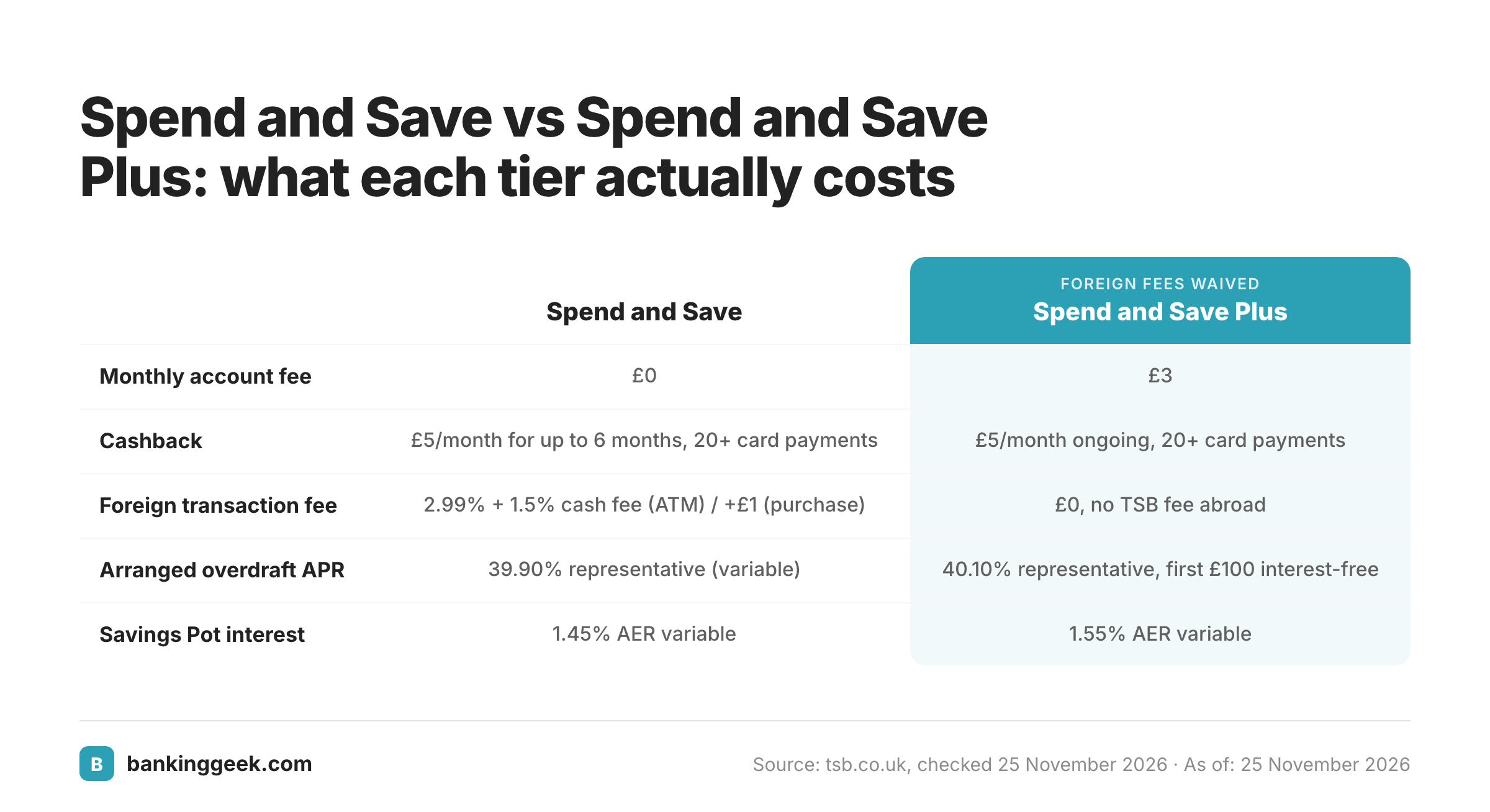
The headline figure is hard to argue with: £0 per month on the standard tier. There is no maintenance charge, no minimum funding requirement published for standard usage, and no fee for the debit card itself. The Spend and Save Plus tier costs £3 per month and exists specifically to remove foreign fees and add a £100 interest-free overdraft buffer. That puts Spend and Save on a par with challenger banks on basic cost, though the overall value equation doesn't come down to the headline fee alone, it depends heavily on how you use the account day-to-day. This comparison shows where the offer sits: Revolut vs Wise.
Where costs really surface is in the detail. On the standard account, foreign-currency ATM withdrawals carry a 2.99% non-pound transaction fee plus a separate 1.5% non-pound cash fee (minimum £2, maximum £4.50 per withdrawal); foreign-currency debit card purchases carry the same 2.99% fee plus a flat £1 purchase fee per transaction. The Plus account tier removes all of these foreign fees, but Plus comes with its own £3 monthly charge, which means the maths only works in your favour if you spend enough abroad to justify the subscription. Arranged overdraft borrowing is charged at 39.90% APR representative (variable) on the standard account and 40.10% APR representative (variable) on Plus, where the first £100 of any arranged overdraft is interest-free. TSB's standard account doesn't offer that interest-free buffer, so even a small unplanned excursion into negative territory generates interest from the first penny. Instant bank transfers via Faster Payments are free, as expected from any UK current account. There is no advertised fee for CHAPS payments initiated in-branch, though TSB charges a standard rate for this service if required.
The cashback element, which is the account's main marketing hook, is a flat £5 paid each calendar month you make 20 or more qualifying debit card payments (cash withdrawals, bank transfers and Direct Debits do not count). On the standard Spend and Save account this runs for up to the first 6 calendar months; on Spend and Save Plus it continues for as long as you hold the account, effectively netting £2 a month once the £3 fee is accounted for. Once the introductory window closes on the standard account, it reverts to being a straightforward free current account with no ongoing rewards mechanism, and there isn't a way to extend it without switching to Plus. Treat the cashback as a welcome bonus rather than a permanent feature, and note that a payment only counts once it has cleared, so spending in the last few days of the month can sometimes miss the cut-off.
Two further savings features travel with the account that are easy to miss. Up to five Savings Pots can be opened per account (up to £100,000 each, £500,000 combined), paying 1.45% AER variable on standard Spend and Save or 1.55% AER variable on Plus: not the dedicated savings product most people reach for, but a genuine interest-bearing option sitting inside the current account. An Auto Balancer feature can also automatically top up the current account from a chosen Pot whenever the balance drops below a limit you set. Separately, TSB also offers a Monthly Saver paying 5.00% Gross/AER fixed for 12 months on deposits of £25 to £250 a month, which isn't exclusive to Spend and Save customers but is commonly opened alongside it.
Cards, contactless payments and digital wallets
Every Spend and Save account comes with a Visa debit card. Visa acceptance is near-universal in the UK and widely recognised across Europe and beyond, which matters if you carry the card as a travel backup. Contactless payments work up to the standard UK limit, and TSB personal current account customers can withdraw up to £500 a day from UK cash machines, with up to £50 cashback available at most supermarkets on a debit card purchase. No credit card is bundled with the account; TSB offers separate credit card products, but these require a distinct application and aren't part of the Spend and Save package.
Apple Pay and Google Pay are both supported, and both wallets are designed to activate during the standard setup process without extra steps. Virtual cards aren't a prominent feature of the standard account in the way they are for challenger accounts such as Monzo or Revolut, TSB's digital-first features are solid but not cutting-edge. There isn't a multi-currency card, no sub-account by currency, and no built-in spending analytics broken down by merchant category in the same granular way as some fintech competitors. What you get is a reliable Visa debit card that works everywhere Visa's accepted, backed by contactless and mobile pay functionality that most UK consumers now consider table stakes. How it holds up day to day is covered in our TSB Business Plus Account review.
The Savings Pot feature deserves a mention here because it lives inside the current account rather than being a separate product. You can move money into up to five Pots from your main balance and each one sits ringfenced, visible in the app. Unlike the main current account balance, a Savings Pot does pay interest: 1.45% AER variable on standard Spend and Save, 1.55% AER variable on Plus, with an Auto Balancer option that can move money back out of a Pot automatically if your current account balance runs low. It's a practical way to earmark money for a specific goal and earn something on it, without opening a separate savings account.
Opening the account: what to expect step by step
TSB supports online account opening, and the process can be completed without visiting a branch. You'll need a UK address, a valid form of photo ID (passport or driving licence), and to pass TSB's identity and credit checks. Applications go through online identity verification; TSB may also carry out a soft or hard credit search depending on the account type and any overdraft request attached to it.
Once approved, TSB issues a UK sort code and account number. Your IBAN follows the GB format, confirming that this is a fully authorised UK bank account. The physical debit card typically arrives within five to seven working days, though you don't have to wait for it to start using the account. You can use your account details for payments and direct debits before the card arrives. TSB participates in the Current Account Switch Service (CASS), so if you want to bring across direct debits and standing orders from an old bank, the full switch takes seven working days and is guaranteed under the CASS framework, meaning any payments misdirected during the switch are automatically redirected for three years.
There's no lock-in period. You can close the account at any time, and there's no notice requirement for standard closure. Branch opening is available for those who prefer face-to-face onboarding, which really does give TSB a clear edge over pure digital banks for customers who find app-only account opening uncomfortable.
App quality, features and customer service
The TSB mobile app is available on iOS and Android. It covers the fundamentals well: real-time balance, transaction history, card freezing, Faster Payments, direct debit management, and access to the Savings Pots and Auto Balancer settings introduced alongside Spend and Save. Push notifications for transactions can be activated. Biometric login (fingerprint and face recognition) is supported on compatible devices. The app has improved substantially over recent years following TSB's notorious 2018 IT migration crisis, which left hundreds of thousands of customers locked out of their accounts. That episode damaged TSB's reputation significantly, and while the bank has invested heavily in its systems since, the memory lingers in some customer sentiment.
Customer service runs across multiple channels, in-app messaging, telephone, in-branch, and online chat. Response times genuinely vary. Branch availability is a genuine differentiator for TSB compared to purely digital competitors, if something goes wrong, you can walk into a local branch and speak to a person. Telephone wait times can be long during peak hours, and that's a complaint that recurs in customer feedback. The app's in-app support function is functional but it's not as responsive as the live-chat offerings from some fintech banks.
Reputation and real customer experience
TSB sits somewhere between a traditional high-street bank and a modernising retail institution. Customer reviews across platforms such as Trustpilot and the FCA's published complaints data reveal a pretty consistent pattern. Positive feedback clusters around branch accessibility, the helpfulness of in-person staff, and the simplicity of the account for everyday use. Customers who appreciate a familiar banking relationship, where they can speak to someone at a local branch, frequently rate their experience positively.
Recurring complaints focus on three areas. First, telephone and online customer service wait times are frequently cited as frustrating. Second, some customers report difficulties with fraud queries and dispute resolution taking longer than expected. Third, the cashback offer generates disappointment when customers realise the 20-payment qualifying condition catches people out, especially near month-end. The 2018 IT outage still surfaces occasionally in longer-form reviews from customers who experienced it directly, though operationally TSB has been stable for several years since. In TSB's own FCA-mandated service-quality data, 53% of customers surveyed said they would recommend TSB overall, with 65% for online and mobile banking, 62% for branch services and 56% for overdraft services (Ipsos survey, published February 2026, covering January-December 2025), roughly mid-table among the UK's largest personal current account providers. Separately, TSB's own complaints data shows a banking and credit cards complaint rate of 3.1 per 1,000 accounts in the first half of 2026, improved from 3.5 per 1,000 in the second half of 2025. The bank is authorised and regulated by the Financial Conduct Authority (FCA) and the Prudential Regulation Authority (PRA).
Day to day, the account experience is unremarkable in the best sense, it just works: payments are designed to process quickly, the app is built to behave reliably, and the Savings Pot is designed to move money in and out without friction. Nothing about the experience is meant to feel broken, and it genuinely doesn't, based on what TSB itself documents about the service. Nothing is meant to feel innovative either. TSB is positioning Spend and Save as dependable rather than cutting-edge.
Safety and deposit protection
TSB Bank plc is authorised by the Prudential Regulation Authority and it's regulated by the Financial Conduct Authority and the PRA too. As a UK-authorised bank, deposits held with TSB are protected by the Financial Services Compensation Scheme (FSCS) up to £120,000 per eligible person per institution. The FSCS limit rose from £85,000 to £120,000 on 1 December 2025. Temporary high balances, such as those arising from a house sale, can receive elevated FSCS protection of up to £1.4 million for up to six months under specific qualifying circumstances. The FSCS is funded by the financial services industry itself and backed by government, making it one of the strongest retail depositor protection frameworks in the world.
TSB's ownership has changed since this account launched: TSB joined the Santander group on 30 April 2026, and the two banks are now proposing a full legal transfer of TSB's banking business to Santander UK, planned for 22 March 2027 subject to High Court approval (objections are asked for before 5 February 2027, ahead of a High Court hearing scheduled for 15 February 2027). Until that transfer completes, Santander UK and TSB remain separate legal entities, so the £120,000 FSCS limit currently still applies to each separately, worth checking again nearer the transfer date if you also hold a Santander UK account, since combined deposits across the same institution count toward a single £120,000 limit. Day-to-day banking isn't affected for now, account numbers, cards and the way you use Spend and Save stay the same.
Verdict: open it or look elsewhere?
TSB Spend and Save genuinely earns its place as a solid, no-fee current account for UK residents who want the reassurance of a high-street bank with branch access. The £0 monthly fee removes any financial risk from trying it, and FSCS protection up to £120,000 means your money is as safe here as anywhere on the high street. The cashback introductory offer is a genuine, if time-limited, reason to switch, and the Current Account Switch Service makes the migration painless.
Open it if you want: a free current account from an established UK bank; regular branch access; Apple Pay and Google Pay from day one; a Savings Pot that actually pays interest (1.45% AER variable) without opening a separate account; or a switching incentive while it is active. Look elsewhere if you: travel internationally with any regularity and want fee-free foreign spending; need in-credit interest on your main current account balance specifically (the Pot earns interest, the everyday balance does not); want cutting-edge app features such as multi-currency accounts or granular spending insights; or are still uneasy about TSB's operational history. For heavy travellers, Starling or Chase (UK) offer fee-free foreign transactions. For interest on your everyday balance, Chase UK currently pays a higher in-credit rate. TSB Spend and Save is, ultimately, a reliable mainstream account, competent rather than exceptional, and honest about what it is, now operating as part of the Santander group, with no change to how it works for customers today.
How safe is TSB Bank TSB Spend and Save?
TSB Bank TSB Spend and Save vs alternatives
A direct comparison of the key conditions against the strongest competitors in the market.
 |  |  |  | |
| Rating | 3.0 /5 | 5.0 /5 | 5.0 /5 | 5.0 /5 |
| Monthly fee | £0/month | £0/month | £0/month | £0/month |
| Debit card | ✓ | ✓ | ✓ | ✓ |
| Credit card | ✗ | ✗ | ✗ | ✓ |
| Apple Pay | ✓ | ✓ | ✓ | ✓ |
| Google Pay | ✓ | ✓ | ✓ | ✓ |
| Cash withdrawal abroad | 2.99% + £1.00 per transaction (Spend & Save Standard); no fees with the Plus account | Free up to £200/30 days; then 3% (Perks/Max: £600/30 days) | Free (no Starling fees) | No Chase fee; up to £500/day and £1,500/month abroad |
| Online account opening | ✓ | ✓ | ✓ | ✓ |
| Deposit protection | £120,000 | £120,000 | £120,000 | £120,000 |
| iOS app | ✓ | ✓ | ✓ | ✓ |
| Branches | ✓ | ✗ | ✗ | ✗ |
How we rate
About the author

Frequently asked questions
UK residents aged 18 or over with a UK address and a valid form of photographic identity can apply. TSB runs a credit check as part of the application, so a poor credit history may affect eligibility or overdraft access.
The standard Spend and Save account has no monthly fee. A Spend and Save Plus upgrade is available at a monthly charge and removes foreign transaction fees, but the base account costs GBP 0 per month with no minimum deposit requirement.
TSB is a fully licensed UK bank, so deposits are covered by the FSCS (Financial Services Compensation Scheme) up to GBP 120,000 per person per bank. The scheme is funded by the UK banking industry and backed by the government.
You can apply online or through the TSB mobile app in a few minutes using your National Insurance number and photographic ID. Alternatively, you can walk into any TSB branch to complete the process in person, and the Current Account Switch Service handles the transfer of direct debits and standing orders from your old bank.
Yes. TSB is authorised by the Prudential Regulation Authority and regulated by the FCA and the PRA. The app uses biometric authentication and real-time transaction alerts, and the Visa debit card benefits from chargeback rights on disputed purchases.
Interest earned in the savings pot is treated as savings income under UK tax rules. Most savers are covered by the Personal Savings Allowance: basic-rate taxpayers can receive up to GBP 1,000 in interest per tax year tax-free, while higher-rate taxpayers have a GBP 500 allowance. Amounts above the allowance are added to taxable income.