

Nationwide is the UK's largest building society and one of the few major current account providers still owned by its members rather than by shareholders. This review covers what that ownership model actually means for your money, plus the exact rates, fees and safety details behind every major Nationwide product, so you can decide whether to bank with it without digging through a dozen separate pages on nationwide.co.uk.
What Is Nationwide?
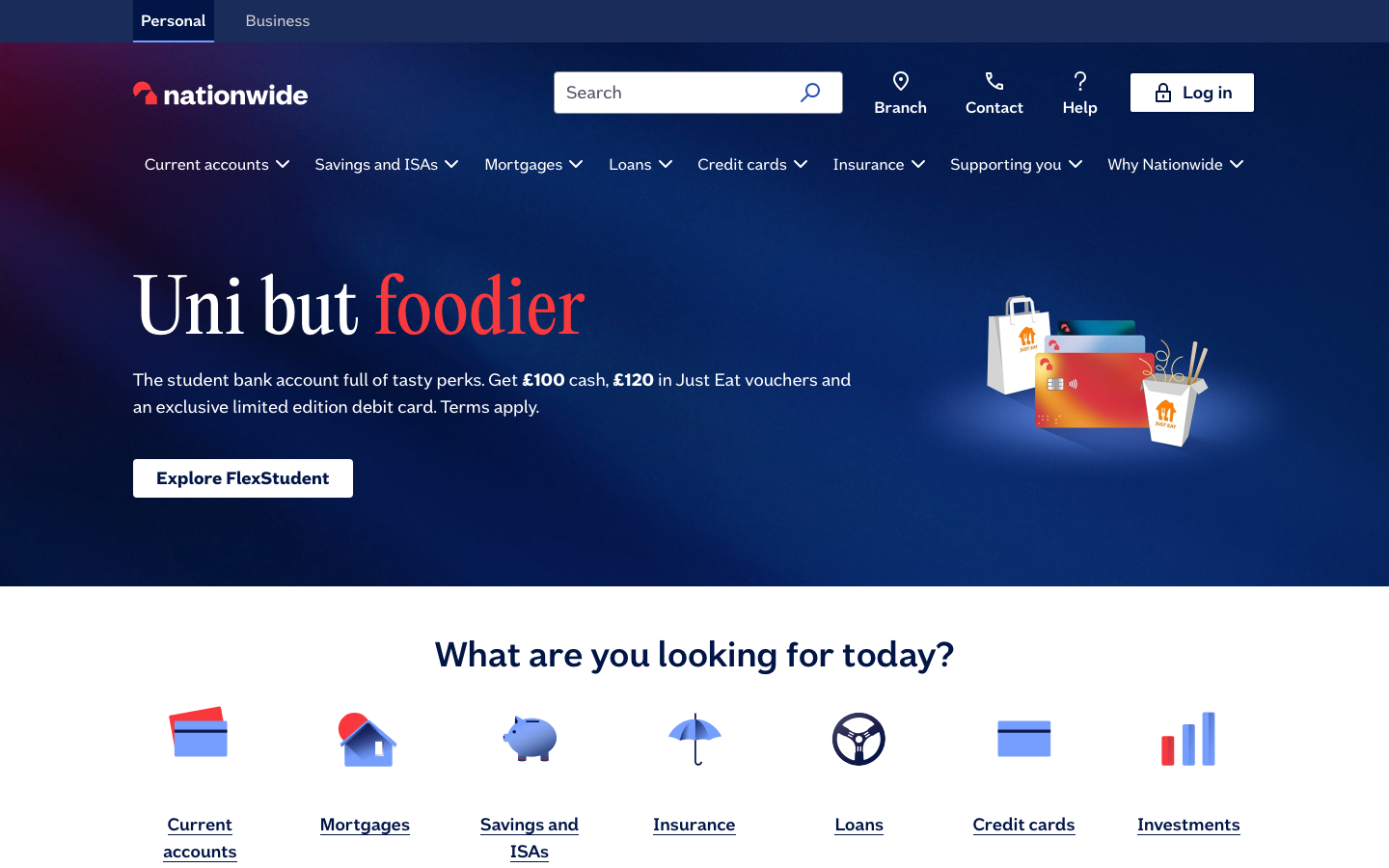
Nationwide Building Society is a mutual financial institution, which means it belongs to its members (its customers) rather than to outside shareholders chasing dividends. Its roots go back to 1884, and after completing a £2.9 billion acquisition of Virgin Money in October 2024, Nationwide now serves a combined customer base of more than 24.5 million people across current accounts, savings, mortgages, credit cards and insurance. It runs 605 of its own branches, all promised to stay open until at least the start of 2030, plus the former Virgin Money network layered on top.
The mutual structure is the single biggest thing that separates Nationwide from Barclays, HSBC, Lloyds or NatWest. Instead of paying profits out to shareholders, Nationwide periodically redistributes a share of its financial performance directly to eligible members through its Fairer Share Payment, discussed in more detail below. More providers are listed here: Best joint savings account.
Nationwide at a Glance
| What you're checking | Nationwide's answer |
|---|---|
| Ownership structure | Mutual (member-owned), not a shareholder bank |
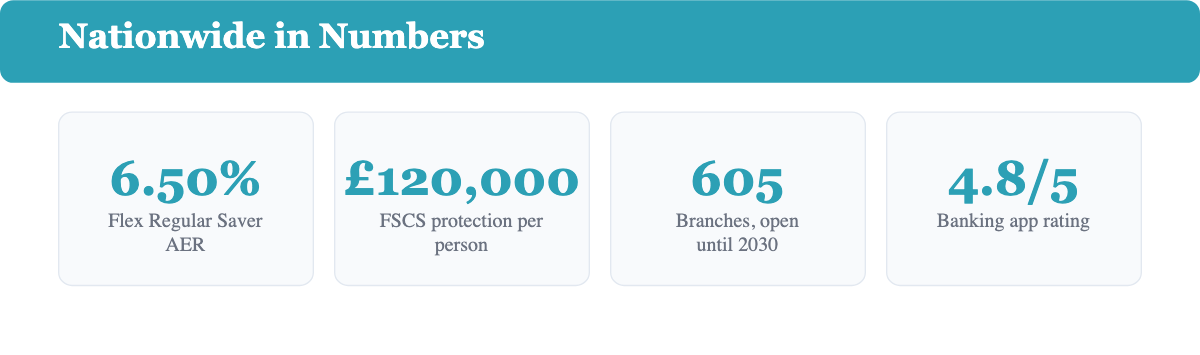
| Deposit protection | FSCS-covered up to £120,000 per person (combined with Virgin Money) |
| Branch network | 605 branches, promised open until at least 2030 |
| Customer satisfaction (CMA survey) | Joint 4th in Great Britain, 67% |
| Which? status | Which? Recommended Provider |
| Banking app rating | 4.8/5 on both the App Store and Google Play |
| Independent review sentiment (Trustpilot) | Rated "Poor", around 2/5 from over 8,000 reviews |
| Current switch incentive | Up to £175 via the Current Account Switch Service |
That last row is worth pausing on. Nationwide's own app consistently scores close to the top of its category on both app stores, while its aggregate Trustpilot score sits far lower. That gap is common across large UK banks: app-store reviews mostly reflect day-to-day usability, while Trustpilot reviews are dominated by people who had a specific problem, most often a fraud dispute or an account-opening delay, and went looking for somewhere to complain. Read both signals, but don't let either one stand in for the whole picture.
Current Account Options: FlexAccount, FlexDirect, FlexPlus and More
Nationwide runs six current account tiers rather than a single flagship product, so the right one depends on how you want to be paid and what extras you actually need.
FlexDirect
FlexDirect is Nationwide's interest-and-cashback account, aimed at people who want their everyday current account to actually earn something. New customers get 5% AER (4.89% gross) fixed for the first 12 months on balances up to £1,500, dropping to 1% AER variable after that, plus 1% cashback on debit card purchases (capped at £5 a month) for the same 12-month introductory period. To qualify for both, you need to pay in at least £1,000 a month. An arranged overdraft is interest-free up to £50, then charged at 39.9% a year (variable) on the rest.
FlexPlus
FlexPlus is the packaged account, at £18 a month. That fee buys worldwide family travel insurance, mobile phone insurance, and UK and European breakdown cover bundled in, which can work out cheaper than buying each policy separately if you'd have bought them anyway. If you wouldn't have taken out that insurance on your own, the monthly fee is just a cost with no offsetting benefit.
FlexAccount, FlexBasic, FlexStudent and FlexOne
The remaining tiers are all fee-free. FlexAccount is Nationwide's plain everyday account with no monthly charge and no interest. FlexBasic is a basic bank account for people who don't qualify for a standard current account, with no overdraft facility and no monthly fee. FlexStudent gives students an interest-free arranged overdraft that scales up over each year of study. FlexOne is aimed at 11 to 17-year-olds and pays interest on balances, giving younger members a first taste of the same mutual model their parents might already use.
Across every tier, new and switching customers can currently claim up to £175 through the Current Account Switch Service when moving a current account to Nationwide, on top of whichever account-specific perks apply.
Savings, ISAs and Beyond Current Accounts
Nationwide's savings range is where its rates are genuinely competitive rather than merely adequate. The Flex Regular Saver currently pays 6.50% AER (variable) with four fee-free withdrawals a year, easily one of the stronger regular saver rates on the UK market, though the rate drops sharply to 1.05% if you exceed that withdrawal allowance. For instant access, the Flex Instant Saver pays 2.30% AER, while the standard tiered Instant Access Saver pays between 1.10% and 1.20% depending on balance. On the fixed side, Nationwide's Cash ISAs range from 4.50% AER on a 1-year fix up to 4.70% AER on a 5-year fix, all tax-free up to the standard £20,000 annual ISA allowance, alongside a 1-Year Triple Access ISA at 3.30% for savers who want some flexibility without giving up a competitive rate entirely.
Beyond day-to-day banking, Nationwide also runs a full mortgage range (first-time buyer, home mover, buy-to-let and tracker deals), two main credit cards, and a broad insurance and investment arm. The Purchase and Balance Transfer card carries a 24.9% APR representative rate (variable) with 15 months at 0% on both purchases and balance transfers, while the dedicated Balance Transfer card stretches that to 30 months on balance transfers (3 months on purchases) at the same representative APR. Both cards require you to already hold a Nationwide current account, savings account or mortgage to apply, and since April 2026 balance transfers between Nationwide and Virgin Money cards are no longer possible, since the two card books haven't been merged in that direction.
Is Nationwide Safe?
Yes. Nationwide is authorised by the Prudential Regulation Authority (PRA) and regulated by both the PRA and the Financial Conduct Authority (FCA), and eligible deposits are protected by the Financial Services Compensation Scheme (FSCS) up to £120,000 per person, or £240,000 for a joint account, following the FSCS limit rise from £85,000 that took effect on 1 December 2025.
There's a nuance worth knowing if you also bank with Virgin Money. Because of the transfer into Nationwide, deposits held across Nationwide and Virgin Money now count as being with a single FSCS provider. Your combined balance across both brands is protected up to £120,000 in total, not £120,000 with each brand on its own. Check your combined exposure if you hold accounts with both.
Nationwide's mutual structure adds a second layer of financial return that shareholder banks don't offer. Through its Fairer Share Payment, Nationwide has returned roughly £1.5 billion to members since the scheme launched in 2023. Its most recent round paid £100 to around 4.4 million eligible members between 10 and 30 June 2026, funded from the building society's own financial performance rather than from a marketing budget, and reserved for members who use Nationwide for their everyday banking alongside a qualifying savings or mortgage product. It isn't guaranteed every year and the amount can change, but it's a genuine, recurring benefit of banking with a member-owned institution rather than a shareholder-owned one.
Nationwide App and Online Banking
The Nationwide banking app is rated 4.8 out of 5 on both the App Store and Google Play, putting it comfortably among the better-reviewed banking apps in the UK, and covers the everyday essentials: viewing your debit card details and PIN, freezing and unfreezing a lost card, and managing payments without visiting a branch. Internet banking on desktop covers the same core functions for anyone who prefers a browser to a phone.
That app-store score sits in sharp contrast to Nationwide's Trustpilot rating, where it's classed as "Poor" (around 2 out of 5) across more than 8,000 reviews. The gap comes down to what each platform measures. App-store reviews mostly cover whether the app works smoothly day to day, and by that measure Nationwide performs well. Trustpilot skews toward customers with an unresolved dispute, most often a fraud claim or a switching hiccup, who were frustrated enough to leave a public review. Neither number tells the whole story alone, but the app itself is well-regarded, separate from the complaints that dominate Trustpilot.
Pros and Cons
Where Nationwide does well:
- Mutual ownership means profits can come back to members directly, via the Fairer Share Payment, instead of disappearing to shareholders
- A genuinely competitive savings range, led by the Flex Regular Saver at 6.50% AER
- A large, currently protected branch network (605 branches, promised open until 2030), useful if you still value in-person banking
- A well-reviewed app (4.8/5 on both major app stores) and Which? Recommended Provider status
- Ranked joint 4th for overall customer satisfaction in the latest published CMA current account survey for Great Britain
Where it falls short:
- FlexDirect's 5% introductory rate only applies to the first £1,500, which is a low ceiling next to some challenger-bank offers
- A "Poor" aggregate Trustpilot rating, driven largely by fraud-dispute and account-service complaints
- FlexPlus's £18 monthly fee only pays off if you'd genuinely have bought the bundled insurance separately
- Post-Virgin Money, your combined FSCS protection across both brands is capped at one £120,000 limit, not two separate ones, if you hold accounts with both
Nationwide vs Other Banks
The clearest way to place Nationwide against Barclays, HSBC, Lloyds or NatWest is ownership structure, not any single feature. Every one of those four is a shareholder-owned bank, meaning its profits are ultimately answerable to investors; Nationwide answers to its own members instead, which is why the Fairer Share Payment exists as a concept at all: there's no dividend to compete with for the money. Feature-for-feature, Nationwide's current accounts are broadly comparable to the big four (fee-free everyday options, an interest-paying tier, a packaged account with insurance bundled in), but its savings rates, particularly the Flex Regular Saver, tend to sit above what the shareholder banks offer on equivalent products, and its branch commitment (605 branches guaranteed until 2030) is more explicit than most competitors have been willing to put in writing. Where the shareholder banks can pull ahead is in some of their app feature sets and broader international services; if you travel constantly or want a more feature-rich fintech-style app, that's worth weighing against Nationwide's stronger savings rates and member-payment model.
Who Is Nationwide Best For?
- Switchers chasing a cash incentive: the current £175 Current Account Switch Service payment is competitive against most other UK switch offers right now.
- Savers who want a strong regular saver rate: 6.50% AER on the Flex Regular Saver is one of the better rates available, provided you can stick to four withdrawals a year.
- Branch-dependent customers: 605 branches with a 2030 open commitment matters if you still want in-person banking, especially in a town where Nationwide is the last branch standing.
- Members who value profit-sharing over the single lowest headline rate anywhere on the market: the Fairer Share Payment is a genuine, if not guaranteed, extra return that shareholder banks structurally cannot offer.
- Not the best fit if: you want the absolute highest-cap interest rate on your main current account balance (FlexDirect's £1,500 cap is limiting), or you specifically want a slick, feature-heavy fintech-style app experience over a traditional building society one.
How to Open a Nationwide Account
Opening most Nationwide accounts takes three steps: apply online, via the app, or in branch with proof of ID and address; verify your identity (a UK passport or driving licence usually clears this instantly online); and, if you're switching from another bank, authorise the Current Account Switch Service to move your direct debits, standing orders and incoming payments automatically, typically within seven working days. FlexStudent needs proof of course enrolment. FlexOne needs a parent or guardian involved for under-18s. FlexBasic has a lighter eligibility bar by design, built for applicants who don't qualify for a standard current account.
Verdict
Nationwide earns its place as a serious option for anyone who wants a full-service UK bank account without giving up the option of walking into a branch, and it has a genuinely different financial relationship with its customers than any shareholder-owned bank can offer, through the Fairer Share Payment. Its savings rates, led by the Flex Regular Saver, are strong enough to justify moving money there even if your main current account stays elsewhere, and its FSCS protection, Which? Recommended status and top-tier app rating all hold up under scrutiny. The trade-offs are real but narrow: a low interest cap on FlexDirect, a Trustpilot record dragged down by dispute-handling complaints, and one shared FSCS limit to watch if you also bank with Virgin Money. For most people comparing UK current accounts and savings products in 2026, Nationwide is worth shortlisting, particularly if a member-owned bank and a strong savings rate matter more to you than the single highest current-account interest cap on the market.
Frequently Asked Questions
Is Nationwide a bank or a building society?
Nationwide is a building society, meaning it's owned by its members rather than by shareholders. It offers the same range of everyday banking products as a high-street bank, but any profit-sharing takes the form of member payments like the Fairer Share Payment instead of shareholder dividends.
Is my money safe with Nationwide?
Yes. Nationwide is regulated by the FCA and PRA, and eligible deposits are protected by the FSCS up to £120,000 per person (£240,000 for joint accounts). If you also hold money with Virgin Money, that protection is shared as a single £120,000 combined limit across both brands, not doubled.
What is the Nationwide Fairer Share Payment?
It's a periodic cash payment Nationwide makes to eligible members who bank with it for everyday banking alongside a qualifying savings or mortgage product, funded from the building society's own financial performance. The most recent round paid £100 to around 4.4 million members in June 2026, and Nationwide has returned about £1.5 billion to members since the scheme began in 2023. It isn't guaranteed to repeat at the same amount every year.
What's the best Nationwide savings account right now?
For most savers, the Flex Regular Saver at 6.50% AER is the standout, provided you can work within its four-withdrawals-a-year limit. For lump-sum savers, the 5-year Fixed Rate Cash ISA at 4.70% AER is currently Nationwide's highest fixed rate.
Does Nationwide have a switch incentive?
Yes, currently up to £175 for customers who switch their current account to Nationwide (FlexDirect, FlexAccount or FlexPlus) using the Current Account Switch Service.
How many Nationwide branches are there?
605 branches, which Nationwide has committed to keeping open until at least the start of 2030, following its acquisition of Virgin Money in 2024.