
GoHenry is a prepaid debit card and money app for children aged 6 to 18, built to teach kids to earn, save, spend and invest under parental supervision. Three plans run from £3.99 to £9.99 a month, every plan includes a free Junior Stocks & Shares ISA, and the company is currently in the middle of a significant ownership change: Barclays agreed in June 2026 to buy GoHenry's UK business outright. Here's what the app actually costs, what you get at each tier, and what the Barclays deal means if you sign up now.
What Is GoHenry?
GoHenry launched in the UK in 2012 as a prepaid Visa debit card and companion app for children too young to hold a standard bank account. More than 2.2 million UK children have used a GoHenry card since launch, and the company says over 500,000 UK children are active members today. The setup is split into two linked apps: a parent app that funds the account, sets spending limits and approves chores, and a kid app where children track their own balance, savings goals and earned pocket money. If you are still shopping around, start here: Revolut vs Starling.
The core pitch hasn't changed much since 2012: give a child a real card with real spending limits, rather than cash, and use the app to turn everyday spending into a financial-literacy lesson. What has changed is who owns the company delivering that pitch. For the wider picture, see our comparison: Revolut vs Wise.
GoHenry Is Being Acquired by Barclays: What That Means for Your Child's Account
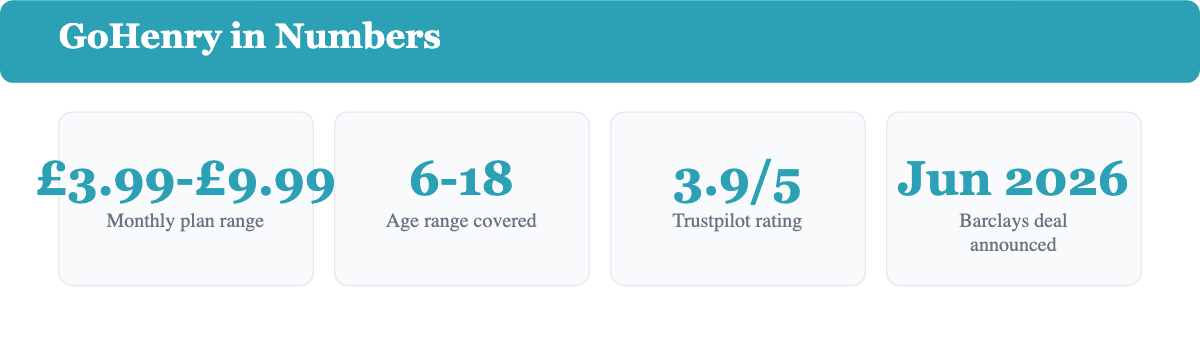
On 12 June 2026, Barclays announced it had agreed to acquire GoHenry's UK business from Acorns Grow Incorporated, the US fintech that has owned GoHenry since 2023. The deal is expected to complete in the fourth quarter of 2026, subject to the usual regulatory approvals, and Barclays says it intends to keep GoHenry running as a standalone brand and app rather than folding it into its own current-account products.
A few things are worth knowing if you're weighing up whether to sign up while this is still in progress:
- Nothing changes immediately. Existing and new GoHenry members carry on as normal until the deal completes, and Barclays has said the app and card will continue operating under the GoHenry name afterwards too.
- Scale is the stated reason. Barclays CEO Vim Maru described GoHenry as having "played a pioneering role in creating youth-focused financial services," and Barclays' own announcement frames the deal as a way to build relationships with customers from childhood through to adult banking, and GoHenry founder Louise Hill said the move "gives GoHenry a platform to accelerate that mission."
- It's a UK-only carve-out. Acorns is keeping GoHenry's US business, which was already rebranded to Acorns Early in 2024, plus GoHenry's separate European subsidiary, Pixpay. Only the UK operation, its 500,000+ young members and roughly 200 staff included, moves to Barclays.
- The price wasn't officially disclosed. Barclays and Acorns didn't publish a deal value, but CityAM reported, citing sources close to the transaction, that Barclays is paying around £180 million for a business it also described as currently loss-making.
None of the third-party GoHenry reviews currently ranking for this topic mention the acquisition at all, which makes sense: most were written before June 2026. It's a genuinely useful thing to know before you commit a card to a six-year-old, even if the practical impact for now is close to zero.
GoHenry Pricing: Everyday, Plus and Max Plans Compared
GoHenry runs three plans, charged monthly per child (except Max, which covers a whole family):
- Everyday: £3.99/month per child. Core learning tools: the money app, a standard debit card, parental controls, Giftlinks, instant transfers, pocket money and chore lists, and one free balance top-up a month (each extra top-up costs 50p).
- Plus: £5.99/month per child. Everything in Everyday, plus unlimited free top-ups and interest on savings balances.
- Max: £9.99/month for up to four children. All Plus benefits extended to as many as four kids' accounts under one family fee, the only plan priced per family rather than per child.
Every plan comes with a one-month free trial and no annual contract, and you can change plans or cancel from the parent app at any time. A free standard debit card is included on all three tiers; personalised card designs (45+ options) start at £4.99, and GoHenry replaces lost, stolen or damaged cards free of charge, including personalised ones. Membership fees are taken from your GoHenry parent balance first; if that balance is too low, GoHenry falls back to your linked bank account and adds a 50p service charge.
Interest on Savings: Why the Everyday Plan Isn't What It Looks Like
GoHenry's own pricing page lists "2.63% AER interest on savings" as a bullet point under all three plans, including Everyday, but that's misleading. Look lower down the same page, at GoHenry's own plan-comparison table, and the "Interest on savings" row is marked as available "With Plus & Max plans" only. The Google Play listing for the GoHenry app agrees: "Plus and Max members can earn interest on their savings." Everyday members do not.
In practice, that means, Junior Stocks & Shares ISA aside, earning any interest on your child's GoHenry cash balance requires upgrading to at least Plus (£5.99/month). It's admittedly a small inconsistency on GoHenry's own site, but worth knowing before you pick a plan based on the cheaper tier's advertised feature list. The AER itself is variable and can change, so treat 2.63% as a snapshot rather than a fixed promise.
Features: Earn, Spend, Save and Invest
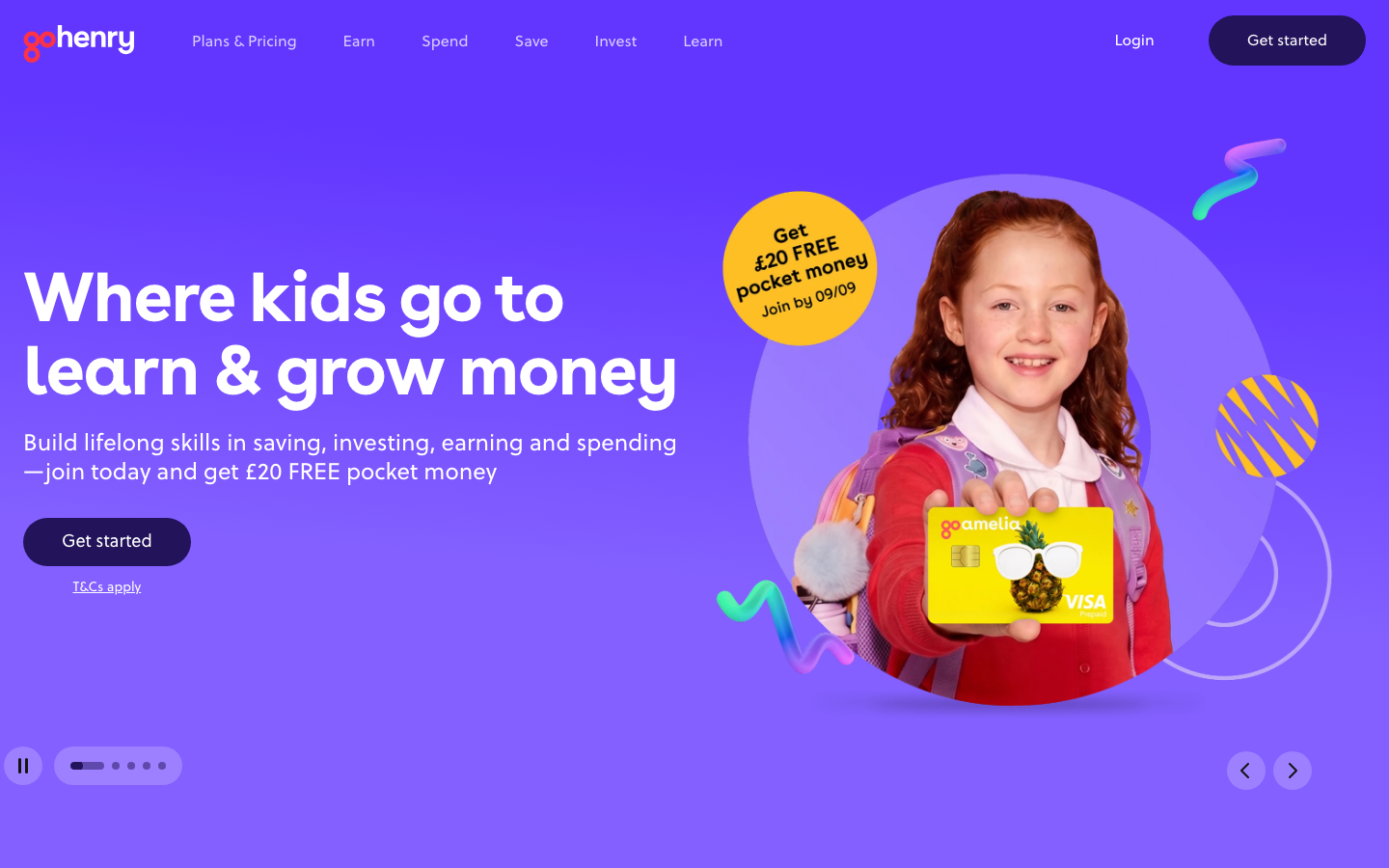
GoHenry organises its features into four categories that map onto how a child actually interacts with money:
- Earn: parents set up pocket money and chore/task lists that pay out automatically; family and friends can send gifted money via Giftlinks; transfers from the parent account land instantly. Teenagers 13 and older can also receive wages directly via BACS payments.
- Spend: a Visa debit card (standard design free, personalised from £4.99), with Apple Pay support for children aged 13 and up, and full parental controls to set spending limits, block categories or freeze the card instantly from the parent app.
- Save & Invest: custom savings goals a child can set and a parent can lock to remove temptation, plus a Junior Stocks & Shares ISA included on every plan, Everyday included. The ISA invests in Vanguard's LifeStrategy 60% equity fund, and like any investment, capital is at risk and the balance can fall as well as rise.
- Learn: a library of 100+ "Money Missions," short interactive lessons on budgeting, saving and spending, plus a parent-facing hub of guidance and tips.
Is GoHenry Safe?
GoHenry cards run on the Visa network and are covered by Visa's zero-liability policy for unauthorised transactions, and the company describes its systems as using bank-level encryption. It's worth understanding what GoHenry actually is under the hood, though: it's a prepaid card and e-money account, not a bank account in its own right, and children's balances sit as e-money rather than as a deposit protected by the Financial Services Compensation Scheme (FSCS). That's the same regulatory category most non-bank kids' cards and e-money apps (not just GoHenry) fall into, worth knowing since it's a genuinely different protection model from a standard current account, even though the day-to-day spending controls and card security are otherwise robust.
On the parental-control side, every plan gives you real-time transaction notifications, the ability to set per-card spending limits, freeze a card instantly, and block spending at specific merchant categories, the actual mechanism that most parents are relying on day to day, more than the underlying account structure.
GoHenry vs Other UK Kids' Bank Accounts
GoHenry competes with a mix of dedicated kids' cards and bank-run "junior" accounts bolted onto a parent's own bank. The clearest differentiator is age range: GoHenry covers 6 to 18, wider than every major named alternative:
| Provider | Age range |
|---|---|
| GoHenry | 6-18 |
| NatWest Rooster Money | 6-17 |
| Revolut <18 | 6-17 |
| HyperJar | 6-17 |
| Starling Kite | 6-16 |
| Nationwide FlexOne | 11-17 |
| Halifax Money Smart | 11-17 |
| Lloyds Smart Start | 11-15 |
The bank-run junior accounts (Nationwide FlexOne, Halifax Money Smart, Lloyds Smart Start) generally don't charge a monthly fee, which is the trade-off against GoHenry's £3.99-£9.99: you pay for the parental-control app, chore automation, Giftlinks and the Junior ISA, rather than getting a free but more basic account that only starts at age 11. If you're weighing up the parent account that would sit alongside a GoHenry card, see our best bank account UK 2026 comparison.
What Do GoHenry Customers Say?
Ratings for GoHenry are solid but not uniform across platforms, so it's worth looking at more than one:
- Trustpilot: 3.9 out of 5 from 12,121 reviews, the most mixed of GoHenry's public scores. Positive reviews focus on ease of use and the financial-education angle; recurring complaints cluster around unexpected top-up charges and balance discrepancies.
- Google Play: 4.7 out of 5, over 1 million downloads.
- Apple App Store (UK): 4.5 out of 5 from roughly 40,000 ratings.
- Finder's independent review: 4.6 out of 5 based on 2,535 reviews, with a Finder Score of 9.5/10.
The pattern across all four is fairly consistent: strong app-store satisfaction with the day-to-day product, a somewhat lower Trustpilot score driven mainly by billing/top-up friction rather than security or safety complaints.
Pros and Cons
- Pros: widest age range (6-18) of any major UK kids' card; free Junior Stocks & Shares ISA on every plan, including the cheapest tier; strong parental controls and instant transfers; free card replacement, even for personalised designs; no annual contract, cancel anytime; strong app-store ratings (4.5-4.7/5).
- Cons: monthly fee starts at £3.99 and rises to £5.99 for interest on savings, pricier than the free bank-run junior accounts; interest is Plus/Max only despite GoHenry's own site implying otherwise on the Everyday plan; Trustpilot score (3.9/5) is noticeably lower than GoHenry's app-store ratings, largely over top-up fees; the business is currently mid-acquisition, so long-term product direction under Barclays isn't fully settled yet.
Our Verdict
GoHenry is a solid choice if you want a dedicated kids' money app rather than a bare-bones junior account bolted onto your own bank: the wider 6-18 age range, included Junior ISA and genuinely useful chore-and-pocket-money automation justify the monthly fee for most families who'll actually use those features. If your child is 11 or older and you mainly want a fee-free card with basic spending controls, a bank-run junior account (Nationwide FlexOne, Halifax Money Smart) is worth comparing first, and if you're also shopping for your own account, our Revolut and Monzo reviews cover the two digital banks GoHenry itself gets compared to most often. Either way, the pending Barclays acquisition is a reason to check in on the account occasionally over the next year rather than a reason to avoid signing up now: Barclays has committed to keeping GoHenry running as-is, but "as-is" is worth re-verifying once the deal actually completes in Q4 2026.
Frequently Asked Questions
Is GoHenry still independent, or is it already part of Barclays?
Still independent for now. Barclays agreed to acquire GoHenry's UK business in June 2026, but the deal is expected to complete in Q4 2026 subject to regulatory approval; until then, GoHenry continues to operate under Acorns' ownership as before.
How much does GoHenry cost?
Everyday costs £3.99 a month per child, Plus costs £5.99 a month per child and adds interest on savings plus unlimited free top-ups, and Max costs £9.99 a month for up to four children on one family plan. All three include a one-month free trial.
Does the Everyday plan earn interest on savings?
No. Despite a bullet point on GoHenry's own pricing page suggesting otherwise, GoHenry's comparison table and its Google Play app listing both confirm interest on savings is a Plus and Max benefit only.
What age range does GoHenry cover?
6 to 18 years old, the widest range of any major UK kids' banking app, ahead of NatWest Rooster Money, Revolut <18 and HyperJar (all 6-17), Starling Kite (6-16), and the bank-run junior accounts, which typically start at 11.
Is GoHenry a real bank account?
No. GoHenry issues a prepaid Visa debit card linked to an e-money account, not a licensed bank account, so balances aren't protected by the Financial Services Compensation Scheme (FSCS) the way money in a standard current account would be.