
Barclays is one of the UK's oldest and biggest banks, with roots going back more than 330 years and millions of current account customers today. This review covers the costs, the account tiers, and how safe your money is. It also covers a 2026 strategy reversal on the high street that most other reviews miss.
What Is Barclays?
Barclays traces its history back to 1690, making it one of the oldest banking brands still operating in Britain. Today it offers personal current accounts, savings, credit cards (Barclaycard), mortgages and business banking, alongside a large retail investment arm. Its free everyday account has no monthly fee. It also runs a paid Blue Rewards tier and a fee-free but income-gated Premier tier for higher earners.
What most reviews leave out: after years of shutting branches, Barclays is now reopening them. The "bank manager" job title is back too, positioning the bank as a deliberate hybrid of branch access and digital banking against app-only challengers like Revolut and Wise. More on that below, since it's arguably the most relevant 2026 development if you're weighing Barclays against a digital-first competitor. How it stacks up against the rest of the market is shown here: Wise vs Monzo.
Barclays at a Glance
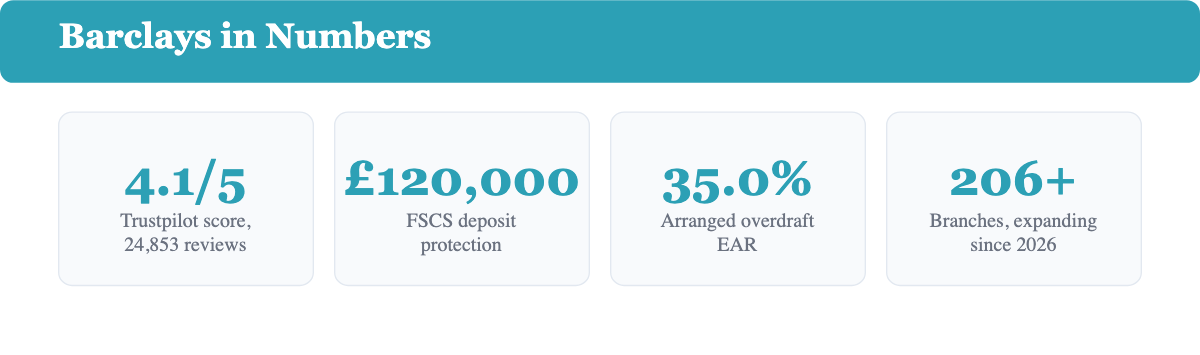
| What you're checking | Barclays' answer |
|---|---|
| Cheapest current account | Barclays Bank Account, £0/month |
| Reward tier | Blue Rewards, £5/month (cashback bonus discontinued Sept 2024) |
| Arranged overdraft rate | 35.0% EAR representative (variable) |
| Overdraft interest cap | £180 per monthly charging period (temporary cap) |
| Rainy Day Saver rate | 3.89% gross/3.96% AER to £5,000, 0.70% above (Blue Rewards/Premier only) |
| Deposit protection | FSCS-covered up to £120,000 per person |
| Branch network | 206+ branches, expanding after an ~80% cut since 2019 |
| Banking app rating | 4.2/5 on Google Play |
| Independent review sentiment (Trustpilot) | 4.1/5 from 24,853 reviews |
| Recent switch incentive | £200 (standard account, ran 9 Jun-27 Aug 2026, now ended) |
Barclays Current Account Range: Bank Account, Blue Rewards and Premier
Barclays runs a simpler tier structure than most high-street banks: one free everyday account, one paid upgrade, and one income-gated premium tier. Here's what each actually gets you.
Barclays Bank Account
The standard Barclays Bank Account is free. No monthly fee, no minimum pay-in requirement. It comes with a debit card, Apple Pay and Google Pay support, budgeting tools in the app, and access to Barclays' 206+ branches. For most people who just want a fee-free everyday account without extras, this is the default choice. Our own Barclays Bank Account review covers it in full detail.
Blue Rewards
Blue Rewards costs £5 a month and requires paying in at least £800 a month plus registering for the app or online banking. It's worth being precise about what you actually get in 2026, because the product has changed significantly: from September 2024, Barclays scrapped the old monthly cash loyalty bonus (previously up to £15 a month for current account customers). In its place, members now get an Apple TV+ subscription (normally £8.99/month) with an MLS Season Pass included, optional debit card cashback of up to 15% at selected retailers, and access to the Rainy Day Saver account. Since March 2025, Barclays also auto-cancels Blue Rewards membership (and stops charging the fee) if you're not earning at least £60 in benefit value over a year from its core features. In practice, that means Blue Rewards is now a streaming-and-savings-access bundle rather than a cashback account, and it's only worth the £5 fee if you'll actually use Apple TV+ or the retailer cashback scheme, not on the strength of a loyalty payment that no longer exists.
Premier
Barclays Premier has no monthly fee but is gated by eligibility: you need £75,000 or more in gross annual income, or £100,000 or more held in savings and investments with Barclays. In exchange, Premier customers get preferential rates on some products, a dedicated relationship service, and access to experience-led rewards during switch promotions. It's not an account most people can simply choose to open, so treat it as a threshold tier rather than a general recommendation.
Barclays also runs a Student Account, a Higher Education Account for graduates, BarclayPlus for 11-15 year olds, a Young Person's Account for 16-17 year olds, and a Basic Current Account for customers who don't qualify for a standard account. For business banking, our Barclays Business Current Account review covers fees and eligibility separately.
Fees, Overdrafts and the 2026 Switch Offer
Barclays' arranged overdraft rate is 35.0% EAR representative (variable), noticeably below the roughly 39.9% many other UK high-street banks charge. Barclays has also temporarily capped overdraft interest at £180 per monthly charging period regardless of how much you borrow within your limit, which puts a real ceiling on the worst-case cost. Unarranged overdraft use (going beyond an agreed limit, or borrowing without one) is treated separately and can trigger declined payments rather than an automatic extension, so it isn't a like-for-like cost comparison with the arranged rate above.
On switching: Barclays ran a £200 cash switch offer for its standard Bank Account between 9 June and 27 August 2026 (with a separate experience-led reward worth up to £600 for customers switching into Premier), requiring a full switch via the Current Account Switch Service, at least two Direct Debits, and a £2,000 minimum deposit within 30 days. That specific offer has now closed and isn't currently running, which several other UK bank review pages still get wrong by presenting lapsed promotions as live. Barclays has run comparable switch incentives repeatedly over the past few years, so it's worth checking the bank's own current account switch offers page for whatever is live today rather than assuming last summer's terms still apply.
Savings Accounts and Rainy Day Saver Rates
Barclays' Rainy Day Saver pays a banded rate, effective from 11 March 2026: 3.89% gross p.a. (3.96% AER) on balances from £1 to £5,000, dropping to 0.70% gross/AER on anything above £5,000. Interest is calculated daily and paid monthly. The catch is eligibility: Rainy Day Saver is only open to Blue Rewards members and Premier customers, so factor the £5 monthly Blue Rewards fee into the real return if you're opening it purely for the rate. Barclays also offers standard easy-access savings and fixed-term/ISA products outside the Blue Rewards ecosystem, though their rates are less competitive than the Rainy Day Saver's top band and worth comparing against best-buy tables before committing a large balance.
Mobile App and Online Banking
The Barclays app covers everyday account management, card freezing, biometric login, spend categorisation, and the debit card cashback scheme used by Blue Rewards members. On Google Play, the Barclays UK app holds a 4.2 out of 5 rating from tens of thousands of reviews, a solid score for a major bank's primary app. Its Apple App Store rating carries a far smaller sample size and moves around enough between sources that it isn't reliable to quote a precise figure here; the Google Play score is the more stable reference point.
Customer Service and Trustpilot Reviews
Barclays holds a 4.1 out of 5 TrustScore on Trustpilot from 24,853 reviews, a comfortably positive score for a major UK bank. Smart Money People, a UK-focused financial services review site, rates Barclays' current account slightly higher at 4.33 out of 5 from 4,962 reviews. Reading through the Trustpilot commentary, the recurring complaint theme isn't the app or the branches, it's phone-based customer service: long waits and difficulty reaching a human through the automated phone system come up repeatedly, while in-branch service and quick card replacement get specific praise. If you mostly bank digitally and rarely need to call in, that complaint pattern is far less likely to affect you day to day.
Is Barclays Safe? FSCS Protection Explained
Yes. Barclays Bank UK plc is regulated by the Financial Conduct Authority (FCA) and the Prudential Regulation Authority (PRA), and eligible deposits are protected by the Financial Services Compensation Scheme (FSCS) up to £120,000 per person, per authorised institution (this limit rose from £85,000 on 1 December 2025, so treat any source still citing £85,000 as out of date). Joint accounts are protected up to double that limit. As one of the UK's largest and longest-established banks, Barclays also sits under close ongoing regulatory supervision, which is a separate reassurance from the deposit-guarantee scheme itself.
Why Barclays Is Reopening Branches and Bringing Back Bank Managers
Barclays is reversing its own branch-closure strategy. Having shut around 80% of its branches since 2019, Barclays UK chief executive Vim Maru confirmed in 2026 that the bank has paused further closures and now intends to grow its network beyond its current 206 sites. Barclays has also revived traditional branch job titles, including "bank manager", which Maru described as a direct response to customer demand for clearer, more familiar roles when visiting a branch in person.
The stated rationale is competitive: Maru pointed to intensifying competition from app-based challenger banks like Revolut and Wise, and framed Barclays' answer as combining digital banking with real in-person support, aimed particularly at personal customers and newer small businesses that, in his words, "love a bit of human touch". It's a notable about-turn for an industry that spent most of the last decade closing branches, and it's a genuinely useful differentiator if you're choosing between Barclays and a digital-only competitor and branch access still matters to you. More providers are listed here: Revolut vs Wise.
Barclaycard, Mortgages and Business Banking at Barclays
Barclaycard, Barclays' credit card arm, runs a range of purchase, balance transfer and rewards cards with representative APRs that move regularly, so always check the live rate rather than relying on a figure quoted elsewhere. On mortgages, Barclays is one of the UK's largest lenders by volume, covering residential, buy-to-let, first-time buyer and remortgage products with both branch-based and online advice available. Business banking spans sole trader, limited company and startup accounts, with our dedicated Barclays Business Current Account review covering the fee structure and eligibility criteria in full.
Barclays vs Other UK Banks: Who Is It Best For?
Barclays suits different people depending on what matters most in a bank:
- Branch-and-digital hybrid customers: the branch-network expansion and revived "bank manager" role make Barclays one of the few high-street banks actively growing its in-person footprint rather than shrinking it.
- Barclaycard holders: a Barclays current account sits naturally alongside a Barclaycard for customers who already use one.
- Occasional overdraft users: at 35.0% EAR with a £180 monthly interest cap, Barclays is cheaper than many high-street alternatives if you sometimes dip into the red.
- Blue Rewards members who'll actually use Apple TV+ or retailer cashback: £5 a month is a fair deal if you'd subscribe to Apple TV+ anyway; it's a weak deal if you're only signing up out of habit from the old cashback scheme.
If you want a purely digital, branch-free experience, a challenger like Revolut or Monzo is likely a better fit than a bank that's now deliberately investing in physical branches again. If a mutual, member-owned alternative with a similarly sized branch network appeals more, our Nationwide review is worth reading alongside this one. For a wider market view, see our roundup of the best bank accounts in the UK.
Pros and Cons of Barclays
Where Barclays does well:
- Free everyday account with no monthly fee or minimum pay-in
- Arranged overdraft rate (35.0% EAR) is lower than most high-street competitors, with a £180/month interest cap
- Actively expanding its branch network and reviving in-branch roles, unusual among UK banks in 2026
- Solid app rating (4.2/5 on Google Play) and a positive Trustpilot score (4.1/5 from 24,853 reviews)
- Broad product range under one roof: current accounts, savings, Barclaycard, mortgages and business banking
Where Barclays falls short:
- Blue Rewards' headline cashback benefit was scrapped in September 2024, and the £5 fee is now only clearly worth it for Apple TV+ users
- Premier's best perks are gated behind a £75,000 income or £100,000 savings threshold most customers won't meet
- Rainy Day Saver's competitive rate is restricted to Blue Rewards/Premier customers, not available on the free account
- Recurring Trustpilot complaints about long phone-support wait times
Our Verdict
Barclays is a strong, mainstream choice if you want a genuinely free everyday account, a below-average overdraft rate, and a bank that's visibly recommitting to branch access rather than retreating from it. That branch-strategy reversal, complete with the return of the "bank manager" title, is a real differentiator against app-only challengers in 2026, and it's backed up by solid app and Trustpilot scores. Where Barclays is weaker is on rewards: Blue Rewards no longer pays a cash bonus, so the £5 monthly fee only makes sense if you'll use the Apple TV+ subscription or the retailer cashback scheme, and Premier's better perks are out of reach unless you clear a real income or savings threshold. If you want a free account with cheap-for-the-high-street borrowing costs and value having a real branch to walk into, Barclays earns its place on the shortlist. If you're chasing cashback or the best possible savings rate, compare it directly against a challenger bank or a savings specialist before committing.
Is Barclays a good bank?
Yes, for most everyday banking needs. Barclays offers a genuinely free current account, a below-average overdraft rate (35.0% EAR versus roughly 39.9% at many competitors), a solid app rating (4.2/5 on Google Play) and a positive Trustpilot score (4.1/5 from 24,853 reviews). It's a weaker fit if you want cashback rewards, since Blue Rewards dropped its cash loyalty bonus in September 2024.
Is Barclays Blue Rewards worth it in 2026?
It depends on whether you'll use the included Apple TV+ subscription and MLS Season Pass, or the optional retailer debit card cashback. The old monthly cash loyalty bonus was scrapped in September 2024, so the £5 monthly fee is only clearly worthwhile if you value the streaming benefit or will actively use the cashback scheme and the Rainy Day Saver account it unlocks.
What is Barclays' overdraft rate?
Barclays' arranged overdraft rate is 35.0% EAR representative (variable), with overdraft interest temporarily capped at £180 per monthly charging period. This is lower than the roughly 39.9% many other UK high-street banks charge.
Is my money safe with Barclays?
Yes. Barclays Bank UK plc is regulated by the FCA and PRA, and eligible deposits are protected by the FSCS up to £120,000 per person (£240,000 for joint accounts), a limit that rose from £85,000 on 1 December 2025.
Is Barclays still closing branches?
No, the opposite. After closing around 80% of its branches since 2019, Barclays paused the closure programme in 2026 and is now expanding its network beyond its current 206 branches, alongside reviving the traditional "bank manager" job title.
How do I qualify for Barclays Premier?
You need a gross annual income of £75,000 or more, or £100,000 or more held in savings and investments with Barclays. Premier has no monthly fee but includes preferential rates and a dedicated relationship service for customers who meet the threshold.