
Barclays Business Current Account: review 2026
Last updated: 16.10.2026
Contents
Summary
The Barclays Business Current Account is a full-service business banking option backed by one of the UK's largest high-street banks, scoring 60 out of 100 in our assessment. At 8.50 GBP per month after the introductory free period, it suits established SMEs that value branch access, relationship managers, and a broad lending portfolio more than zero-cost digital banking. Sole traders and early-stage startups with simple needs will likely find Starling Business Account or Mettle Business Account a cheaper fit.
Pros
- Full-service business banking with dedicated relationship managers available
- Access to Barclays branch network across the UK for cash deposits and in-person support
- Introductory free banking period for new businesses helps manage early costs
- Wide product range covering overdrafts, loans, and trade finance under one roof
- Both Apple Pay and Google Pay supported alongside Visa debit and credit cards
Cons
- Monthly fee of 8.50 GBP applies once the introductory period ends
- Transaction charges apply on cash and cheque deposits
- Onboarding is more involved than with challenger banks such as Starling or Mettle
- Overdraft and lending are subject to credit approval, not guaranteed
Key facts
| Monthly fee | £8.50 |
| Debit card | ✓ |
| Credit card | ✓ |
| Virtual credit cards | ✓ |
| Free cash withdrawal | ✓ |
| Number of sub-accounts | – |
| Online banking users | – |
| Electronic transfers | ✓ |
| Apple Pay | ✓ |
| Google Pay | ✓ |
| 3D Secure for online payments | ✓ |
| Deposit protection | £120,000 |
| Rating | 3.0 /5 |
Strengths in detail
How well the provider covers the most important areas.
A closer look
Overview: what Barclays Business Current Account offers and who it suits
Barclays has been serving British businesses for well over a century, and its Business Current Account remains one of the most recognisable offerings in the UK market. The account combines a physical branch presence with full digital banking, relationship manager access, lending products, and a debit and credit card from day one. For an established SME that needs all of those things under one roof, this matters enormously.
In our test, the standout characteristic is breadth. Very few single accounts give you a named relationship manager, an overdraft facility, invoice financing eligibility, and a high street branch you can actually walk into. New businesses benefit from 12 months with no monthly account fee before the standard charge kicks in, which softens the cost during the early, cash-sensitive phase of trading; businesses that already hold a Barclays business current account are not eligible for this introductory offer. This Business Current Account, sometimes shortened to the Barclays Business Account, is the product Barclays markets publicly to UK businesses of every size, from brand-new start-ups through to established companies, with more than 900,000 business banking customers in total; the free period is simply a feature of that account for new customers rather than a separate pricing tier. We put the competition side by side here: Best children's savings account.
The Barclays Business Current Account isn't the right fit for every business, though. Sole traders and freelancers who process only a handful of transactions per month will likely find the fee structure heavier than it needs to be. Digital-first founders who want instant onboarding, a free Mastercard, and free EUR transfers will almost certainly be better served by a challenger. Barclays is built for substance and longevity, not speed and minimalism. Which accounts else are worth a look is covered here: Best Student Bank Accounts in the UK.
Real costs and hidden fees in detail
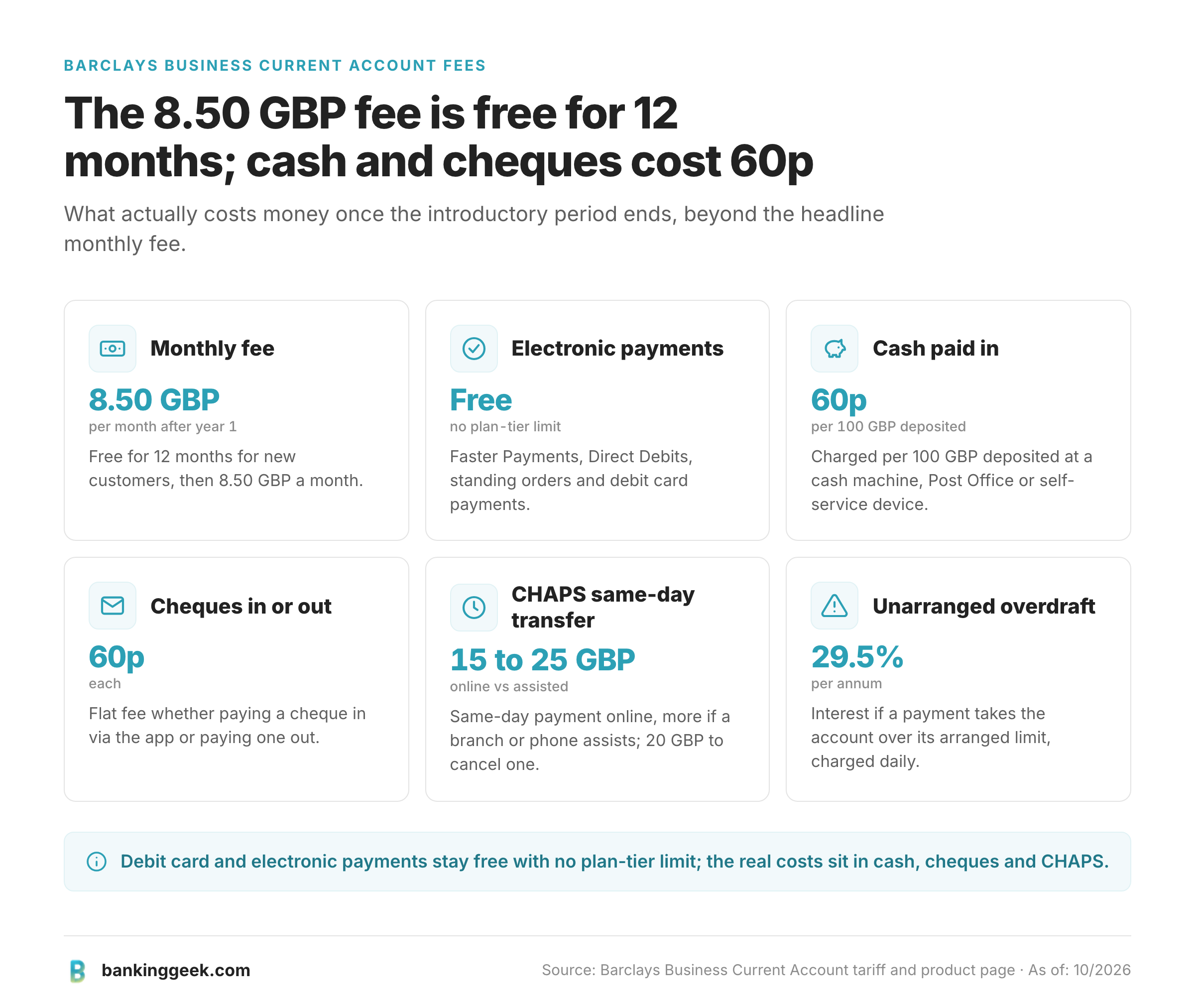
The headline monthly fee is 8.50 GBP once the 12-month introductory period ends. That figure sounds manageable, and day-to-day banking is genuinely cheap: simple electronic payments (Faster Payments, Direct Debits and standing orders made through Online Banking or the app) and debit card payments are free, with no plan-tier transaction limit, though that doesn't mean every transaction type is free. Where the real costs show up is cash, cheques and higher-value transfers, so a business handling large numbers of invoices or regular cash takings needs to model its monthly costs carefully before committing. A broader selection is in this overview: Best business savings account.
Cash withdrawals at a cash machine, Post Office, or self-service device are free, which is a genuine plus compared with several challengers that charge for ATM access. Paying cash in works differently: deposits via a cash machine, Post Office, Barclays Collect or self-service device cost 60p per 100 GBP deposited, not a flat per-visit fee. Cheques paid in via the app or a self-service device cost 60p each, and cheques paid out also cost 60p each. Non-sterling transactions, including card use abroad, carry a 2.75% conversion fee calculated on the Visa card scheme's reference exchange rate. International transfers through the Barclays International Payments Service cost 15 GBP online (25 GBP if assisted by a branch or phone), plus an optional 3 GBP USD cover charge and a small overseas-bank charge; receiving most incoming international payments is free. Instant bank transfers via Faster Payments are included, but CHAPS same-day transfers cost 15 GBP online or 25 GBP if assisted, with a 20 GBP charge to cancel one. Businesses that regularly hold or move money in other currencies can open a separate Foreign Currency Account alongside the current account, covering 17 freely traded currencies including EUR and USD with no minimum balance required, which is worth setting up before relying on card-rate conversion for frequent international business.
Overdraft access is one of the genuine advantages here. Subject to credit approval, Barclays can extend an arranged overdraft linked directly to the current account, priced individually per business. If a payment takes the account into an unarranged overdraft, interest is charged at 29.5% per annum, calculated daily and debited monthly, so an arranged facility is always the cheaper route if you expect to dip into it. If your business runs seasonal cash flow gaps, having the facility at all has real monetary value that many fintech accounts simply can't offer.
- Monthly fee: 8.50 GBP after a 12-month introductory free period for new customers
- Cash withdrawals: free at cash machines, Post Office, and self-service devices
- Simple electronic payments and debit card payments: free, no plan-tier transaction limit
- Cash paid in: 60p per 100 GBP; cheques in or out: 60p each
- Overdraft: arranged facility priced individually; unarranged overdraft interest 29.5% per annum
- CHAPS payments: 15 GBP online, 25 GBP if assisted; 20 GBP to cancel
Cards and payments: debit, credit, Apple Pay and virtual cards
Barclays issues a Visa debit card with the account as standard. A business credit card is also available, sitting alongside the current account and billed separately. Both cards support Apple Pay and Google Pay, which means your team can pay for business expenses contactlessly from a phone or watch without needing the physical card present. 3D Secure is enabled for online payments, adding the authentication layer that most corporate procurement portals now require.
Virtual cards are supported, which is useful for subscription management and online purchasing. A virtual card tied to the account lets finance teams assign spending to specific categories or team members without issuing additional physical cards. The feature isn't as fully developed as dedicated spend-management platforms, but it covers the core use case for small teams.
The debit card works on the Visa network globally. Acceptance is broad across Europe, North America, and most of Asia. Foreign currency transactions, including purchases, cash withdrawals and refunds, incur a 2.75% conversion fee on top of the Visa exchange rate, so businesses with heavy international travel spend may want to pair the account with a dedicated travel expense card for those corridors. Day-to-day UK purchasing is completely seamless.
Opening the account: step by step
You can open a Barclays business current account online, by booking a branch appointment, or by phone, with business support available 8am to 6pm on weekdays for anyone who prefers to talk it through first. The online route is the most common starting point. To qualify, you need to be at least 18, and at least one applicant must be a UK resident with three years of address history to provide; other directors named on the application don't each have to be UK residents themselves, as long as one is, but an application with no UK-resident applicant at all, or an under-18 applicant, won't qualify. You'll also need the company registration number (for limited companies), proof of the beneficial owners' identities, a UK trading address, and details of the business activity and expected turnover. Sole traders and partnerships need equivalent personal identification documents. We place the providers in context in this comparison: Best business account for sole traders in the UK.
Unlike many challenger accounts that verify identity in minutes, Barclays conducts a more thorough review process. Expect the application to take several business days, particularly if the business sector triggers additional compliance checks. Regulated sectors, businesses with complex ownership structures, or newly incorporated companies with no trading history may experience a longer wait. There's a separate guide on this: Barclays Bank Account.
Once approved, the account is issued with a UK sort code and account number. Your IBAN uses the standard GB prefix, which is accepted by all European banking counterparties and any global payment platform that requires SEPA-compatible identifiers. A debit card arrives by post within a few working days. The relationship manager introduction, where applicable, typically happens via telephone or a branch appointment shortly after account opening.
App, features and customer service quality
The Barclays Business app provides the core functions you would expect: balance and transaction visibility, Faster Payments, standing order management, and statement downloads. Payee management is handled within the app, and bulk payment files can be submitted via Barclays.net, the web-based business banking platform, for companies running payroll or managing supplier batches.
Open banking connectivity means the account links with accounting software packages including Xero, QuickBooks, and Sage, which reduces manual reconciliation work considerably. Barclays also bundles 12 months of free access to Sage Accounting (or Sage Accounting Sole Trader), dropping to 50% off after that, for customers who sign up to Sage separately and accept Sage's own terms. It's a genuine cost saving on top of the account itself, though you'll need to download your records before the discount ends if you ever decide to switch providers. Feeds are generally reliable, though occasional delays during peak periods have been noted in user forums. The app itself is stable and receives regular updates, though it doesn't offer the card freeze/unfreeze speed or instant push notification granularity that some fintech accounts provide.
In our test, reaching customer service by telephone during business hours was straightforward. Hold times were reasonable, and the agent was able to resolve a query about transaction limits without requiring an escalation. The relationship manager model, available to eligible accounts, adds a meaningful layer of personal support that digital-only providers can't replicate. For a business facing a loan application or a large-value transaction query, having a named contact is genuinely useful, not just a marketing point.
Reputation and real customer experience
Barclays consistently scores in the mid-range of UK business banking satisfaction surveys, sitting above some legacy high street peers but below the leading challengers on speed and digital experience metrics. Trustpilot reviews for Barclays Business reflect a mixed picture that's typical for a large institution: volume matters, and with millions of accounts, both strongly positive and strongly negative reviews accumulate. We cover it in more depth here: Barclays.
Recurring praise clusters around relationship manager responsiveness, lending support during difficult trading periods, and branch availability for cash-heavy businesses. Retailers, hospitality operators, and trades businesses frequently mention the value of being able to deposit cash in person and speak to someone who already knows their account history.
Recurring complaints focus on the pace of onboarding relative to challengers, account freezes triggered by automated fraud monitoring without sufficient prior communication, and occasional difficulty reaching the right department by phone when a specialist query arises. Some customers report that the transition from the introductory free banking period to the standard fee tier isn't well signposted. These themes aren't unique to Barclays, but they appear consistently enough across independent review sources to be taken seriously.
Regulatory standing is solid. Barclays Bank UK PLC is authorised by the Prudential Regulation Authority and regulated by both the PRA and the Financial Conduct Authority. This dual-regulated status applies to the most systemically significant UK banks and signals a higher baseline of regulatory scrutiny and capital requirement.
Safety and deposit protection
Deposits held with Barclays Business are protected by the Financial Services Compensation Scheme, the FSCS. The FSCS limit for eligible deposits is 120,000 GBP per person per authorised institution, raised from 85,000 GBP with effect from 1 December 2025. For business accounts, the limit applies to the legal entity holding the account, not to individual directors or shareholders separately, and eligible deposits across a business current account and any other Barclays, Barclays Business Banking, Barclays Premier Banking, Barclays Wealth Management or Tesco Bank products held by the same entity are added together under that single 120,000 GBP cap, since they share one banking licence.
Businesses with deposits exceeding 120,000 GBP may qualify for temporary high balance protection of up to 1.4 million GBP in specific circumstances, such as proceeds from a property sale or a business transaction. The protection reverts to the standard limit after six months, so businesses holding large transient cash balances should be aware of the timeline.
Beyond the statutory protection, Barclays operates under the Bank of England's resolution framework for systemically important institutions. In practice, this means the bank is subject to stress testing, recovery planning requirements, and ring-fencing rules that separate retail and SME deposits from investment banking activities. For most business customers, the FSCS is the relevant protection layer, but the structural robustness of the institution adds a further layer of confidence.
Verdict: who should open it and who should look elsewhere
Barclays Business Current Account suits established UK companies that value a blend of physical presence, lending access, and comprehensive banking under one provider. Limited companies processing regular volumes of payments, businesses that handle cash, and SMEs seeking an overdraft or trade finance facility will find genuine value here that newer accounts simply don't offer.
The 8.50 GBP monthly fee is reasonable for what you receive, but only if you're actually using the full service. A sole trader invoicing five clients per month and collecting payment digitally is paying for features they will never touch. Equally, a startup prioritising zero fees and instant setup will find the onboarding timeline frustrating.
Look elsewhere if your business is fully remote, operates entirely in digital payments, doesn't need an overdraft, and wants the account live within hours rather than days. In that profile, a challenger account will save money and open faster. Choose Barclays when your business has outgrown the fintech tier and needs the infrastructure, the relationships, and the regulatory gravitas that only a full-service bank can provide.
How safe is Barclays Business Current Account?
Barclays Business Current Account vs alternatives
A direct comparison of the key conditions against the strongest competitors in the market.
 |  |  |  | |
| Rating | 3.0 /5 | 5.0 /5 | 4.0 /5 | 4.2 /5 |
| Monthly fee | £8.50 | £0.00 | £0.00 | £0 (£25 if avg. balance below £10,000) |
| Debit card | ✓ | ✓ | ✓ | ✓ |
| Credit card | ✓ | ✗ | ✗ | ✗ |
| Virtual credit cards | ✓ | ✗ | ✗ | ✓ |
| Free cash withdrawal | ✓ | ✓ | ✗ | ✓ |
| Number of sub-accounts | – | – | – | Several |
| Online banking users | – | – | – | Several |
| Electronic transfers | ✓ | ✓ | ✓ | ✓ |
| Apple Pay | ✓ | ✓ | ✓ | ✓ |
| Google Pay | ✓ | ✓ | ✓ | ✓ |
| 3D Secure for online payments | ✓ | ✓ | ✓ | ✓ |
| Deposit protection | £120,000 | £120,000 | ✗ | £120,000 |
How we rate
More comparisons
About the author

Frequently asked questions
The account is available to UK-registered businesses, including sole traders, partnerships, and limited companies. Applicants must be UK residents and pass Barclays' identity and business verification checks, which include providing company registration details and director identification.
New customers get 12 months with no monthly account fee, then the standard fee is 8.50 GBP a month. Businesses that already hold a Barclays business current account are not eligible for the introductory offer. Day-to-day electronic payments and debit card spending stay free beyond that; the charges that actually add up are cash paid in (60p per 100 GBP), cheques in or out (60p each), and CHAPS same-day transfers (15 GBP online, 25 GBP if assisted).
Barclays is a fully authorised UK bank, and eligible deposits are protected by the FSCS (Financial Services Compensation Scheme) up to 120,000 GBP per person per bank. Barclays, Barclays Business Banking, Barclays Premier Banking, Barclays Wealth Management and Tesco Bank deposits share one banking licence, so they are added together under that single 120,000 GBP cap, and a business account counts as one depositor regardless of how many people can access it. A temporary high balance extension of up to 1.4 million GBP for up to six months can apply after a qualifying event such as a property sale.
You apply online or in branch, providing business registration documents, director identification, and information about your business activity. The process is more thorough than with digital challengers and typically takes several business days; Barclays may request additional documentation depending on business type and risk profile.
Yes. Barclays is regulated by the FCA and PRA, uses two-factor authentication for online banking, supports biometric login on mobile, and operates dedicated fraud monitoring. In our test, the security infrastructure matches what you would expect from a major UK clearing bank.
Business accounts do not generate personal savings income in the same way as personal accounts, but any interest credited to the account forms part of your business income and is subject to corporation tax for limited companies, or income tax for sole traders. The Personal Savings Allowance applies to individuals, not to company accounts; a qualified accountant can advise on the correct treatment for your structure.
Yes. Non-sterling card transactions, including purchases, cash withdrawals and refunds, carry a 2.75% conversion fee on the Visa exchange rate. International transfers through the Barclays International Payments Service cost 15 GBP online or 25 GBP if assisted, plus an optional 3 GBP USD cover charge; receiving most incoming international payments is free.