
Wise does not charge a monthly account fee, and it does not run subscription tiers the way some UK fintechs do. Instead, you pay a small fee each time you send, convert or spend money, and the fee changes depending on the currency and amount involved. This guide breaks down exactly what you pay for every Wise service in the UK, as of August 2026, sourced directly from Wise's own published pricing.
Quick answer: Wise has no monthly fee. Sending or converting money costs from 0.24% of the amount, varying by currency. A physical card costs £7 to order, ATM withdrawals are free up to £250 a month then cost 2.69% of the excess, and Wise is not covered by the FSCS because it is an e-money institution, not a bank.
How much does Wise cost in the UK?
Wise charges £0 a month for a personal account, with no subscription and no card tiers to choose between. Every cost is tied to something you actually do: sending money abroad, converting currency, spending on the card or pulling cash from an ATM. That pay-as-you-go model is the main structural difference from a plan-based provider like Revolut. For a closer look at the terms, see our review of Wise Account.
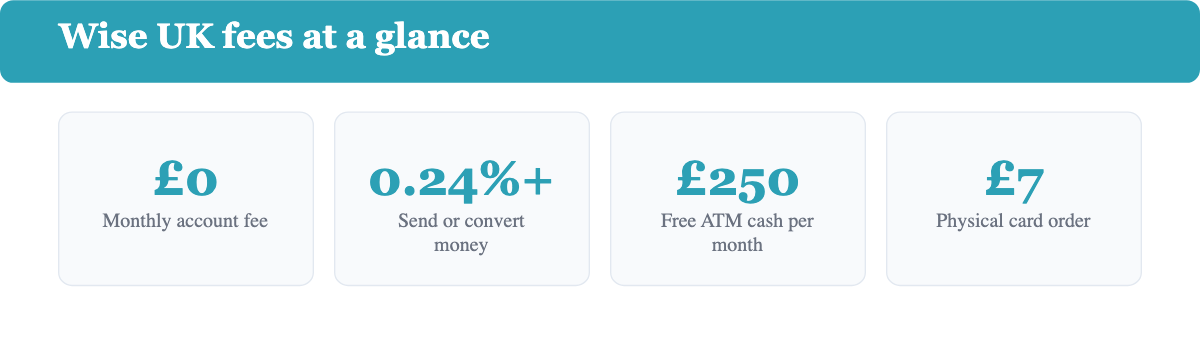
- Monthly account fee: £0
- Sending or converting money: from 0.24% of the amount, varies by currency
- Physical card: £7 to order
- Digital card: free
- ATM withdrawals: free up to £250/month, then 2.69% of the amount over that
- Holding 40+ currencies in your account: free
The table below pulls every fee category into one place, using Wise's own current UK pricing.
| Fee type | What you pay |
|---|---|
| Monthly account fee | None |
| Sending or converting money | From 0.24% of the amount, varies by currency, small minimum fee on small transfers |
| Transfers over roughly £20,000 (or equivalent) | Automatic discount applied |
| Wise-to-Wise transfers, same currency | Free |
| Physical card order | £7, standard delivery included |
| Express card delivery | From £10.85 |
| Digital card | Free |
| Replacement card | £2.50 |
| Card spending in a currency you hold | Free |
| Card spending in a currency you don't hold | Small conversion fee, shown before you confirm |
| ATM withdrawals | Free up to £250/month, then 2.69% of the excess |
| Holding money in 40+ currencies | Free |
| Receiving domestic payments (GBP, EUR, USD and six other currencies) | Free |
| Receiving international (Swift) payments | Roughly £2 to £6 depending on currency |
These figures reflect Wise's published UK pricing, checked in August 2026. Wise changes individual currency rates often, so confirm the exact percentage for your transfer on Wise's own pricing page before you send, though the structure above holds true regardless of which currency you're moving. If it is not the right fit, we compared the strongest Wise alternatives.
International transfer fees and the mid-market rate
Sending money with Wise costs a percentage of the amount you're transferring, starting from 0.24%, plus a small minimum fee if you're sending a very small amount. The exact percentage depends on the currency pair and how you fund the transfer, so two people sending the same amount to different countries can end up with different fees. Wise shows the final cost before you confirm anything, so there's no guessing involved. Which accounts else are worth a look is covered here: Wise vs Monzo.
Why the mid-market rate matters
Most banks and some transfer apps build their profit into the exchange rate itself, quietly marking it up so the advertised "fee" looks smaller than it really is. Wise instead uses the live mid-market rate, the same one banks use to trade with each other, and charges its margin as a separate, visible fee. That's the practical meaning behind Wise's "no markup" claim: the rate you see is the rate you get, and the cost sits in one line item instead of being hidden in the conversion. For the wider picture, see our comparison: Wise Business vs Revolut.
Sending money between Wise users
If you and the recipient both hold Wise accounts and you're sending the same currency, the transfer is free. Once a different currency needs converting, the standard percentage fee applies as normal. Payments in euros within the Single Euro Payments Area also stay free on top of any standard sending case.
One more fact worth knowing if you move large sums: Wise automatically applies a discount once a single transfer passes roughly £20,000 or the equivalent in another currency. You don't need to ask for it or hold a particular account type, the lower rate kicks in on its own.
Holding, converting and receiving money in your Wise account
Wise charges £0 to hold balances in more than 40 currencies inside the same account, however long you keep the money there. Converting between those currencies costs the same percentage-based fee as sending money, from 0.24%, since it's the same underlying mechanism.
Receiving money is free in most cases. Domestic payments in GBP, EUR, USD and six other supported currencies (AUD, CAD, HUF, NZD, PHP and SGD) arrive at no cost. International payments that route through the Swift network cost a small fixed fee instead, typically somewhere between £2 and £6 depending on the currency, since Wise has to cover what its banking partners charge on that route.
If you'd rather earn something on idle balances, Wise also offers optional interest and stocks features with their own separate annual charges (interest from around 0.26% a year, stocks from around 0.59%), but these sit outside the core fee structure most people are comparing when they ask what Wise costs.
Wise card fees: ordering, delivery and spending abroad
The Wise card itself has no ongoing cost. A digital card is free the moment you open an account, and you can start spending with it immediately. Ordering a physical card costs £7, which includes standard delivery, or you can pay from £10.85 for express delivery if you need it sooner. Lose the card or need a new one for another reason, and a replacement costs £2.50.
- Digital card: free, available instantly
- Physical card order (standard delivery included): £7
- Express delivery: from £10.85
- Replacement card: £2.50
Spending itself is where the held-currency distinction matters most. Pay in a currency you already hold in your Wise account and there's no conversion cost at all, the money simply comes straight out of that balance. Pay in a currency you don't hold, and Wise converts it automatically at the point of sale, still at the mid-market rate but with a small conversion fee added on top, shown to you before the payment goes through. Holding the currency you're travelling with in advance is the simplest way to avoid that fee entirely.
Does Wise charge ATM withdrawal fees?
Not within your monthly allowance. Wise gives every personal account holder up to £250 in fee-free ATM withdrawals each month. Once you go over that amount, Wise charges 2.69% on the excess, calculated only on the portion above £250 rather than the whole withdrawal. Heavy cash users travelling for a full month abroad are the ones most likely to bump into this limit, since £250 covers a fairly light amount of cash use over four weeks.
One caveat that's easy to miss: the ATM operator itself can still add its own surcharge on top, separate from anything Wise charges. That's standard across the industry and not something any card provider, Wise included, can control.
Is your money protected? UK regulatory status and FSCS cover
No, Wise is not covered by the Financial Services Compensation Scheme, because Wise is not a bank. Wise Payments Limited operates in the UK as an authorised electronic money institution regulated by the Financial Conduct Authority under the Electronic Money Regulations 2011 (Firm Reference 900507), a different regulatory category from a bank with a full banking licence. That distinction matters directly for how your money is protected if Wise were ever to fail.
Instead of FSCS deposit protection, Wise uses a safeguarding model. Customer funds are kept entirely separate from Wise's own operating money, held either as cash with regulated banking partners or in secure, liquid assets such as short-term government bonds. If Wise became insolvent, safeguarded funds would be ring-fenced from the company's creditors and returned to customers, though safeguarding is a contractual protection rather than the statutory guarantee the FSCS provides, and it isn't a promise of instant repayment.
The rules behind this got stricter in 2026. New FCA safeguarding requirements for payment and e-money firms, published as Policy Statement PS25/12, took effect on 7 May 2026 and tightened how firms like Wise must ring-fence and report on customer funds. If protection under the FSCS specifically matters more to you than Wise's fee structure or currency features, a traditional UK bank account will suit you better, since that's the one thing Wise structurally cannot offer.
Which situations is Wise actually worth it for?
Wise earns its fees back fastest for people who regularly send or receive money across currencies: freelancers and contractors paid by overseas clients, remote workers with a foreign employer and anyone sending money home to family abroad. The percentage-based fee is usually cheaper than a bank's international transfer charge, and the mid-market rate removes the hidden markup that traditional banks build into their exchange rates. We went through the fees and features in our review of Wise Business Account.
Frequent travellers get similar value from the card, since spending in a currency you're holding avoids conversion fees altogether and the £250 monthly ATM allowance covers casual cash use. If you exchange more than that pattern suggests, the fee still stays transparent and calculable in advance, which is more than most travel cards offer.
Wise fits less well as your only UK bank account. There's no cheque handling, no overdraft, and critically, no FSCS protection on your balance. Anyone who wants their everyday spending money protected the way a bank deposit is protected should keep a traditional UK bank account for that purpose and use Wise alongside it for the currency and international-transfer side of their finances.
If you're weighing Wise against a multi-currency card provider instead of a bank, it's worth comparing the numbers directly. Our Revolut fees breakdown covers a subscription-tier model that works out cheaper than Wise for some heavy spenders, even though Wise's pay-as-you-go pricing stays simpler for occasional international transfers.
Wise fees FAQ
Does Wise charge a monthly fee?
No, Wise does not charge a monthly account fee or run subscription tiers. You only pay for the specific service you use, such as sending money, converting currency or ordering a physical card.
How much does Wise charge to send money?
Wise charges a percentage of the amount sent, starting from 0.24% and varying by currency, plus a small minimum fee for very small transfers. The exact rate is shown before you confirm any transfer.
Does Wise charge ATM fees?
Not within your monthly allowance. Withdrawals are free up to £250 a month, and Wise charges 2.69% on any amount withdrawn above that limit.
Is Wise covered by the FSCS?
No, Wise is not covered by the FSCS because it is an electronic money institution regulated by the FCA, not a bank. Customer funds are instead protected through safeguarding, which keeps your money separate from Wise's own funds at regulated banking partners.
Does the Wise card charge foreign transaction fees?
Spending in a currency you already hold in your Wise account is free. Spending in a currency you don't hold triggers a small conversion fee at the mid-market rate, shown to you before the payment completes.
Can I avoid Wise fees entirely?
Largely, yes, for everyday use. Holding the currency you need before you spend it, sending to another Wise user in the same currency and staying within your £250 monthly ATM allowance all keep transactions free.