
NatWest is one of the UK's biggest high-street banks, with around 900 branches and millions of current account customers. This review covers exactly what it costs, what its account tiers offer, how safe your money is (including a 2025 ownership change most reviews miss), and whether it still deserves a place on your shortlist in 2026.
What Is NatWest?
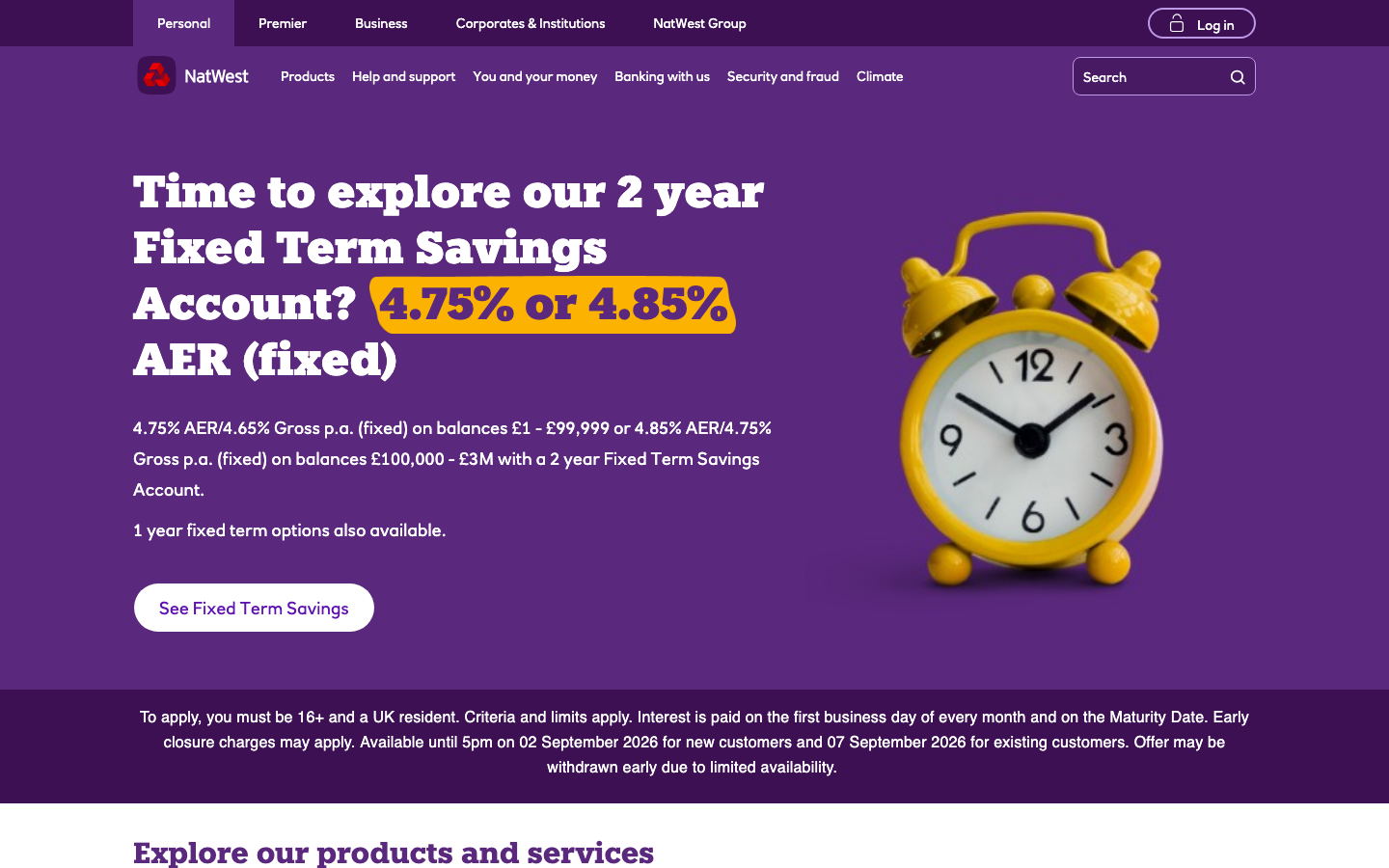
NatWest is a UK high-street bank and part of NatWest Group, the banking group formerly known as Royal Bank of Scotland (RBS) before its 2020 rebrand. It runs around 900 branches across the UK alongside its app and online banking, and offers current accounts, savings, credit cards, mortgages and business banking.
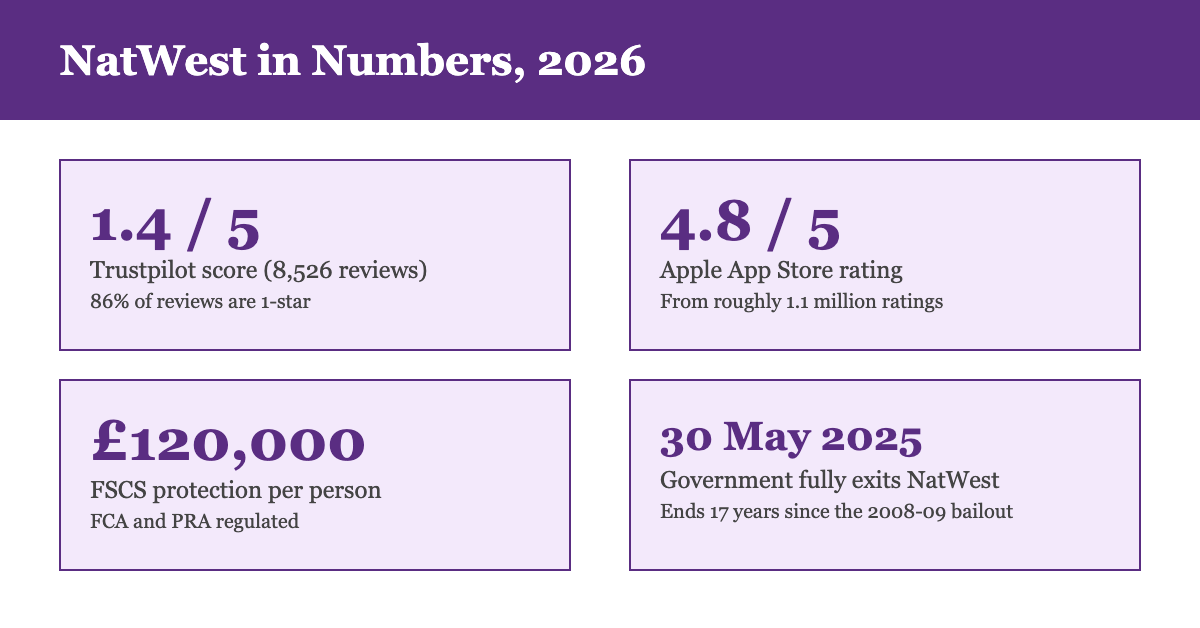
What most reviews leave out: NatWest Group only returned to full private ownership on 30 May 2025. The UK government took an 84.4% stake in the bank during the 2008-09 financial crisis as part of a £45.5 billion bailout, then spent the next 17 years selling that stake down through share sales, buybacks and a trading plan. The Treasury eventually recouped around £35 billion of the original outlay, leaving taxpayers with a roughly £10.5 billion shortfall on the rescue. That history is directly relevant if you're asking "is NatWest safe" or wondering why the brand still carries an RBS-era reputation in some corners of the press.
NatWest at a Glance
| What you're checking | NatWest's answer |
|---|---|
| Ownership structure | Publicly listed bank, fully private since 30 May 2025 (formerly government-owned after the 2008-09 bailout) |
| Deposit protection | FSCS-covered up to £120,000 per person |
| Cheapest current account | Select Account, £0/month |
| Reward account cashback | Up to £5/month against a £2/month fee |
| Arranged overdraft rate | 39.49% EAR variable |
| Foreign transaction fee | 2.75% non-sterling fee |
| Branch network | Around 900 branches UK-wide |
| Banking app rating | 4.8/5 on the App Store (1.1m ratings) and around 4.8/5 on Google Play |
| Independent review sentiment (Trustpilot) | 1.4/5 from 8,526 reviews, 86% one-star |
| Current switch incentive | £200 via the Current Account Switch Service |
Current Account Options: Select, Reward and Beyond
NatWest runs a tiered current account ladder, from a fee-free everyday account up to packaged accounts with built-in insurance. Here's what each tier actually gets you.
Select Account
The Select Account is NatWest's fee-free everyday account: £0 a month, a Visa debit card, Apple Pay and Google Pay support, spend tracking, Round Ups, and the ability to split bills with contacts in the app. New customers switching in via the Current Account Switch Service can currently get a £200 bonus. For most people who don't want to pay a monthly fee for extras they won't use, this is the account NatWest expects you to open.
Reward Account
The Reward Account costs £2 a month, but it's designed to pay for itself: you can earn £4 a month in Rewards for paying at least two Direct Debits of £2 or more from the account, plus £1 a month just for logging into the NatWest app once a month. That's up to £5 a month in Rewards against a £2 fee, paid as cashback into your account or as eGift codes, so a household with a couple of qualifying Direct Debits comes out ahead in cash terms. Like Select, it also comes with no foreign transaction fees on debit card purchases abroad and the £200 switch bonus.
Reward Silver and Reward Platinum
Above Reward sit two packaged accounts. Reward Silver costs £10 a month and layers on European travel insurance and mobile phone insurance. Reward Platinum costs £22 a month and adds worldwide travel insurance and UK car breakdown cover on top of everything in Reward Silver. Both only make financial sense if you'd otherwise buy that insurance separately, since a single annual travel insurance policy or breakdown cover plan can easily cost more than 12 months of the account fee.
Student and Specialist Accounts
NatWest also runs a free Student Account (17+) with an interest-free overdraft from year one, subject to status, plus a £100 welcome offer and a free four-year Tastecard membership. The Adapt Account is a fee-free option for 11-17 year olds with in-app card freezing and balance checking. Joint accounts are available on either the Select or Reward structure, and Premier accounts (for customers who meet income or savings thresholds) currently carry a £500 switch bonus.
Savings, Overdrafts and Fees Beyond Current Accounts
Savings and ISA Rates
NatWest's standout savings product is the Digital Regular Saver, which pays 5.25% AER on balances up to £5,000 (1.00% above that), but it's only open to existing current account holders and lets you pay in between £1 and £150 a month. For lump-sum savers, Fixed Term Savings currently pays between 4.15% and 4.85% AER depending on the term, and the Fixed Rate Cash ISA pays 4.72%-4.75% AER over one or two years. The everyday Cash ISA and Flexible Saver are far less competitive, paying as little as 1.00%-2.45% AER depending on balance tier, so they're worth using only for instant-access flexibility rather than rate-chasing.
Overdrafts and Foreign Fees
This is where NatWest is genuinely expensive. Its arranged overdraft rate is 39.49% EAR variable, among the highest of any UK high-street bank, and it applies from the first pound you borrow (NatWest only charges when you actually use the overdraft, with no separate arrangement fee). Spending abroad on a standard debit card costs a 2.75% non-sterling transaction fee, and a CHAPS same-day payment costs around £25. If you regularly dip into your overdraft or spend heavily overseas, those costs alone are reason enough to look at a challenger bank alongside NatWest rather than instead of it.
Business Banking, Credit Cards and Mortgages
Beyond personal current accounts, NatWest also runs a full business banking arm covering sole trader, limited company and startup accounts, several of which include a free period before a monthly fee kicks in (typically £5 a month once the free period ends). Its credit card range spans low-rate purchase cards, balance transfer cards and rewards cards, with representative APRs that move regularly, so always check the live rate before applying rather than relying on last year's figure. On the mortgage side, NatWest is consistently one of the largest UK mortgage lenders by volume, with residential, buy-to-let, first-time buyer and remortgage products, plus its own in-branch and online mortgage advice service. If you want a deeper look at the business side specifically, our NatWest Business Current Account review covers the fee structure and eligibility in full.
Is NatWest Safe?
Yes. NatWest is regulated by the Financial Conduct Authority (FCA) and the Prudential Regulation Authority (PRA), and eligible deposits are protected by the Financial Services Compensation Scheme (FSCS) up to £120,000 per person (£240,000 for joint accounts).
The more interesting safety question is ownership. NatWest Group (formerly RBS) was rescued by the UK government in 2008-09 with a £45.5 billion bailout that gave the state an 84.4% stake, at the time making it one of the largest banks in the world under partial public control. The government spent the following 17 years gradually selling that stake down through accelerated share sales, buybacks by NatWest itself, and a long-running trading plan, finally completing the exit on 30 May 2025. It recouped roughly £35 billion of the original £45.5 billion, meaning taxpayers took an approximate £10.5 billion loss on the rescue overall. Practically, that means NatWest today is a normal, fully privately owned, publicly listed bank, no longer subject to the government-influence concerns that shaped its reputation for well over a decade.
NatWest App and Online Banking
The NatWest app covers everyday account management, payments, card freezing, biometric login on supported devices, savings Round Ups, spending insight categories, receipt capture and Get Cash, which lets you withdraw cash from an ATM without your card using a one-time code generated in the app. Open banking integration also lets you see accounts held with other banks alongside your NatWest accounts in one place.
The app itself is well reviewed: 4.8 out of 5 on the Apple App Store from around 1.1 million ratings, and a similarly strong score on Google Play. That sits in sharp contrast to NatWest's Trustpilot score of just 1.4 out of 5 from 8,526 reviews, 86% of them one star. The gap isn't really a contradiction. App store ratings mostly reflect whether the software itself works well day to day, while Trustpilot reviews skew heavily towards customers who had a bad experience with something the app can't fix on its own, like a frozen account, a blocked card, or a slow-moving fraud dispute reaching human customer service. Read the app rating as "the software is good" and the Trustpilot score as "escalated customer service problems are common", not as two conflicting verdicts on the same thing.
Pros and Cons of Banking with NatWest
Where NatWest does well:
- Large branch network (around 900 branches) for a high-street bank of its size
- Highly rated app (4.8/5 on the App Store and Google Play)
- Reward account cashback can outweigh its £2 monthly fee for households with a couple of Direct Debits
- Digital Regular Saver rate (5.25% AER) is genuinely competitive for current account holders
- Broad product range: current accounts, savings, ISAs, credit cards, mortgages and business banking under one roof
Where NatWest falls short:
- Arranged overdraft rate (39.49% EAR) is among the most expensive of any UK high-street bank
- 2.75% foreign transaction fee on the free accounts makes it a poor choice for frequent travellers
- Everyday Cash ISA and Flexible Saver rates are uncompetitive against best-buy tables
- Trustpilot score (1.4/5) points to real, recurring customer-service friction on account and card issues
Who Is NatWest Best For?
NatWest suits different people depending on what you actually need from a bank:
- Branch-dependent customers: around 900 branches makes NatWest one of the more accessible high-street banks for in-person banking.
- Households with multiple Direct Debits: the Reward account's £4+£1 cashback structure can turn a £2 fee into a net gain.
- Switchers chasing a cash incentive: the current £200 switch bonus is a straightforward reason to move.
- Students: a free account with an interest-free overdraft from year one is a genuinely useful safety net.
NatWest is a weaker fit if you regularly use your overdraft, spend a lot abroad, or want the best possible savings rate on instant-access cash, since it's expensive or uncompetitive on all three.
NatWest vs the Alternatives
If overdraft cost or foreign fees are a dealbreaker, Starling Bank charges no non-sterling transaction fees and offers a lower representative overdraft rate for most customers, though it has no branch network at all. If you want a mutual, member-owned alternative with a similar branch footprint, read our Nationwide review for how its Fairer Share Payment model compares. And if you're specifically weighing up NatWest's own product range, our dedicated reviews of the NatWest Select Account, the NatWest Business Current Account, the NatWest Savings Account and the NatWest Fixed Term Savings Account go deeper into each product's terms than this overview can. For a wider market comparison, see our roundup of the best current accounts in the UK and the latest current account switch offers.
Verdict: Is NatWest Worth It?
NatWest is a solid, mainstream choice if you value branch access, a genuinely well-built app, and a Reward account that can pay for its own fee. It's now also a fully privately owned bank again, seventeen years after the 2008-09 bailout, which closes the book on the ownership question that hung over the RBS/NatWest brand for most of that period. Where it loses ground is cost: its arranged overdraft is one of the most expensive on the UK high street, its free accounts charge a real foreign transaction fee, and its Trustpilot score reflects genuine customer-service frustration for a meaningful share of its customer base. If you rarely go overdrawn, don't spend heavily abroad, and want a big branch network with a well-rated app, NatWest earns its place on the shortlist. If cost is your main filter, it's worth comparing it directly against Starling, First Direct or a fee-free digital challenger before you commit.
Is NatWest a good bank?
It depends what you value. NatWest scores well on branch access and app quality, with a 4.8/5 App Store rating, but its arranged overdraft rate (39.49% EAR) is among the most expensive on the UK high street and its Trustpilot score (1.4/5) points to real customer-service friction. It's a solid mainstream choice for branch-dependent customers who rarely use an overdraft, less strong for cost-conscious or frequent-overdraft customers.
Is my money safe with NatWest?
Yes. NatWest is regulated by the FCA and PRA, and eligible deposits are protected by the FSCS up to £120,000 per person (£240,000 for joint accounts). NatWest Group also returned to full private ownership on 30 May 2025, ending the government stake it held since the 2008-09 financial crisis bailout.
Does the government still own NatWest?
No. The UK government sold its final shares in NatWest Group on 30 May 2025, ending 17 years of partial public ownership that began with a £45.5 billion bailout in 2008-09. The Treasury recouped around £35 billion of that outlay, leaving an approximate £10.5 billion shortfall for taxpayers overall.
How does the NatWest Reward account work?
It costs £2 a month, but you can earn £4 a month in Rewards for paying at least two Direct Debits of £2 or more from the account, plus £1 a month for logging into the NatWest app once a month. That's up to £5 a month against a £2 fee, paid as cashback or eGift codes.
What is NatWest's overdraft rate?
NatWest's arranged overdraft rate is 39.49% EAR variable, one of the higher rates charged by a UK high-street bank. It applies from the first pound borrowed, with no separate arrangement fee.
How many NatWest branches are there?
Around 900 branches across the UK, giving NatWest one of the larger branch networks among UK high-street banks.