
NatWest Fixed Term Savings Account: review 2026
Last updated: 12.10.2026
Contents
Summary
The NatWest Fixed Term Savings Account offers a guaranteed rate of 4.00% AER for either one or two years, making it a straightforward choice for UK savers who want certainty over their returns. Deposits are protected up to 120,000 GBP per person under the FSCS, and the account is managed entirely through the NatWest app or online banking. It suits existing NatWest customers with a lump sum they will not need to access before the term ends.
Pros
- Guaranteed fixed rate of 4.00% AER for the full 1 or 2 year term
- FSCS deposit protection up to 120,000 GBP per person
- no monthly fees or account charges
- interest paid monthly throughout the term
- fully managed online or via the NatWest mobile app
Cons
- No access to funds before maturity without early closure penalties
- cannot add further deposits after the initial amount is placed
- joint accounts are not available
- new customers must open a NatWest current account before they can apply
Key facts
| Interest on savings account | 4.00% AER fixed (1 or 2 years) |
| Deposit protection | £120,000 |
| Online account opening | ✓ |
| Welcome bonus | ✗ |
| Joint account | ✗ |
| Overdraft interest rate | ✗ |
| Savings account | ✗ |
| Rating | 3.8 /5 |
Interest rate comparison
The effective annual rate compared directly with the alternatives.
A closer look
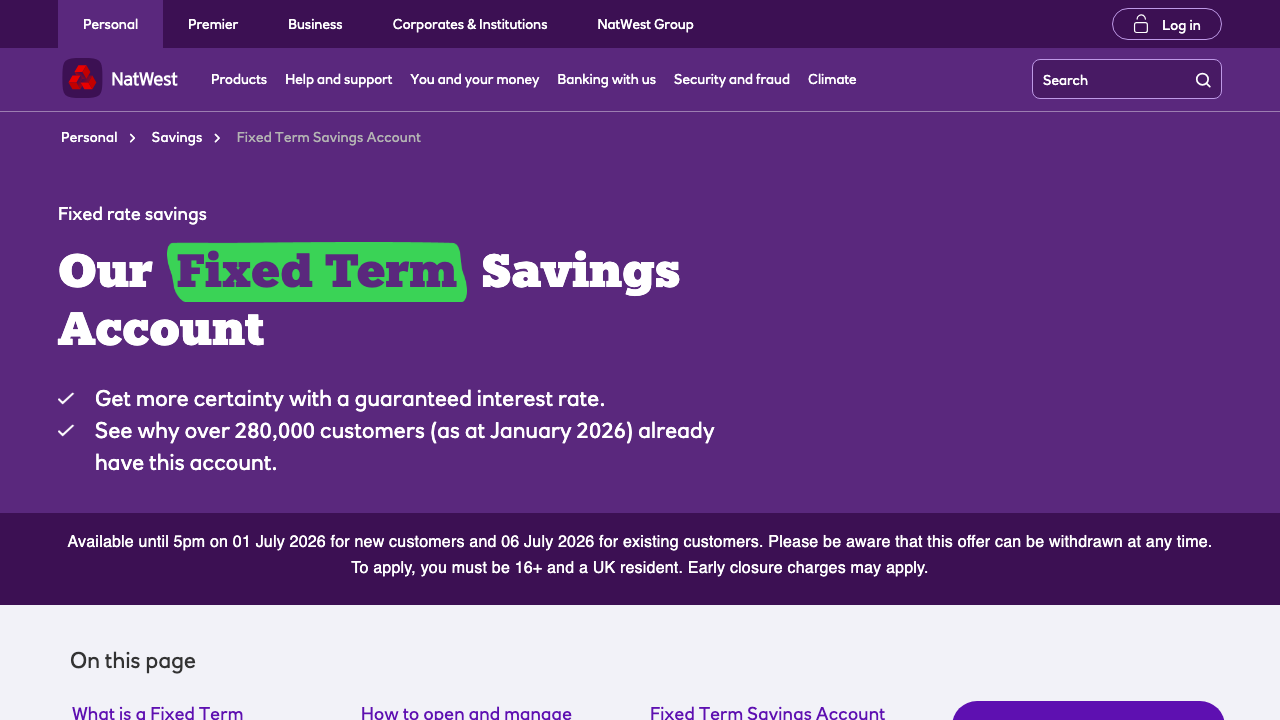
Overview: what the NatWest Fixed Term Savings Account is, and who it suits
NatWest's Fixed Term Savings Account is a straightforward fixed-rate deposit: you lock away a lump sum for either one or two years and receive 4.00% AER for the full duration, regardless of what happens to the Bank of England base rate during that period. The rate is guaranteed the moment you open the account, which is its central appeal. For savers who dislike watching variable-rate accounts drift downward every few months, that certainty is genuinely valuable.
This product suits people who already bank with NatWest and have a defined savings goal anchored to a specific date, for example funding home improvements after a fixed project timeline, building a deposit for a property purchase in twelve or twenty-four months, or simply parking redundancy money while deciding on a longer-term strategy. The key word is "already": NatWest requires an active NatWest current account. New customers must open one before they can apply for the fixed-term product, which adds friction and a step that a challenger bank would never impose. For a closer look at the terms, see our review of NatWest.
This account is explicitly not suitable for anyone who might need to access their money before the term ends. There is no penalty-free withdrawal window. Early closure is possible, but NatWest applies charges that erode the interest earned, and in some scenarios you can receive back less than the equivalent of keeping funds in a top-paying easy-access account. Likewise, if your savings pot is small or you want to drip-feed money in over time, look elsewhere: you cannot top up after the initial deposit, and the product is not available as a joint account.
The interest rate in detail: what 4.00% AER actually means for your money
4.00% AER fixed is the headline figure for both the one-year and two-year terms. AER (Annual Equivalent Rate) accounts for the compounding effect of monthly interest payments, so the gross monthly rate is slightly lower, roughly 0.333% per month before tax. NatWest pays interest monthly throughout the term rather than rolling it up and paying at maturity, which means you see the income arrive in your linked current account every four weeks. That is useful for savers who want to treat the interest as a small monthly income rather than a lump sum at the end. This comparison shows where the offer sits: Best bank account UK.
In our test, the application process confirmed the rate clearly before commitment, and the first interest payment arrived on schedule with a breakdown visible in the mobile app. There are no monthly fees and no penalties simply for holding the account to maturity. However, the rate locks in only your initial deposit. Any additional money you want to save at the same rate must go into a separate account or a new fixed-term product opened later, at whatever rate then applies. That is a real limitation for anyone in an accumulation phase of life rather than a preservation phase.
Compared with the UK easy-access market in mid-2026, where the best instant-access accounts are paying between 4.5% and 5% AER, a two-year lock-in at 4.00% AER requires genuine conviction that rates will fall significantly over the coming years. If the base rate stays elevated, you may have been better served by a flexible product. The one-year term is the more defensible choice for most savers in an uncertain rate environment.
Taxation on interest: the Personal Savings Allowance and what NatWest reports
In the UK, interest earned on savings accounts is subject to income tax, but most savers benefit from the Personal Savings Allowance (PSA). Basic-rate taxpayers (20%) receive a PSA of up to £1,000 per tax year, meaning the first £1,000 of interest is received tax-free. Higher-rate taxpayers (40%) receive a PSA of £500. Additional-rate taxpayers (45%) have no allowance at all and pay tax on every pound of interest.
Because NatWest pays interest monthly, you will receive it across two tax years if you hold a one-year account that spans 6 April. That means your PSA position in each tax year independently determines your liability. A basic-rate taxpayer with, say, £20,000 in the account earns roughly £800 in the first twelve months, comfortably within the £1,000 allowance. At £25,000, the annual interest reaches £1,000 exactly; anything above that and you have a liability to report via self-assessment or HMRC's coding notice adjustment. The specifics are collected here: NatWest Savings Account.
NatWest reports interest to HMRC automatically under the Common Reporting Standard, so HMRC will adjust your tax code or write to you directly if the interest pushes you above the PSA. You do not need to file a full self-assessment return simply because of savings interest unless you already file one for other reasons. Keep an eye on your annual interest statement in the NatWest app, which appears under the account details section and breaks out gross interest paid per tax year. There is a full guide on it: NatWest Business Current Account.
Opening the account: steps, identity checks and what to expect
The application is handled entirely within the NatWest mobile app or through online banking. There is no branch visit required, and NatWest does not post out physical documents for this product. The process typically takes under ten minutes for an existing NatWest current account holder.
Here is the standard flow:
- Log in to the NatWest app or online banking portal.
- Navigate to the savings section and select Fixed Term Savings Account.
- Choose your term (one or two years) and enter the deposit amount.
- Confirm the linked funding account (your NatWest current account).
- Review and accept the terms, which include the early-closure charges schedule.
- Funds transfer immediately from your current account and the fixed-term account activates the same day.
New customers face an additional step: opening a NatWest current account first, which requires identity verification through biometric document scanning in the app. That process is generally completed within one working day, though NatWest may request additional documents for customers whose proof of address does not match their electoral roll record. Once the current account is active, the fixed-term account application follows the same in-app flow described above. The IBAN for UK NatWest accounts begins with GB, as expected for a domestic sterling account. No minimum balance applies beyond the initial deposit, though in practice a very small deposit makes the 4.00% AER rate economically negligible.
Safety: deposit protection and the institution behind the account
The NatWest Fixed Term Savings Account is covered by the Financial Services Compensation Scheme (FSCS), the UK's statutory deposit guarantee. Protection applies up to £120,000 per eligible depositor per authorised institution under standard circumstances. The FSCS limit rose from £85,000 to £120,000 on 1 December 2025. However, NatWest discloses FSCS protection up to £120,000 in its product documentation, reflecting the Temporary High Balance (THB) protection that applies for up to six months when a depositor holds a large sum arising from a qualifying life event, such as a property sale, a divorce settlement, or an inheritance. After six months, the standard £120,000 cap resumes.
The regulator is the Financial Conduct Authority (FCA) and the Prudential Regulation Authority (PRA). NatWest Group plc, which trades as NatWest, RBS, and Ulster Bank in various markets, is one of the largest retail banking groups in the United Kingdom, with roots in the former National Westminster Bank founded in 1970. The UK government held a majority stake in NatWest Group following the 2008 financial crisis; as of 2026, that stake has been fully returned to the private sector following a public share offering. Whatever one thinks of the bank's historical track record, the combination of FSCS protection, FCA and PRA oversight, and the bank's systemic importance in the UK makes the credit risk of holding a fixed-term deposit here about as low as it gets in the British market.
Reputation and real customer experience
NatWest's overall reputation among savings customers is mixed, but the fixed-term product generates a more focused and largely positive response from users who understood what they were signing up for. The recurring praise centres on rate reliability: customers consistently note that the rate stated at opening was precisely the rate credited each month, without adjustments or surprise changes mid-term. The mobile app experience is also frequently cited positively, particularly the visibility of monthly interest credits and the ability to see maturity dates and instructions within the account dashboard.
Recurring complaints divide into two clear themes. The first is the current account prerequisite. Multiple reviewers describe a frustrating detour in which they opened a NatWest current account purely to access the fixed-rate savings product, then found themselves managing two accounts with a bank they did not originally choose for everyday banking. The second theme is early closure. Customers who experienced a change in circumstances mid-term and needed to access funds ahead of maturity report that the charges were higher than they expected, despite being disclosed in the terms. The lesson reviewers draw consistently is that the product punishes circumstances it cannot predict, which is not a criticism of NatWest specifically but a structural feature of fixed-term savings that buyers should absorb before committing.
Customer service contacts related to the fixed-term account tend to go through the main NatWest telephone banking line or the in-app messaging system. Response times via messaging are generally rated as adequate rather than fast, and some users note that the fixed-term product's specific questions sometimes require escalation beyond the first line of support. None of this is unusual for a large retail bank, but savers accustomed to the rapid specialist support of standalone savings platforms may find the experience slower.
Verdict: open this account or look elsewhere?
Open this account if you already hold a NatWest current account, have a lump sum of meaningful size you will not need to touch for one or two years, and want the certainty of a fixed rate without shopping around specialist savings platforms. The 4.00% AER rate is competitive within the NatWest product range and provides genuine protection against rate cuts. Monthly interest payments are a practical advantage for anyone treating the income as a predictable supplement to other cash flow.
Look elsewhere if you do not already bank with NatWest, if there is any realistic scenario in which you might need the money before the term ends, or if you want to continue adding to the pot after opening. In our test, the best-buy easy-access accounts in the UK market in 2026 were offering rates that either matched or exceeded 4.00% AER with full flexibility, which erodes the case for locking in unless you specifically want rate certainty rather than rate maximisation. Dedicated savings platforms such as those from building societies or fintech providers also lack the current-account gate, making them more accessible for savers who simply want a fixed return without a banking relationship attached.
How safe is NatWest Fixed Term Savings Account?
NatWest Fixed Term Savings Account vs alternatives
A direct comparison of the key conditions against the strongest competitors in the market.
 |  |  |  | |
| Rating | 3.8 /5 | 4.5 /5 | 4.3 /5 | 4.2 /5 |
| Interest on savings account | 4.00% AER fixed (1 or 2 years) | 4.71% AER variable (incl. 1.11% bonus for 12 months; standard rate 3.60% AER) | 4.70% AER variable (incl. 1.25% bonus for 12 months; standard rate 3.45% AER) | ca. 3.85% AER variable (Easy Access Saver); up to 7.50% AER (Member Regular Saver, 12 months) |
| Deposit protection | £120,000 | £120,000 | £120,000 | £120,000 |
| Online account opening | ✓ | ✓ | ✓ | ✓ |
| Welcome bonus | ✗ | ✓ | ✗ | ✗ |
| Joint account | ✗ | ✗ | ✗ | ✓ |
| Overdraft interest rate | ✗ | ✗ | ✗ | ✗ |
| Savings account | ✗ | ✓ | ✓ | ✓ |
How we rate
About the author

Frequently asked questions
The account is open to UK residents who hold an existing NatWest current account. New customers must open a current account first, which involves a standard identity and credit check, before they can apply for the fixed term savings product.
There are no monthly fees or account maintenance charges. However, closing the account before the fixed term ends will trigger an early closure charge, so you should only commit funds you are confident you will not need until maturity.
Deposits are covered by the FSCS (Financial Services Compensation Scheme) up to 120,000 GBP per person per bank. NatWest is authorised by the PRA and regulated by both the FCA and the PRA, so your money is protected in the event of bank failure.
Existing NatWest customers can apply entirely through the NatWest app or online banking in under ten minutes, with no branch visit needed. If you are a new customer, you must open a NatWest current account first before accessing the savings product.
Yes. NatWest is a PRA-authorised bank regulated by the FCA and PRA, and deposits are FSCS-protected up to 120,000 GBP. The fixed rate means your return is guaranteed for the chosen term, and there is no market or investment risk on the principal.
Interest is paid gross without any tax deducted at source. It counts towards your Personal Savings Allowance: 1,000 GBP per year for basic-rate taxpayers and 500 GBP for higher-rate taxpayers. Any interest above your allowance is taxed at your marginal income tax rate and should be declared through Self Assessment or your tax code.