
Metro Bank earns a 3.5 out of 5 rating from BankingGeek for 2026. It's a genuinely fee-free, branch-based current account with full FSCS protection and a highly rated mobile app. But the bank itself has been through a real financial crisis, a 2023 rescue by a new controlling shareholder, and a since-scaled-back branch schedule. This review covers what a Metro Bank account actually costs, whether the bank is currently safe, and what its customers say about it.
Contents
What Is Metro Bank?
Metro Bank was founded on 29 July 2010 by Anthony Thomson and Vernon Hill. It has a genuine claim to fame here: it was the first new high-street bank to launch in the UK in more than 150 years. It built its early reputation on a US-style retail-banking model. Branches it calls "stores," long opening hours, in-person account opening, and a promise of face-to-face service the older high-street banks had spent a decade retreating from.
Metro Bank is a standalone, independently listed UK bank. Metro Bank PLC trades on the London Stock Exchange as a FTSE 250 constituent, and it isn't affiliated with the METRO newspaper. It's also a different company entirely from the US-based Metropolitan Bank or the Philippines' Metrobank, both of which sometimes turn up in review searches by mistake.
Is Metro Bank Safe? Ownership, Regulation and the 2023 Rescue
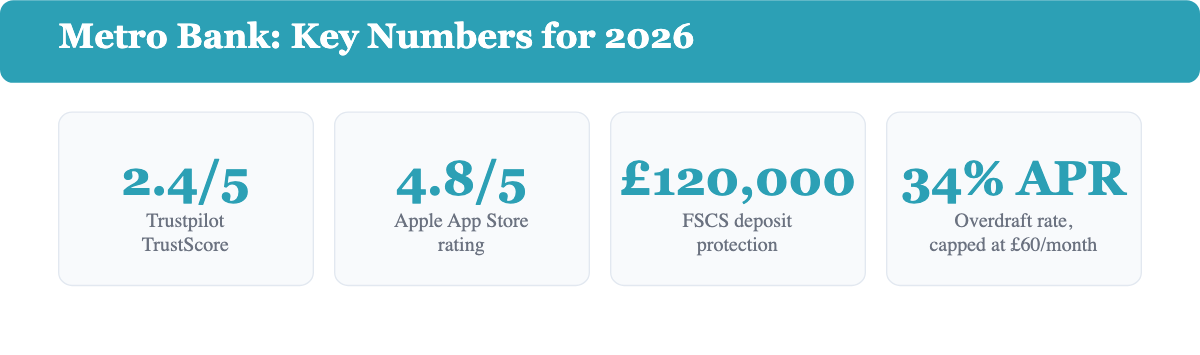
Yes, Metro Bank is definitely safe in the sense that matters most to a UK current-account holder. Eligible deposits are protected up to £120,000 per person by the Financial Services Compensation Scheme, and the bank is authorised and regulated by the Financial Conduct Authority and the Prudential Regulation Authority, exactly like every other UK high-street bank. The question gets asked so often about Metro Bank specifically because the bank has genuinely been through a crisis in recent years, and it's worth understanding what actually happened.
In January 2019, Metro Bank disclosed that it had misclassified a portfolio of commercial loans for regulatory capital purposes, affecting roughly 10% of its loan book. The disclosure triggered a share-price collapse, a capital shortfall, and a £350 million emergency share issue. It also drew sustained scrutiny from the FCA and PRA, and in December 2021 the PRA fined the bank £5.38 million for failing to maintain adequate systems and governance around the affair.
The bank's troubles came to a head again in October 2023. A sharp share-price drop forced an emergency £925 million rescue package, made up of a £325 million capital raise plus £600 million of debt refinancing. Colombian banker Jaime Gilinski Bacal, already a long-standing investor through his firm Spaldy Investments, increased his stake from around 9% to roughly 53% and became Metro Bank's controlling shareholder. Daniel Frumkin has been chief executive since February 2020, and he's led the bank through both the rescue and the recovery that followed.
That recovery looks real on the numbers. Metro Bank reported a record first-half pre-tax profit of £60.7 million in 2026, up 41% year-on-year, and it's opening new stores in Newcastle, Leeds and Nottingham rather than closing them, which runs against the wider industry trend. At the same time, the bank has started a third round of job cuts in as many years, with around 100 roles under review as part of an ongoing cost-reduction drive. That's a fair reminder that the turnaround isn't fully finished, even as profits recover.
Metro Bank Current Account Fees and Features at a Glance
Metro Bank's personal current account carries no monthly fee, no charge for UK debit card payments, and no minimum balance requirement. You can open one online in under 10 minutes if you're 18 or over and a UK resident, or in person at a store on the same day.
| Metro Bank Current Account | Detail (2026) |
|---|---|
| Monthly account fee | £0 |
| Debit card | Mastercard, contactless, Apple Pay and Google Pay |
| UK cash withdrawals and payments | Free |
| Non-sterling card purchases | 2.99% transaction fee |
| Non-sterling cash withdrawals | 2.99% transaction fee plus £1.50 flat charge |
| Overdraft rate | 34% APR (variable), arranged and unarranged |
| Overdraft fee cap | £60 per month |
| Deposit protection (FSCS) | £120,000 per person |
| Online account opening | Under 10 minutes |
Two things really stand out here. There's no separate "packaged account" upsell to wade through; it's simply one free account. And the foreign-currency fees are a real change from Metro Bank's old reputation: the bank used to let customers spend and withdraw cash free of charge across most of Europe, but it scrapped that perk from 29 August 2024, and the 2.99% fee now applies everywhere outside the UK, Europe included.
Metro Bank Overdrafts and Fees
A Metro Bank overdraft costs 34% APR (variable), and that rate applies whether you've arranged the overdraft in advance or gone over your limit without asking. Unlike banks that charge a much higher penalty rate for unarranged borrowing, Metro Bank uses one blended rate for both.
It does cap what you'll actually pay, though. The bank will never charge more than £60 in a single month for unarranged overdraft use or for exceeding an arranged limit, and there aren't any additional flat fees stacked on top of the interest.
That combination, a genuinely high headline APR paired with a hard monthly cap and no hidden fees, makes the overdraft fairly predictable even if it isn't cheap. If you expect to dip into a small overdraft occasionally, the £60 cap limits the downside. If you expect to run a large overdraft regularly, 34% APR is expensive next to some dedicated low-cost overdraft providers, so it's worth comparing before you commit to Metro Bank as your main account.
Metro Bank Savings Accounts and Interest Rates
Metro Bank's easy-access option, the Instant Access Savings account, pays 0.90% AER. That's a low rate by current market standards, and it isn't a reason on its own to choose Metro Bank for everyday savings. Its Young Saver account for under-18s pays a notably higher 1.65% AER.
The more competitive part of Metro Bank's savings range is its fixed-rate products. Fixed Rate Cash ISAs pay 3.60% AER at one and two years, rising to 3.65% at three and five years, and fixed-term savings bonds range from around 2.01% AER on a 6-month term up to 3.75% AER on a 3-year term. If you're choosing Metro Bank specifically for savings, the fixed-term and ISA products deserve a look. The instant-access rate doesn't compete well, so it's best treated as a convenience option for money already sitting in a Metro Bank current account.
Metro Bank Branches: Are They Really Open Seven Days a Week?
Not anymore, in most cases. Metro Bank built its entire early brand around stores open seven days a week, 362 days a year, a genuine point of difference from every other UK high-street bank at the time. That's since been scaled back. Sunday opening has ended at the great majority of Metro Bank's roughly 76 to 78 stores, and standard hours are now Monday to Friday, 9:30am to 5pm, with many locations offering extended Saturday hours from 9:30am to 4pm.
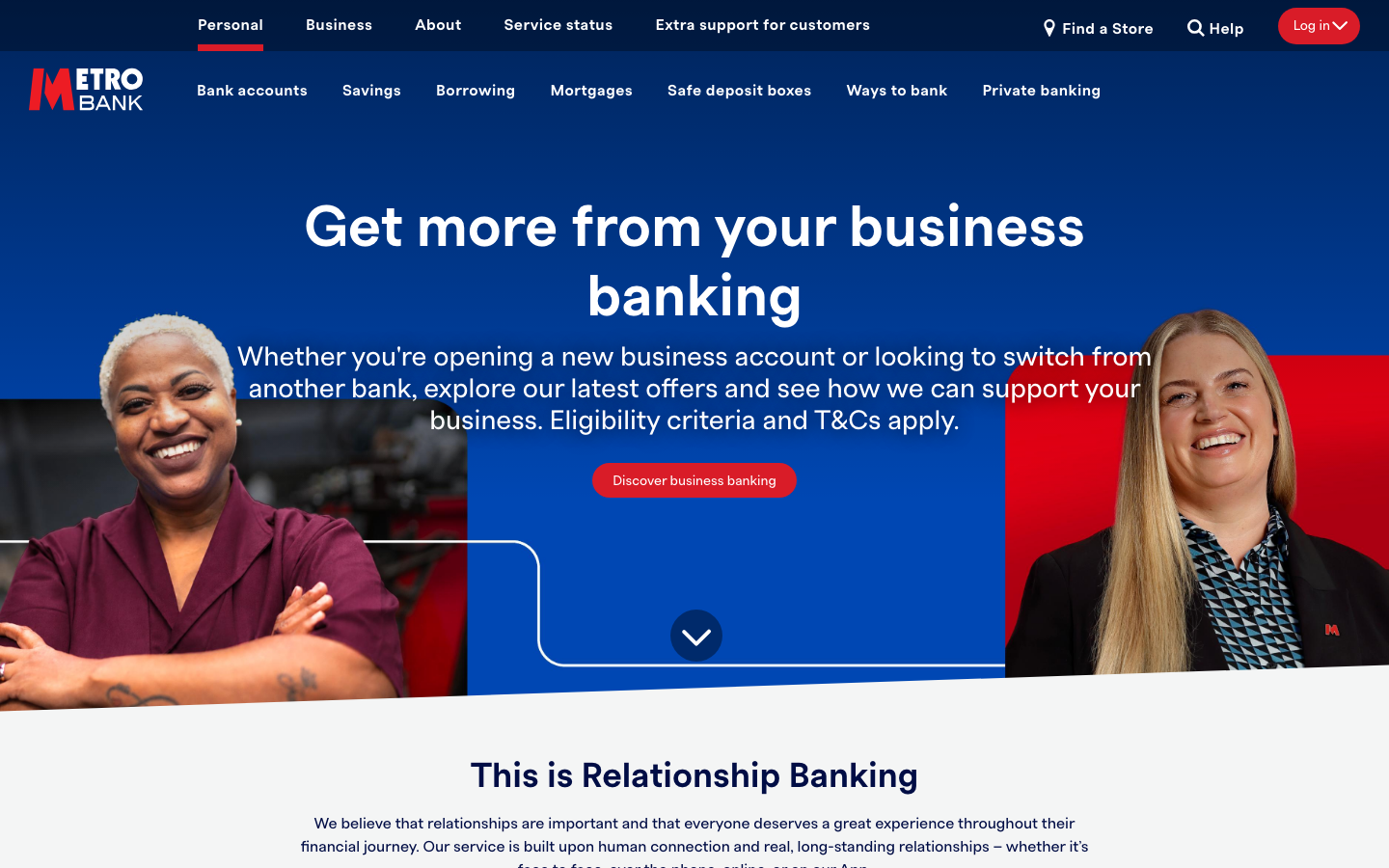
The branch network itself is still growing, though. New stores opened in Chester, Salford and Gateshead in 2025, with further openings confirmed for Newcastle, Leeds and Nottingham as part of a deliberate push into northern England, broadening a network that has historically been concentrated in London and the South East. If seven-day branch access is the specific reason you're considering Metro Bank, check your local store's current hours before opening an account. The blanket claim doesn't hold everywhere anymore.
Metro Bank Customer Reviews: Trustpilot vs the App Store
Metro Bank holds a 2.4 out of 5 TrustScore on Trustpilot from around 5,795 reviews, with a sharply polarised split of 41% five-star and 52% one-star, and very little in between. Its banking app tells a different story entirely. It rates 4.8 out of 5 on the Apple App Store from roughly 234,000 ratings, which is one of the higher scores among UK high-street banking apps.
That gap makes sense once you look at what each platform is really measuring. The Trustpilot complaints cluster around customer service: long phone wait times, accounts frozen or restricted over suspected fraud with little explanation, and difficulty getting help while travelling abroad. The App Store reviews are judging the day-to-day mobile banking experience specifically, and there the app is well regarded for being fast, clear and reliable. In other words, if your Metro Bank account runs smoothly, the app experience is genuinely strong. The Trustpilot score mostly reflects what happens when it doesn't, and those cases skew toward account restrictions and slow resolution rather than everyday usability.
Positive reviews, where they show up, consistently single out in-branch staff, described as patient, knowledgeable and willing to resolve problems face-to-face. That lines up neatly with Metro Bank's branch-first model still being the thing it does best.
Metro Bank vs Other UK High-Street Banks
Metro Bank sits in an unusual middle ground. It's more branch-focused than the digital challengers, but smaller and more turbulent in its recent history than the long-established high-street names.
- Metro Bank vs Monzo or Starling: if you want a purely app-based account and rarely need a branch, Monzo and Starling are simpler, cheaper to use abroad, and don't carry Metro Bank's recent financial history. You do lose the option of walking into a store to sort out a problem in person.
- Metro Bank vs Halifax: Halifax has stopped accepting new customers entirely as its brand gets folded into Lloyds, so it isn't really a live alternative for someone opening a new account today. Metro Bank, by contrast, is actively opening new stores and taking on customers.
- Metro Bank vs a mainstream branch bank (Barclays, NatWest, Lloyds): these offer a larger branch network and a longer, steadier track record, though often with a more bureaucratic account-opening process. Metro Bank's same-day account opening and in-branch culture are a real point of difference if you value speed and personal service.
For the full fee-by-fee breakdown on this same account, see our Metro Bank Current Account review.
Metro Bank Review: Our Verdict
Metro Bank earns a 3.5 out of 5 from BankingGeek. Judged purely as a product, it's a strong, fee-free everyday account: no monthly charge, a well-regarded app, a predictable if not cheap overdraft, and full FSCS protection up to £120,000. The branch-first model is still genuinely useful if you value face-to-face banking, even though the "open every day" promise doesn't hold everywhere anymore.
What holds the score back from higher is the bank's own recent history. A 2019 accounting failure and a 2023 emergency rescue aren't ancient history. They're the reason Metro Bank is majority-owned by a different shareholder than it was a few years ago, and the ongoing rounds of job cuts show the turnaround still isn't fully finished even as profits recover. None of that puts customer deposits at any extra risk; the FSCS protection is unconditional, full stop, and that's clearly the fact that matters most for anyone deciding whether to trust the bank with their money. But it's a fair reason for some readers to prefer a more stable, longer-established alternative. For anyone who values in-person banking and can live with an average-at-best Trustpilot record, Metro Bank remains a solid, currently-improving choice.
Is Metro Bank a safe bank to use?
Yes. Eligible deposits are protected up to £120,000 per person by the Financial Services Compensation Scheme, and Metro Bank is authorised and regulated by the FCA and PRA like any other UK bank. Its 2019 accounting issue and 2023 rescue affected the bank's capital and ownership, not the safety of customer deposits.
Who owns Metro Bank now?
Metro Bank PLC is listed on the London Stock Exchange as a FTSE 250 company. Its controlling shareholder is Colombian banker Jaime Gilinski Bacal, through his investment vehicle Spaldy Investments, which holds roughly 53% of the bank following a £925 million rescue deal completed in October 2023.
What is Metro Bank's Trustpilot rating?
Metro Bank holds a 2.4 out of 5 TrustScore on Trustpilot from around 5,795 reviews, with 41% five-star and 52% one-star ratings. Its banking app rates far higher, at 4.8 out of 5 on the Apple App Store, since most Trustpilot complaints concern customer service rather than the app itself.
How much does a Metro Bank overdraft cost?
Metro Bank charges 34% APR (variable) on both arranged and unarranged overdrafts, but caps the total monthly charge at £60 for unarranged borrowing or exceeding an arranged limit, with no additional fees on top.
Is Metro Bank open seven days a week?
Not anymore at most stores. Metro Bank was historically open seven days a week, but Sunday opening has ended at the majority of its roughly 76 to 78 stores. Standard hours are now Monday to Friday, 9:30am to 5pm, with extended Saturday hours at many locations.
Are there any problems with Metro Bank?
The most common complaints relate to customer service: long phone wait times and accounts being frozen or restricted over suspected fraud with limited explanation. The bank's mobile app itself is well regarded, and deposits remain fully FSCS-protected regardless of these service issues.