
first direct is a phone and app-based current account provider and a division of HSBC UK Bank plc, and it has spent more than three decades building a reputation most UK banks would kill for. It has no branches, no flashy marketing gimmicks, and a website that still looks like it belongs to a bank rather than a fintech startup. What it does have is a switching offer worth checking, an overdraft that is genuinely cheaper than most rivals for the first £250, and a customer service record that keeps beating banks with ten times its marketing budget.
This review breaks down exactly what first direct charges, how it compares with Monzo, Starling, Nationwide and its own parent HSBC, and who should open an account here instead of somewhere else.
Quick take: No monthly account fee at all, a £250 interest-free overdraft buffer, FSCS protection up to £120,000, and a joint 3rd-place finish in the CMA's August 2026 customer service survey. The full breakdown, the honest drawbacks, and our rated verdict follow below.
What Is first direct?
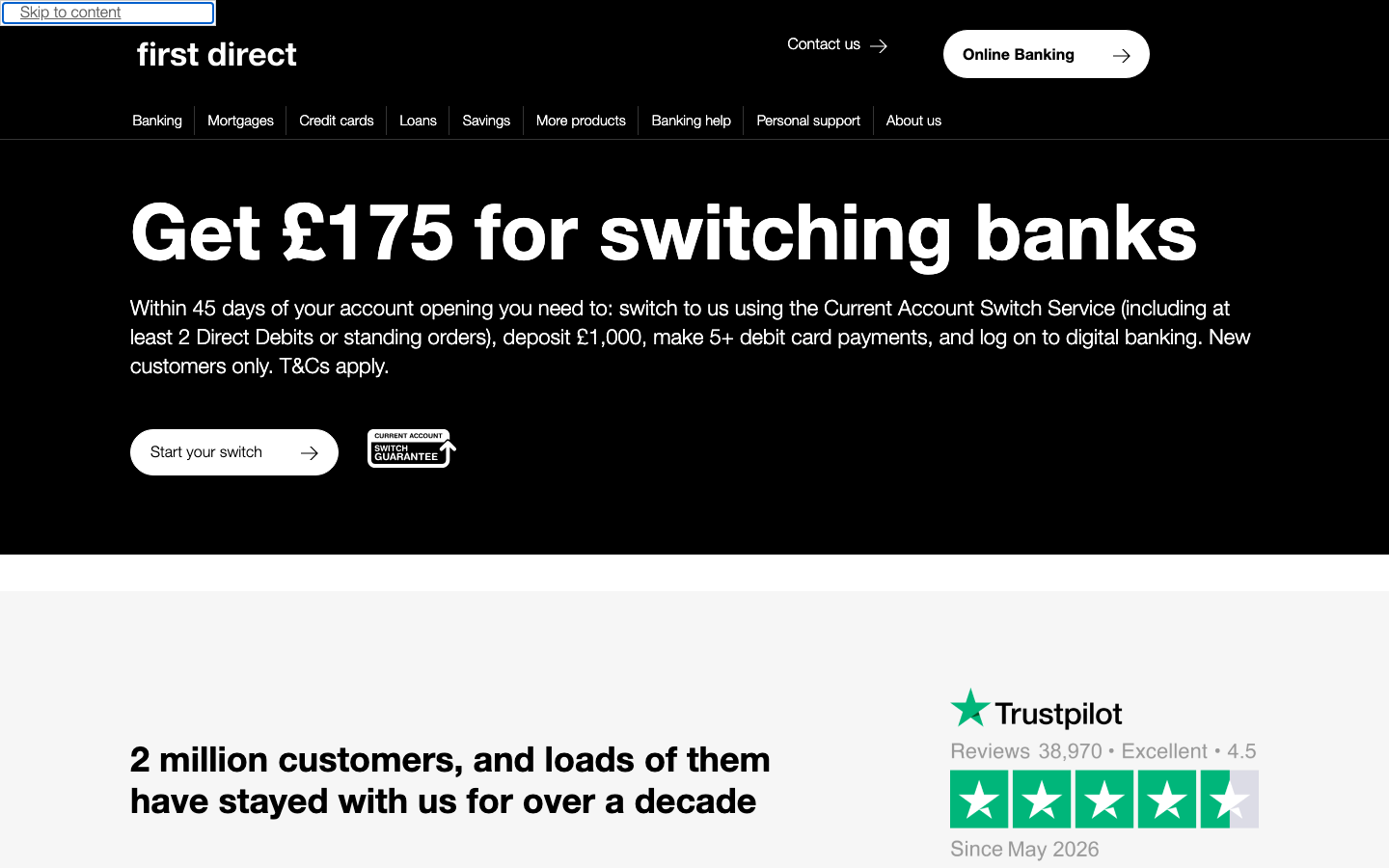
Picking up the phone rather than opening a browser tab is the whole idea behind first direct: a UK current account and savings provider built around 24-hour phone banking and an app, with no branch to visit even if you wanted one. The model dates back to October 1989, when it launched as the UK's first telephone-only bank under Midland Bank, moved under HSBC's ownership when HSBC bought Midland in 1992, and has traded as a division of HSBC UK Bank plc rather than a separately licensed bank since HSBC's 2018 ring-fencing restructure.
That last point's the one most people are actually searching for. first direct isn't its own bank with its own banking licence. It is a brand and a division inside HSBC UK Bank plc, authorised by the Prudential Regulation Authority and regulated by the Financial Conduct Authority and the Prudential Regulation Authority. Every account, card and app is first direct's own product, but the regulatory permission behind it belongs to HSBC UK.
first direct is based in Leeds and now serves around 2 million customers, most of whom hold its everyday current account, the 1st Account, or its linked savings products. Growth has been steady rather than explosive: the bank passed 100,000 customers by May 1991, 500,000 by April 1995, and 1 million by January 1997, before settling into the roughly 2 million it serves today. That slow, word-of-mouth growth curve is itself part of the pitch. A bank that grew mainly through customer referrals over three decades has to keep service quality high to sustain it, and the CMA and Which? scores further down this review suggest that pressure has worked in first direct's favour.
The bank's stayed deliberately narrow in what it offers: one main current account, one linked regular saver, a handful of loans, mortgages and credit cards, and no attempt to compete with HSBC or Barclays on product range. That narrowness is by design. It lets first direct put its money into phone staff and app development instead of branches, and the results show up directly in the customer service numbers further down this review.
first direct at a Glance
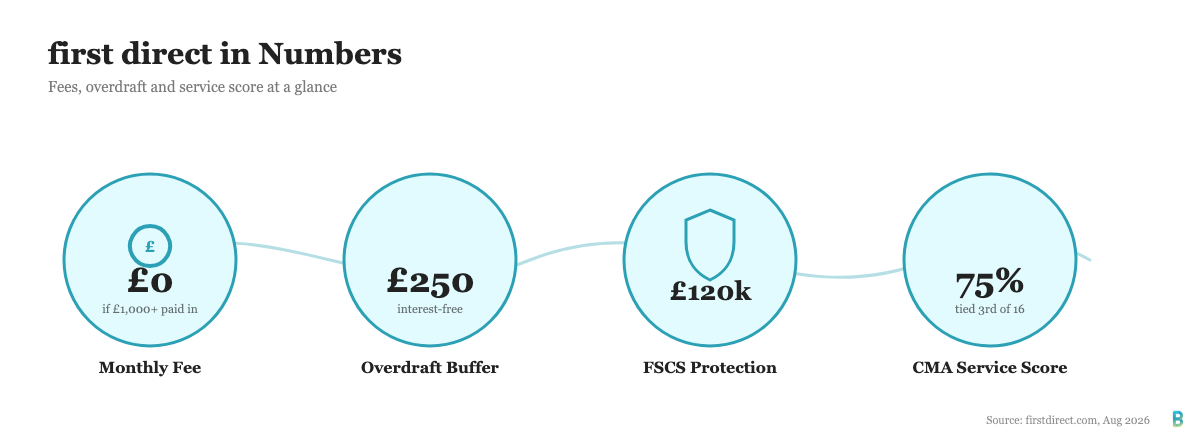
Before the detail, here is what actually matters if you are deciding whether to switch.
| What you want to know | first direct's answer |
|---|---|
| Monthly account fee | £0, no conditions attached |
| Arranged overdraft | First £250 interest-free (subject to status), then 39.9% EAR variable |
| Switching offer | £175 for switching via the Current Account Switch Service, subject to conditions (see below) |
| Linked savings | Regular Saver paying 7% AER on £25 to £300 a month for 12 months |
| Safety | FSCS protected up to £120,000, shared with HSBC UK deposits |
| Customer service score | 75% in the CMA's August 2026 service quality survey, tied 3rd of 17 providers |
| Branches | None. Phone and app only |
| Card use abroad | No fees on spending or cash withdrawals, Mastercard exchange rate passed through |
The first direct 1st Account and Regular Saver
The 1st Account is first direct's only everyday current account, and it's the account almost everyone who joins first direct actually opens. It's built like most modern current accounts: a debit card for spending, a linked app and online banking for day-to-day management, and 24-hour telephone banking staffed by actual people rather than a chatbot.
The account's real selling point isn't a headline interest rate. It is what comes bundled with it. Every 1st Account holder can open a Regular Saver paying 7% AER on deposits between £25 and £300 a month for 12 months, one of the better regular saver rates among high street and digital banks. Combined with the £175 switching offer covered in the next section, a new customer who commits to the full 12 months of saving comes out of year one meaningfully ahead of where a fee-free challenger account alone would leave them. For a closer look at the savings side specifically, our first direct Savings Account review covers the Regular Saver and first direct's other savings products in full.
Eligibility and how to apply
Opening a 1st Account takes a credit check, the same as any other UK current account provider, and first direct's screening has a reputation among switchers for being a little firmer than the fully digital challengers. That doesn't mean it's unusually strict. It means the bank checks your credit history and financial conduct in the way any high street bank does, rather than relying purely on open banking data the way some app-only providers can. If your credit file is thin or has recent problems, it's worth checking your report before applying rather than assuming approval.
Applying itself is done entirely online or by phone, usually taking a matter of minutes for the initial application, with the account and card typically arriving within a few working days. Our dedicated first direct 1st Account review walks through the application steps and card features in more depth if you want the full picture before you start.
- You'll need to be a UK resident aged 18 or over.
- first direct will run a credit check as part of the application, the same as any other UK current account provider.
- You can apply and manage the account entirely through the app or online banking once it is open, with 24-hour phone banking available for anything the app can't handle.
- Existing HSBC UK current account customers who opened their account on or after 1 January 2018 are excluded from the switching cash offer, though they can still open a 1st Account without the cash incentive.
Perks and Card Benefits
Every 1st Account comes with two benefits that rarely get mentioned alongside the headline fee and overdraft numbers. The debit card is fee-free for spending and cash withdrawals abroad, passing on the Mastercard exchange rate with no added markup, a change first direct made in 2023 and has kept in place since. Account holders can also register for first direct's Perks platform, a free discount scheme open to anyone with a current account, savings account, credit card, loan or mortgage, offering money-off and 2-for-1 deals from a rotating list of retail and leisure brands through the app or a dedicated web login.
The App and Online Banking
first direct's app covers the basics well: balance checks, card freezing, payment transfers, Direct Debit management and secure messaging with the bank all work as expected. It doesn't try to match Monzo or Starling on features like spending categorisation, instant merchant-level notifications or round-up savings pots, and forum discussion consistently describes it as functional rather than exciting. For a customer who mainly wants reliable access to their money and a fast route to a human when something needs sorting, that trade-off tends to matter less than it would to someone who picked their bank specifically for budgeting tools.
How Much Does first direct Cost?
first direct's 1st Account has no monthly account fee, and there's no minimum monthly pay-in required to keep it that way. first direct scrapped its old £10-a-month charge (which used to apply if you paid in less than £1,000 a month) back in September 2019, and the account has stayed free to hold ever since. Some older comparison sites still describe the £10/£1,000 rule as if it were current; it isn't, so ignore any source that quotes it as an active fee.
Overdraft charges are a lot more transparent. The first £250 of an arranged overdraft is interest-free, subject to status, and anything borrowed beyond that £250 is charged at 39.9% EAR variable. first direct's own representative example puts the cost at 30.5% APR variable, assuming a £1,200 arranged overdraft. Unarranged overdrafts are cheaper than they used to be: first direct stopped charging interest on unarranged borrowing from 19 May 2026, in line with a wider industry move away from unarranged overdraft charges.
To put the arranged overdraft rate into a concrete number, borrowing £500 through the arranged overdraft for 30 days costs interest only on the £250 above the buffer. At 39.9% EAR, that works out to roughly £8 for the month, which is a fair amount cheaper than a card cash advance or an unarranged overdraft at most other UK banks over the same period.
| Cost item | Amount |
|---|---|
| Monthly fee | £0, no minimum pay-in required |
| Arranged overdraft, first £250 | Interest-free, subject to status |
| Arranged overdraft, above £250 | 39.9% EAR variable (30.5% APR representative on £1,200) |
| Unarranged overdraft interest | None, since 19 May 2026 |
The £175 switching offer, explained
first direct currently offers £175 to customers who switch an existing current account across using the Current Account Switch Service. To qualify, within 45 days of opening the account you need to complete the full switch including at least two Direct Debits or standing orders, pay in at least £1,000, make five or more debit card payments, and log on to first direct's digital banking. Gambling transactions, cash withdrawals, and card-to-card payments don't count towards the five debit card payments.
The offer isn't open to everyone. You won't qualify if you've previously held a first direct product, or if you opened an HSBC UK current account on or after 1 January 2018. If you meet the criteria, first direct pays the £175 into your account before the 20th of the following month. Cash switching offers like this change without much notice across the entire banking sector, so treat the amount above as accurate at the time of writing and double check the live figure on first direct's own switching page before you apply.
Is first direct Safe? FSCS Protection Explained
Yes, first direct's as safe as any UK-regulated current account gets. It operates under HSBC UK Bank plc's authorisation from the Prudential Regulation Authority and is regulated by the Financial Conduct Authority and the Prudential Regulation Authority, and eligible deposits are protected by the Financial Services Compensation Scheme up to £120,000 per eligible person, per banking licence, since the FSCS limit rose from £85,000 on 1 December 2025.
Joint accounts get double the cover, up to £240,000, since the FSCS limit applies per eligible person rather than per account. The catch is the shared licence: first direct's £120,000 (or £240,000 joint) allowance is not exclusive to first direct. It's pooled with everything you hold at HSBC UK, HSBC Private Bank, M&S Bank and M&S Savings and Investments, since all five brands sit on the one HSBC UK Bank plc authorisation. Pay in £80,000 at first direct and £60,000 at HSBC UK directly, for example, and £20,000 of that combined £140,000 sits outside FSCS cover. Anyone switching in from a completely different banking group, Barclays, Nationwide, a challenger bank, never has to think about this. It only bites if you already hold money across more than one of those five HSBC-family brands.
Beyond deposit protection, first direct also publishes its ranking in the Payment Systems Regulator's authorised push payment scam reimbursement league table, which tracks how often banks reimburse customers who are tricked into sending money to a fraudster. Very few independent reviews of first direct mention this table at all, but it's a genuinely useful safety signal alongside FSCS cover, since it measures how a bank behaves after something goes wrong rather than just whether your balance is protected if the bank itself fails.
Customer Service and the CMA Satisfaction Survey
first direct's customer service is the reason most people search for a review of it in the first place, and the reputation holds up against independent, dated evidence rather than just marketing copy. In the Competition and Markets Authority's August 2026 service quality survey, covering the year to June 2026, first direct scored 75% for overall personal current account service quality, tying for third place with Nationwide. Monzo led the table at 79% and Starling followed at 76%, so first direct sits close behind the two app-only challengers rather than trailing the market.
Which? rates first direct even more highly on the specific question of service. Its most recent customer survey gives first direct a score of 84%, ranking it joint fourth out of 22 current account providers, with a full five stars for both customer service and telephone banking specifically. Which? describes first direct as its longest-serving Recommended Provider, a status it's held for years rather than picking up once and losing.
The practical reason behind both scores is simple: first direct staffs genuine 24-hour telephone banking with people rather than routing everything through an app or chatbot, which matters most to customers who want to talk through a problem rather than search a help centre for it. That said, if first direct's own service status happens to be degraded at the exact moment you need it, its live service updates page is the place to check rather than relying on social media chatter.
The CMA survey also breaks scores down by category, and it's a more mixed picture than the headline number suggests. first direct actually leads on online and mobile banking among the providers with branches, scoring 78% against Halifax's 77% and Nationwide's 76% (Monzo and Starling still lead outright at 85% and 83%), which cuts against the idea that its app is a weak point. Overdraft services score lower at 70%, behind Monzo, Nationwide, Starling and Lloyds, which lines up with Monzo and Starling's slightly better CMA service scores overall despite first direct's larger interest-free buffer. first direct isn't scored on in-branch services at all, since it doesn't run one.
Martin Lewis's MoneySavingExpert doesn't single first direct out as its single top pick, but it does list the 1st Account among its "top bank accounts with low-cost arranged overdrafts" specifically because of the £250 0% overdraft, alongside the switching offer and Regular Saver rate. That is a narrower, more useful endorsement than a blanket "best account" badge: it tells you exactly which kind of customer MoneySavingExpert thinks the account suits.
first direct vs Monzo, Starling, Nationwide FlexDirect and HSBC Premier
first direct's in an unusual middle position: more human than the app-only challengers, more digital-first than a full high street bank, and priced somewhere between "completely free" and "fee-gated by income." The table below lines up the accounts people most often compare it against.
| Provider | Banking model | Monthly fee | Interest-free overdraft buffer | CMA service quality score (Aug 2026) |
|---|---|---|---|---|
| first direct 1st Account | Phone-first, app-supported, no branches | £0, no conditions | £250, then 39.9% EAR | 75% (tied 3rd) |
| Monzo | App-only, no branches | £0 on the standard account | None disclosed; 19%, 29% or 39% EAR depending on credit score | 79% (1st) |
| Starling Bank | App-only, no branches | £0 | None disclosed; 15%, 25% or 35% EAR variable | 76% (2nd) |
| Nationwide FlexDirect | Branch network plus app and online banking | £0 | £50, then 39.9% EAR variable | 75% (tied 3rd with first direct) |
| HSBC Premier | Branch network plus app and online banking, income or savings-gated | £0 (eligibility-based, not fee-based) | £500, then 39.9% EAR (21.8% APR representative) | Not scored separately from HSBC's main brand in CMA data |
Monzo and Starling both beat first direct narrowly on the CMA's service score and both are unconditionally fee-free, but neither offers phone banking in the way first direct does, and their overdraft pricing has no disclosed interest-free buffer, so light overdraft users can end up paying from the first pound borrowed. Nationwide FlexDirect matches first direct's CMA score exactly but has a much smaller £50 interest-free overdraft buffer; our full Nationwide FlexDirect review covers its regular saver rate and cashback terms in detail. HSBC Premier has the largest interest-free buffer of the group at £500, but you only qualify with a £100,000 annual income or £100,000 in savings and investments with HSBC, which rules it out for the vast majority of people comparing first direct against everyday accounts.
Worth knowing: first direct and Nationwide FlexDirect tie exactly on the CMA's 2026 service score, so the deciding factor between them usually comes down to overdraft buffer size and whether you want a branch network at all, not customer service.
Who Is first direct Best For (and Who Should Look Elsewhere)?
first direct's a fit for people who want a proper current account with a real person on the phone when something goes wrong, and who are comfortable banking without a branch to walk into. It particularly suits anyone who already knows they'll use an overdraft occasionally, since the £250 interest-free buffer is one of the more generous ones among accounts without an income requirement, and anyone who wants a genuinely competitive regular saver rate attached to their day-to-day account.
It isn't the right choice for people who need to pay in cash regularly at a branch counter, since first direct has none and relies on the Post Office network instead. It also isn't the best fit for anyone with a thin or damaged credit file who wants the highest chance of approval, since a more relaxed, open-banking-driven application process at a challenger bank may suit better. And if a fully modern budgeting app with spending categories, round-ups and instant notifications is the main priority, Monzo or Starling's app experience is more polished than first direct's, which reviewers and forum users consistently describe as solid and reliable rather than cutting edge.
first direct Pros and Cons
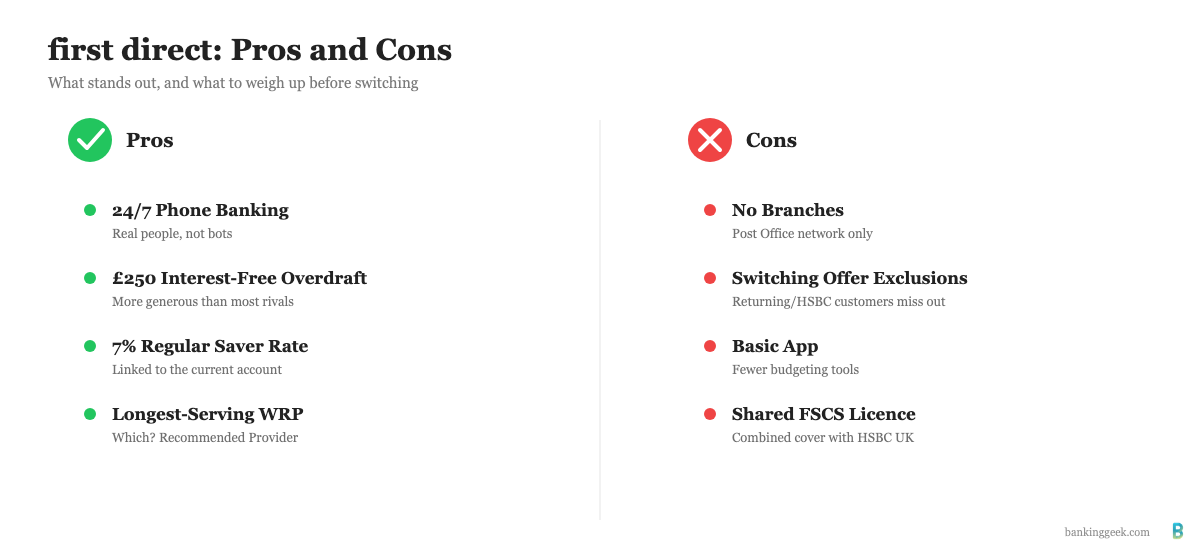
- Pro: Genuine 24-hour telephone banking staffed by people, not bots, and it is the main reason customer satisfaction scores stay high year after year.
- Pro: £250 interest-free arranged overdraft buffer, more generous than Monzo or Starling's undisclosed buffers and five times Nationwide FlexDirect's £50.
- Pro: 7% AER Regular Saver linked to the current account, plus a switching offer worth checking at application.
- Pro: Held Which?'s Recommended Provider status longer than any other current account brand, with five stars for customer service and telephone banking specifically.
- Pro: Fee-free debit card spending and cash withdrawals abroad, plus a free Perks discount platform most competitor reviews don't mention.
- Con: No branches at all, so anyone who wants face-to-face banking or regular cash paying-in needs the Post Office network instead.
- Con: The £175 switching offer excludes anyone who's held a first direct product before or opened an HSBC current account since 2018, so returning customers get no signup incentive at all.
- Con: The app is reliable but noticeably more basic than Monzo or Starling's, without the same budgeting tools or spending insights.
- Con: FSCS protection is pooled across the whole HSBC group of brands rather than separate to first direct, which matters only if you already hold money with HSBC UK, HSBC Private Bank or M&S Bank.
Our Verdict on first direct
first direct earns its reputation, and frankly, the customer service numbers aren't marketing spin: a tied third place in the CMA's own August 2026 survey and the longest unbroken run as Which?'s Recommended Provider back up what Trustpilot reviews and forum threads say in less formal language. The overdraft terms are genuinely competitive for anyone who dips into one occasionally, and the switching offer plus Regular Saver rate make the first year worthwhile for most switchers who can meet the qualifying conditions.
It loses ground only where its narrow, phone-first model naturally costs it something, and that's worth weighing up before you switch: no branches, a switching offer that excludes returning and recent HSBC customers, and an app that does the job without matching the polish of dedicated app-only challengers. For anyone who values talking to a real person over chasing the newest app feature, first direct is one of the strongest current accounts on the UK market right now. If you're still weighing up the full field, our guide to the best current accounts in the UK lines up first direct against every major provider side by side.
Rating: 4.4 out of 5. Excellent for service and overdraft value, held back only by the lack of branches and a plainer app.
first direct Review: Frequently Asked Questions
Is first direct part of HSBC?
Yes, first direct is a division of HSBC UK Bank plc rather than a separately licensed bank. It operates under HSBC UK Bank plc's authorisation from the Prudential Regulation Authority and is regulated by the Financial Conduct Authority and the Prudential Regulation Authority, though it runs its own current account, savings, and card products under the first direct brand.
Is first direct having problems right now?
Service status changes day to day like any bank's systems can, so this isn't something anyone can promise will never happen. first direct publishes live service status updates on its own website, and that page is a more reliable source than social media if you want to know whether online or mobile banking is affected right now.
Is Monzo or first direct better?
It depends on what you value most. Monzo edges first direct on the CMA's service quality score and has a fully app-based experience with strong budgeting tools, while first direct offers 24-hour human telephone banking and a larger interest-free overdraft buffer. Neither one is objectively better; they suit different banking habits.
Does first direct have branches?
No, first direct hasn't ever operated its own branch network. Cash and cheque paying-in is handled through the Post Office network instead, and all day-to-day banking is done by phone or through the app and online banking.
How much does it cost to switch to first direct?
Switching itself doesn't cost anything: the Current Account Switch Service moves your Direct Debits, standing orders and incoming payments automatically within 7 working days, at no charge, whichever bank you're leaving. The part that costs first direct money, not you, is the £175 it currently pays out to switchers who meet its qualifying conditions, covered in full above.
Is my money safe with first direct?
Yes, eligible deposits with first direct are protected by the Financial Services Compensation Scheme up to £120,000 per eligible person (£240,000 joint), pooled across the wider HSBC group of brands. That protection is automatic: you don't need to apply or register for it, and if a bank ever failed, the FSCS aims to pay eligible claims within 7 working days without you having to do anything beyond holding the account.