


Best Business Account for Limited Company UK 2026

All contents of this article:
Best Business Accounts for Limited Companies compared (October 2026)
We compared 6 Business Accounts for Limited Companies and these 6 accounts made it into our overview:
Swipe sideways to compare
| #1Top pick | #2 | #3 | #4 | #5 | #6 | |
| Provider |  |  |  |  |  |  |
| Account | Starling Bank Starling Business Account | Allica Bank Business Rewards Account | WorldFirst World Account | Mettle Business Account | Wise Business Account | Monzo Business Account |
| Offer | Open account | Open account | Open account | Open account | Open account | Open account |
| Review | Read review | Read review | Read review | Read review | Read review | Read review |
| Rating | 5.0 /5 ★★★★★ | 4.2 /5 ★★★★☆ | 4.2 /5 ★★★★☆ | 4.0 /5 ★★★★☆ | 4.0 /5 ★★★★☆ | 4.0 /5 ★★★★☆ |

- No monthly account fee on the core business account; Fully licensed UK bank with FSCS protection; Strong app with invoicing and bookkeeping toolkit add-on; Integrations with accounting software
- No arranged overdraft for many customers; Optional add-ons cost extra; App-led with no branches
- 1% cashback on all card spending with no cap
- rising to 1.5% above £10k monthly spend; no monthly fee for accounts maintaining £10
- 000 average balance; free cash withdrawals in the UK and abroad; dedicated named relationship manager from account opening; multiple Business Rewards Accounts can be opened to manage money across pots
- £25 monthly fee applies if average balance falls below £10
- 000 in the prior month; designed for established SMEs
- not suitable for sole traders or start-ups with low balances; no physical branch network for face-to-face support; minimum deposit of £50
- 000 required to unlock the full Welcome Boost savings promotion
- No monthly fee and no fee to receive payments in 20+ currencies; competitive FX rates capped at 0.5% for major currencies and 0.75% for others; up to 20 virtual World Cards with zero FX fees in 15 supported currencies; connects directly to 130+ global marketplaces including Amazon and eBay; same-day or next-day international payments to 200+ countries in 100+ currencies
- Funds are safeguarded but not covered by FSCS (FCA-authorised e-money institution only); Apple Pay and Google Pay not yet available for the World Card as of mid-2026; no cash or cheque deposits accepted
- funding by bank transfer only; not a full business current account so unsuitable as a sole UK banking solution
- Completely free
- no monthly fee app-only account; Backed by NatWest; Built-in invoicing and bookkeeping tools; Free accounting software integration
- Eligibility limited with some exclusions; No overdraft or lending; App-only with no branches
- Mid-market FX and low-cost international payments in 40+ currencies; Local account details in multiple currencies; Cashback on eligible card spending; Integrations with accounting software
- One-off setup fee for the business account; Not a bank
- deposits safeguarded not FSCS protected; No overdraft or lending
Running your business finances through a personal current account is not just bad practice when you operate as a limited company; it is actively dangerous. A limited company is a separate legal entity under UK law. Mix the company's money with your own and you create VAT record-keeping problems, muddle your annual accounts, and risk eroding the liability protection that makes the limited company structure worth having in the first place.
UK business banking options have improved considerably. Starling, Monzo, and Mettle offer full-featured accounts with no monthly fee. Allica pays a competitive interest rate on balances that would otherwise sit idle. WorldFirst and Wise cover multi-currency without a monthly charge. What the provider can actually do is set out in our review of WorldFirst World Account.
Below you will find six options rated specifically for limited companies. Each section covers fees, FSCS status, accounting integrations, and eligibility, the details that matter when you are running a company, not just a side project. Which accounts else are worth a look is covered here: Tide vs Starling.
Starling Bank Business Account
Starling earns the top spot for most UK limited companies. No monthly fee, no charge per UK Faster Payment, no ATM fee at UK cash machines, and FSCS protection up to £120,000 from a full banking licence. The FSCS limit rose from £85,000 to £120,000 on 1 December 2025. Very few accounts hit all four of those marks at zero cost. If you want to read on, there is more here: Aldermore Business Savings.
Make 10 transfers a month or 200 and the cost is identical: zero. Tide caps free transfers at five per month on its standard plan before a 20p per-transfer charge kicks in. Most traditional banks charge per transaction even on paid plans. Starling does not restrict volume at any tier. It does not have to be this provider: we lined up the best Tide alternatives.
What you get
- No monthly account fee and no charge per UK Faster Payment
- FSCS protection to £120,000 (full UK banking licence)
- Free ATM withdrawals in the UK
- Spaces feature for ring-fencing VAT, PAYE, and Corporation Tax
- Xero, QuickBooks, and FreeAgent integrations at no extra cost
- Apple Pay, Google Pay, iOS and Android apps
- Overdraft on application (for companies trading 24 months or more)
Starling for limited companies
Starling accepts sole-director limited companies, multi-director limited companies, and LLPs. The application is completed online and typically takes a few hours, sometimes less. You will need your Companies House registration number, proof of identity for each director, and your business address. The specifics are collected here: Starling Savings Spaces.
Cash deposits are handled via the Post Office, and the Post Office charges a handling fee (not Starling), but that is standard across digital-first banks. If your business regularly handles cash, you should factor in that cost.
Best for: Limited companies of any size looking for a zero-cost, FSCS-protected account with strong accounting integrations and no restrictions on transfer volume.
Watch out for: No built-in invoicing. Cash deposits via Post Office carry third-party handling fees. Overdrafts require 24 months of trading history.
Allica Bank Business Rewards Account

Most limited companies collect VAT from clients and hold it for up to a quarter before paying HMRC. Add PAYE reserves and a Corporation Tax provision, and it is routine for a small Ltd company to carry £20,000 to £50,000 in tax funds that could be earning interest. Allica is the account built for exactly that pattern.
The integrated savings pot pays up to 4.33% AER (variable). On £30,000 in reserves, that comes to roughly £1,300 per year in interest. That money would otherwise earn nothing in a standard business current account.
What you get
- No monthly fee (£25/month if average balance falls below £10,000)
- Up to 4.33% AER on integrated savings pot
- FSCS protection to £120,000
- Dedicated UK relationship manager
- Apple Pay and iOS app
- CASS (Current Account Switching Service) available
Allica for limited companies
Allica is designed for established SMEs, not early-stage startups. If your average monthly balance is likely to stay above £10,000, the account is effectively free and the interest rate makes it the most rewarding current account on this list. The full assessment is in our Allica Bank Business Savings review.
The account requires switching via CASS and maintaining at least 15 monthly transfers to access the headline interest rate. For an active limited company, those conditions are straightforward to meet.
Best for: Established limited companies with cash reserves of £10,000 or more that want to earn a competitive interest rate on tax reserves and working capital.
Watch out for: £25/month charge if the average balance drops below £10,000. Best suited to established businesses rather than early-stage companies. Android app not yet available.
WorldFirst World Account
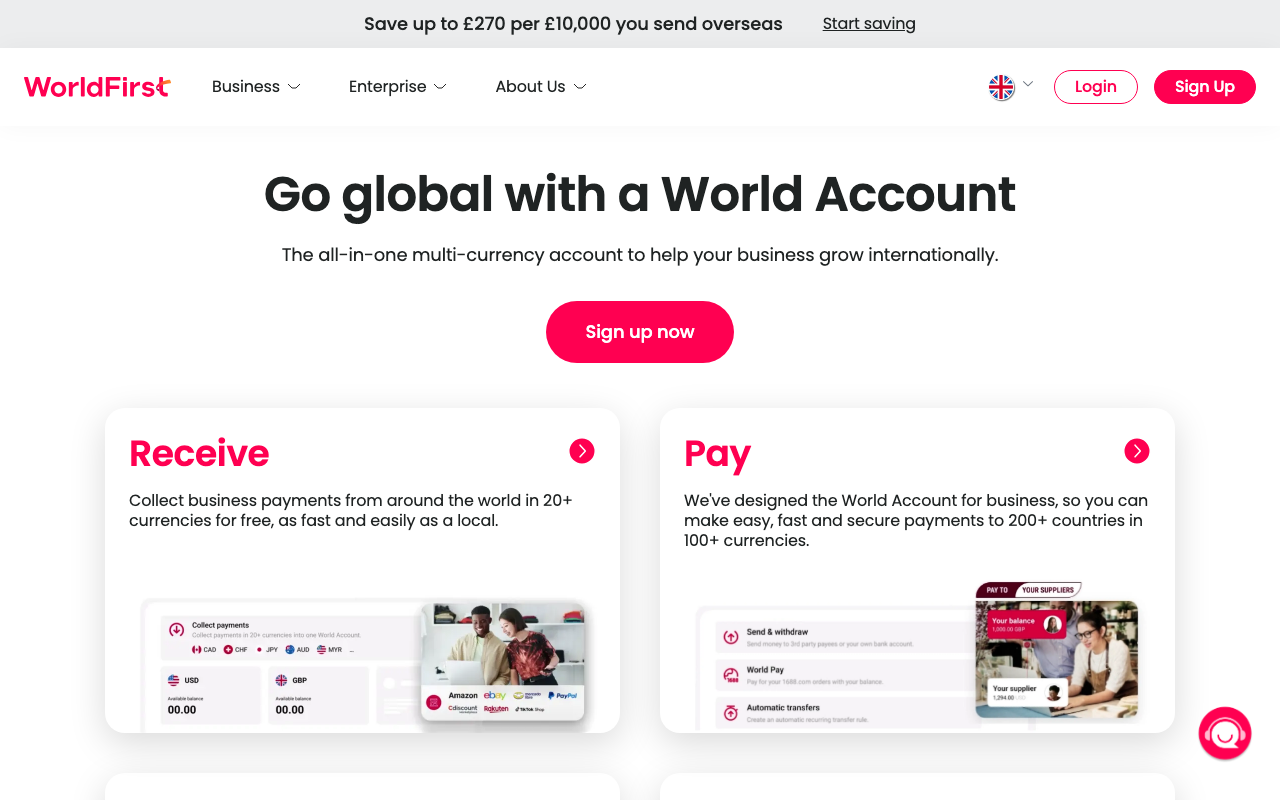
WorldFirst is a strong option for limited companies that trade internationally, exporting to European or US clients, importing goods from overseas suppliers, or paying contractors in foreign currencies. The World Account lets you hold and receive payments in over 70 currencies from a single account.
There is no monthly fee. Currency exchange uses competitive rates close to the mid-market rate, which compares favourably to the margins most high street banks apply to international transfers.
What you get
- No monthly fee
- Local currency accounts in 70+ currencies
- Competitive FX rates for international transfers
- Designed for importers, exporters, and e-commerce businesses
- Receive overseas payments directly to local currency accounts
WorldFirst for limited companies
WorldFirst is not a full UK bank. It operates as a payment institution, which means deposits are not covered by FSCS. Funds are safeguarded in accordance with FCA regulations, but this is not the same as the government-backed compensation scheme. If your company holds large sterling balances domestically, you may want to pair WorldFirst with an FSCS-protected account for those reserves.
For the international payments use case, WorldFirst competes directly with Wise and consistently offers competitive pricing on high-volume currency transactions. An overview of the Wise alternatives is in a separate article.
Best for: Limited companies with significant overseas revenue or costs that need multi-currency accounts without a monthly fee.
Watch out for: Not FSCS-protected. Less suitable as a primary domestic UK account for companies with minimal international activity.
Mettle Business Account
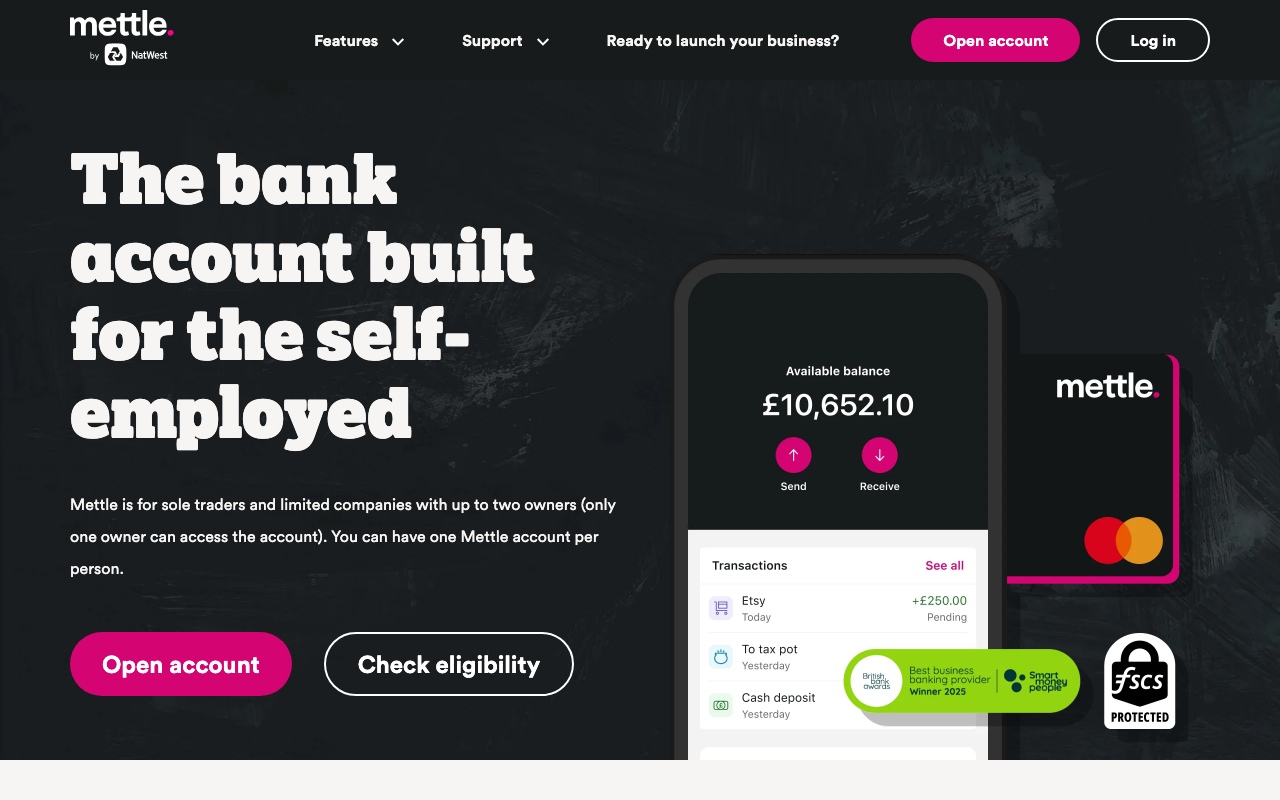
Mettle is NatWest's digital banking offshoot. The headline feature is a free FreeAgent subscription bundled into the account. FreeAgent normally costs £228 per year for a limited company plan. Switching to Mettle turns that fixed cost to zero. We go through every condition in our review of Mettle Business Account.
For a freelancer or small limited company that already uses FreeAgent for VAT returns, payroll, and self-assessment, Mettle effectively pays for itself before any banking features are considered.
What you get
- No monthly fee (optional Mettle+ at £4/month for auto-invoicing)
- FreeAgent accountancy subscription included free
- Xero and QuickBooks integrations also available
- NatWest-group backing
- Apple Pay, Google Pay, iOS and Android apps
Mettle for limited companies
There is an important eligibility restriction: Mettle is open to sole traders and single-director limited companies only. If your limited company has two or more directors, Mettle is not available to you.
Mettle operates as an e-money institution rather than a bank. That means deposits are safeguarded separately from NatWest's own assets in line with FCA requirements, but they are not covered by the FSCS compensation scheme.
There is also no cash deposit facility. If your company takes any cash payments, Mettle is not suitable as your primary account.
Best for: Single-director limited companies that use FreeAgent. The free accountancy subscription delivers more value than any other perk on this list for the right user profile.
Watch out for: Single-director limited companies only. Not FSCS-protected (e-money safeguarded). No cash deposits. Not suitable for high-cash-volume businesses.
Wise Business Account
Wise is built around multi-currency and international payments. The Business account has no monthly fee and lets you hold balances in over 40 currencies. The debit card earns 0.5% cashback on spending, which is unusual for a business account with no monthly charge.
For limited companies with international contractors, overseas suppliers, or clients paying in foreign currencies, Wise offers mid-market FX rates with transparent per-transfer fees, consistently cheaper than high street banks and competitive with WorldFirst on most corridors.
What you get
- No monthly fee (one-off £50 for Advanced features)
- 0.5% cashback on card spending
- Hold and send payments in 40+ currencies at mid-market rates
- Xero, QuickBooks, and FreeAgent integrations
- Apple Pay, Google Pay, iOS and Android apps
- Batch payment uploads for paying multiple suppliers at once
Wise for limited companies
Wise operates as an e-money institution (Wise Payments Ltd) rather than a bank. Deposits are safeguarded under FCA rules, but they are not covered by FSCS. For limited companies holding large tax reserves in sterling, this is worth considering. Pairing Wise with an FSCS-protected account for domestic sterling balances is a common setup for internationally active companies.
Wise accepts limited companies across all director configurations. The online application is straightforward and fast. There is no credit check for the standard account.
Best for: Limited companies with regular international payments or overseas contractors who want competitive FX rates and no monthly fee.
Watch out for: Not FSCS-protected (e-money safeguarded). The Advanced features one-off fee of £50 covers bulk payment uploads and additional user access. Less suitable for cash-heavy businesses.
Monzo Business Account
Monzo's Business Lite account is free, FSCS-protected, and takes most applicants from application to a working account within hours. It does not restrict transfer volumes. For a newly formed limited company that wants a quick, reliable, fully protected account with no monthly cost, Monzo competes directly with Starling.
The paid Business Pro plan at £9 per month adds expense tracking, accounting integrations, and virtual cards. For a one or two-person limited company that handles its own bookkeeping, the free Lite plan often covers everything needed.
What you get
- Lite plan: free; Pro: £9/month; Team: £25/month
- FSCS protection to £120,000 (full UK banking licence)
- Free UK Faster Payments with no volume cap
- 24/7 in-app support
- Pots for separating VAT and tax funds
- Apple Pay, Google Pay, iOS and Android apps
Monzo for limited companies
Monzo accepts sole-director and multi-director limited companies. The Companies House registration number is required during the application. Approval for the Lite plan typically happens the same day.
Accounting integrations (Xero, QuickBooks, FreeAgent) require the Business Pro plan at £9 per month. If accounting integration is a priority, Starling offers it at zero cost on the free plan, making Starling the stronger choice for integration-focused users. Monzo's advantage over Starling is its 24/7 in-app support and slightly faster typical approval time.
Best for: Newly formed or early-stage limited companies that want a free, FSCS-protected account that is quick to open and easy to use.
Watch out for: Accounting integrations are locked behind the paid Pro plan (£9/month). Cash deposits not supported. No overdraft on the Lite plan.
What About Traditional Banks?
Barclays, HSBC, Lloyds, and NatWest remain relevant for certain limited company profiles. Traditional banks offer overdraft facilities, relationship managers, branch access, and cheque handling, all of which digital-first accounts either cannot provide or restrict to higher-tier paid plans.
The tradeoffs are significant. Applications take three to ten working days, compared to hours for digital accounts. Monthly fees apply from the outset or after a short introductory period. Technology integrations with accounting software are weaker. For a limited company that mainly transacts electronically and values speed and zero cost, the digital options above are consistently better.
Where traditional banks make more sense: property companies that handle high-value cash flows, businesses that regularly deposit cash at branch, companies needing a substantial unsecured overdraft from day one, or directors whose personal banking relationship with a specific bank provides preferential business account terms.
FSCS Protection vs E-Money Safeguarding
For personal accounts, this distinction rarely matters. Ltd companies are different. VAT collected from clients, PAYE withheld from payroll, and Corporation Tax provisions can sit in the business account for weeks or months before being paid to HMRC. Holding £30,000 in a safeguarded account is a different risk profile from holding £3,000.
FSCS-protected accounts
Starling, Monzo and Allica all hold full UK banking licences. If the bank becomes insolvent, the Financial Services Compensation Scheme pays back deposits up to £120,000. This is a government-backed guarantee. For a company holding £40,000 in tax reserves, this protection is meaningful.
E-money safeguarded accounts
Wise, Mettle, and WorldFirst operate as e-money institutions or payment institutions. They are required by FCA rules to keep client funds separated from their own company assets in a dedicated safeguarding account with a regulated bank. If the institution fails, those segregated funds are returned to customers ahead of other creditors.
Safeguarding is not the same as FSCS. There is no government-backed guarantee, and the recovery process in an insolvency scenario can take longer. In practice, the distinction is most important for companies holding large balances over extended periods, not for companies that move money through the account quickly.
How to Choose the Right Account for Your Limited Company
The right account depends on your company's specific transaction profile, not just the headline fee. Use these criteria to narrow the options:
- You want zero cost and full FSCS protection: Starling or Monzo Lite. Both are free, both are fully licensed UK banks. Starling is stronger if you need accounting integrations at no cost.
- Your company holds significant cash reserves: Allica Bank. The interest rate on balances makes it the most financially rewarding account on this list for cash-heavy companies.
- You trade internationally: WorldFirst (high volume, no monthly fee) or Wise (multi-currency, cashback, no monthly fee). Use alongside an FSCS account for domestic reserves.
- You want FreeAgent included free: Mettle. But you must be a single-director limited company to qualify.
- Your company has multiple directors or employees: Starling or Monzo Business, both of which support multi-director access. Check the permission settings before applying.
- You need an overdraft from day one: Consider a traditional bank (Barclays, HSBC) alongside a digital account for everyday transactions.
Opening a Business Bank Account as a Limited Company
All business bank accounts for limited companies require a Companies House registration number. You cannot open a business current account before your company is formally incorporated, though some providers allow you to start an application in advance.
For digital accounts, the typical application steps are:
- Your Companies House registration number and company name
- Proof of identity for each director (passport or driving licence, selfie verification)
- Registered business address
- Estimated annual turnover
- Nature of business (SIC code; note that some sectors face additional review)
Digital accounts typically approve applications within a few hours to one business day. Traditional banks take three to ten working days and may require an in-branch appointment or video call.
Sectors including gambling, cryptocurrency, and money services businesses face additional scrutiny or outright decline from some digital-first providers. If your SIC code falls into a flagged category, check eligibility before applying.
Frequently Asked Questions
Do limited companies legally need a business bank account?
Yes, in practice. A limited company is a separate legal entity under UK law, which means it must keep its finances separate from the personal finances of its directors. While there is no single law that says "you must have a business bank account", commingling funds creates serious problems for accounting, tax reporting, and the liability protection that the limited company structure is designed to provide. Every accountant and Companies House guidance recommends having a dedicated business account.
Can I use a personal bank account for my limited company?
Most personal account terms and conditions prohibit using the account for business purposes. Beyond the terms breach, using a personal account for company transactions creates VAT record-keeping problems, complicates self-assessment, and undermines the legal separation between you and your company. It is not recommended in any circumstance.
Can multiple directors access the same business account?
Yes, for most providers. Starling and Monzo both support multi-director access. Mettle is the exception: it is restricted to single-director limited companies. For companies with multiple directors, check the access and permission settings before applying, particularly if you need separate spending limits for each person.
What is the difference between FSCS protection and e-money safeguarding?
FSCS protection means the government guarantees your deposits up to £120,000 if the bank fails. E-money safeguarding means the institution keeps your funds in a segregated account with a regulated bank, separate from the institution's own assets. If the e-money institution becomes insolvent, you should eventually get your money back, but without the speed or certainty of the FSCS scheme. For large, long-held balances, FSCS protection is preferable.
Can a limited company get an overdraft?
Yes, though availability varies by provider. Starling offers arranged overdrafts for limited companies that have been trading for at least 24 months. Traditional banks (Barclays, HSBC, Lloyds) offer overdraft and credit facilities more broadly, though application requirements are stricter. Monzo does not currently offer business overdrafts on its standard plans.
Which business accounts support Xero and QuickBooks integration?
Starling and Wise both support Xero and QuickBooks at no extra cost. Mettle includes FreeAgent free and also supports Xero and QuickBooks. Monzo's accounting integrations require the Business Pro plan (£9/month). Allica's accounting integration options are more limited, and it is best paired with a dedicated accounting platform if you use complex bookkeeping software.
How we rate
At BankingGeek we compare products independently on fees, real terms, safety and user experience. We update the data regularly. If you open an account through a link we may earn a commission, at no extra cost to you and without affecting our rating.
Frequently asked questions
Do I legally need a business bank account?
Sole traders are not legally required to, but separating finances helps. A limited company must keep business money in a company account.
How much does a business account cost?
App-based banks offer accounts from 0 pounds per month. Compare fees for transfers, cash deposits and extra cards.
Can I claim the fees as an expense?
Yes. Business bank account fees are an allowable business expense you can deduct.
How fast can I open one?
With many app-based banks the account is ready within a day, fully online, with FSCS protection up to 120,000 pounds.