
Starling Business Account review 2026: fees, features and verdict
Last updated: 12.10.2026

5.0 /5 ★★★★★Excellent
Rank 1 of 21 in our comparison
Contents
Summary
Starling Bank's Business Account is one of the most compelling options for UK sole traders and limited companies. It carries no monthly account fee, runs entirely through a polished mobile app, and is backed by a full UK banking licence with Financial Services Compensation Scheme (FSCS) protection up to £120,000. The account comes with a Mastercard debit card, instant payment notifications, real-time spending categorisation, and seamless integrations with Xero and QuickBooks. Optional paid add-ons -- including a Business Toolkit for invoicing and bookkeeping -- mean you only pay for the features you actually need. For freelancers, sole traders, and small limited companies that want a genuinely modern business bank without the overhead of a traditional high-street account, Starling is a strong front-runner.
Pros
- No monthly fee on the core business account
- Full UK banking licence with FSCS protection up to £
- 120,000
- Slick, highly rated mobile app with real-time notifications
- Connects directly to Xero, QuickBooks, and FreeAgent
- Supports multiple Spaces (sub-accounts) for budgeting and saving
- UK-based customer support available 24/7 in-app
Cons
- No physical branches -- everything is app and online only
- Arranged overdrafts are not widely available and subject to eligibility
- Business Toolkit and some features carry an additional monthly charge
Key facts
| Monthly fee | £0.00 |
| Debit card | ✓ |
| Credit card | ✗ |
| Virtual credit cards | ✗ |
| Free cash withdrawal | ✓ |
| Number of sub-accounts | – |
| Online banking users | – |
| Electronic transfers | ✓ |
| Apple Pay | ✓ |
| Google Pay | ✓ |
| 3D Secure for online payments | ✓ |
| Deposit protection | £120,000 |
| Rating | 5.0 /5 |
Strengths in detail
How well the provider covers the most important areas.
A closer look
Overview: what Starling Business Account is and who it suits
Starling Bank launched its business current account in 2018, and it has since become one of the most widely used digital business accounts in the United Kingdom. Unlike many challenger banks that hold an e-money licence, Starling is a fully authorised UK bank regulated by the Financial Conduct Authority and the Prudential Regulation Authority. That distinction matters: customer deposits are protected under the Financial Services Compensation Scheme up to £120,000 per eligible depositor. The FSCS limit rose from £85,000 to £120,000 on 1 December 2025.
The account targets sole traders, limited companies, and small businesses that want a lean, app-first banking experience without paying a monthly subscription fee. In our test, the onboarding was the smoothest we encountered among UK business accounts: no branch visit, no paper forms, no courier arriving with a card three weeks later. The Mastercard debit card arrived within days of approval, already linked to Apple Pay and Google Pay. Anyone thinking about switching will find options among the Zopa alternatives.
Who is this account not for? Businesses that regularly handle large cash deposits will find Starling restrictive: cash can be deposited at Post Office counters, but fees apply and the process is not designed for retailers depositing hundreds of pounds each day. Companies that need a credit card issued under the same account will also be disappointed; Starling offers only a debit card. Businesses requiring an arranged overdraft facility may face refusal, as Starling's credit appetite for smaller firms remains conservative. We compared both providers side by side in Tide vs Starling.
Real costs and hidden fees in detail
The headline is genuinely hard to argue with: the core Starling Business Account costs £0.00 per month. There is no minimum turnover requirement to maintain that fee-free status, and no tier system forcing you to upgrade to access basic banking features. UK bank transfers in and out are free. Faster Payments, CHAPS, and Direct Debits carry no transaction charges on the standard account. It does not have to be this provider: we lined up the best Starling alternatives.
ATM withdrawals within the UK are free. Abroad, Starling passes on the Mastercard exchange rate with no additional foreign currency markup on the debit card, which is a genuine advantage for businesses that buy from international suppliers or travel regularly. SWIFT payments to foreign bank accounts do carry a fee, currently priced per transaction and displayed in the app before you confirm. We place the providers in context in this comparison: Starling vs Chase.
Where costs do appear is in the add-on toolkit. The Business Toolkit, which bundles invoicing, tax estimation, and deeper bookkeeping features, is a paid monthly subscription on top of the free account. Businesses that integrate third-party software such as Xero, FreeAgent, or QuickBooks can sync transactions automatically without the Toolkit, but sole traders who want everything inside one app will likely find the add-on worthwhile. Euro business accounts are available as a separate product with their own fee structure.
Cards and payments
Every Starling Business Account holder receives a Mastercard debit card. There is no credit card option and no virtual card functionality within the standard account. The debit card supports 3D Secure for online payments, which satisfies most e-commerce authentication requirements and keeps chargebacks manageable.
Apple Pay and Google Pay are both fully supported, which covers the vast majority of contactless payment scenarios in 2026. For businesses that pay suppliers via phone or tap devices in the field, this works well. Card spending limits are set within the app and can be adjusted, including temporarily raising the contactless limit or blocking international transactions when staff cards are not in use abroad.
One gap worth noting: Starling does not issue multiple employee debit cards under the same account in the way that some competitors offer linked sub-accounts with individual cards. Businesses with employees who need their own spending cards will need to manage this differently, either through a separate Starling employee card feature or by using a third-party expense tool alongside the account.
Opening the account: step by step
The application is handled entirely through the Starling app, available on iOS and Android. You download the app, choose business account, and confirm whether you are a sole trader or a limited company. Sole trader applications are typically the faster path; limited company applications require additional documentation including Companies House registration details and information on any beneficial owners holding more than 25% of the company.
Identity verification is completed via a selfie and a photograph of a government-issued document, usually a passport or UK driving licence. Starling uses automated document verification combined with human review for edge cases. In our test, approval came within the same business day. The account IBAN is a UK sort code and account number, formatted to the GB IBAN standard, which is accepted by all UK payment processors and the majority of international transfer services. Our verdict on Starling Current Account runs through the strengths and the drawbacks.
There is no minimum deposit required to open the account and no minimum balance to maintain it. Once approved, the physical Mastercard debit card is dispatched and typically arrives within three to five working days. Digital payments via Apple Pay or Google Pay can be set up immediately after approval, before the physical card arrives, which is useful for businesses that need to start transacting quickly.
App, features, and customer service
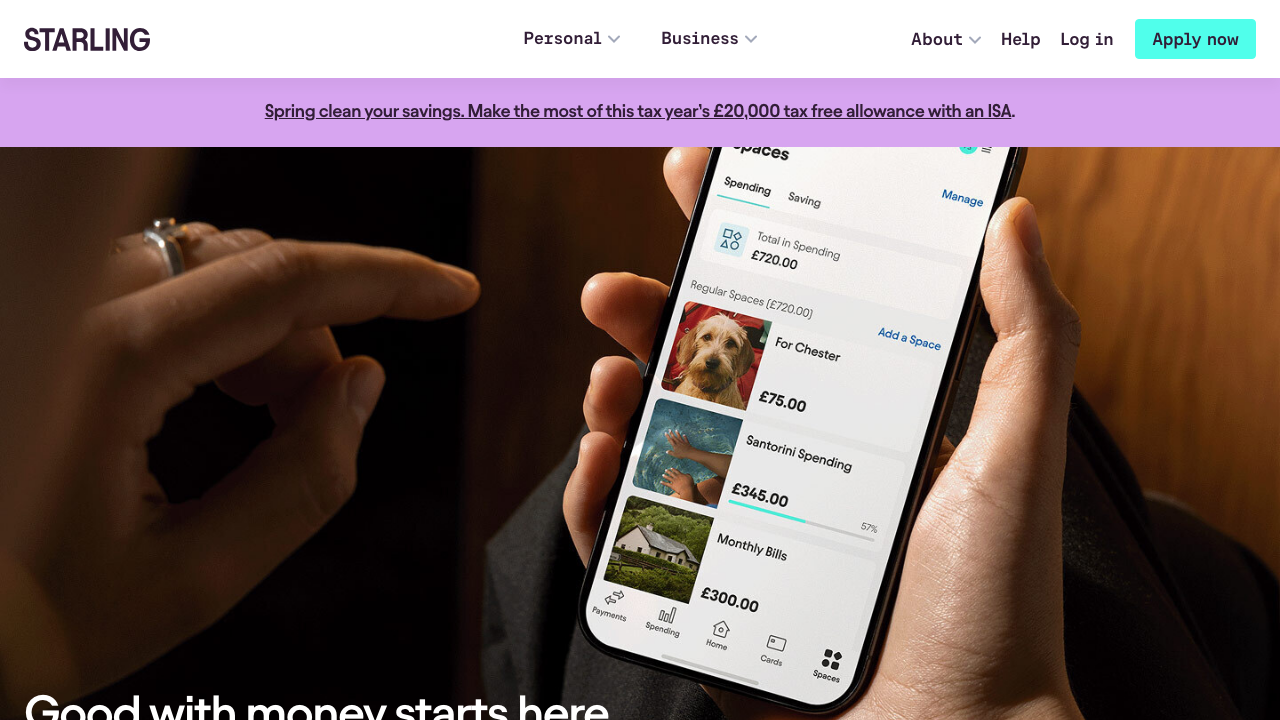
The Starling app is widely regarded as one of the best-designed banking apps in the UK market. The business version includes real-time transaction notifications, automatic categorisation of spending, the ability to attach receipts to individual transactions, and a cash flow graph that shows money in and out over rolling periods. Accountants can be granted a read-only access login, which simplifies bookkeeping handoffs considerably.
Integrations with Xero, FreeAgent, QuickBooks, and FreeAgent are live connections rather than CSV exports: transactions sync automatically, reducing manual reconciliation. For businesses that pay VAT, the app can separate VAT amounts from net figures when you photograph receipts, a feature that small business owners consistently highlight as a time-saver.
Customer service operates via in-app chat and phone. Starling does not operate a branch network, which is a deliberate cost decision rather than an oversight. Support hours are broad and the in-app chat typically connects to a human agent rather than a bot for account-related queries. Response times can stretch during peak periods, and some customers report that complex fraud disputes take longer to resolve than they would at a high-street bank with a local branch to escalate to.
Reputation and real customer experience
Starling Business Account scores consistently near the top of UK business banking satisfaction surveys. On Trustpilot, the bank holds one of the higher ratings among UK challenger banks, driven by recurring praise for the speed of opening, the quality of the app, and the absence of hidden fees. The five-star rating reflected in the editorial dataset aligns with what independent review platforms report: this is not a polished-numbers exercise.
Recurring complaints fall into three clear themes. First, account freezes: Starling's automated fraud detection occasionally flags legitimate transactions, particularly for newer businesses or those with irregular payment patterns. Businesses in sectors that Starling's systems flag as higher-risk, such as crypto-adjacent services or certain import-export activities, report a higher rate of account suspensions. Second, the lack of overdraft: small businesses in genuine short-term cash-flow difficulty have few options within Starling itself. Third, the absence of a branch network is a genuine inconvenience for anyone who needs face-to-face support during a fraud event or account dispute.
Praise clusters around three areas as well. The instant payment notifications are cited frequently by sole traders who invoice clients and need to know immediately when funds clear. The accounting integrations save hours of manual bookkeeping. And the fee structure, zero monthly charge with transparent per-service pricing, is appreciated by early-stage businesses watching every pound. In our test, the overall experience held up well against the kind of friction that still characterises traditional business accounts at high-street banks.
Verdict: who should open it and who should look elsewhere
Starling Business Account is the benchmark for fee-free UK business banking in 2026. Sole traders, freelancers, and small limited companies that conduct most of their transactions digitally will find it hard to beat: no monthly fee, a polished app, strong accounting integrations, and full FSCS protection up to £120,000. The Mastercard debit card with Apple Pay and Google Pay support covers everyday spending without friction.
Look elsewhere if your business needs a credit card on the same account, requires arranged overdraft facilities as a regular tool, or handles significant daily cash volumes. Traditional high-street banks retain an edge for cash-heavy businesses and for those who value branch access when disputes arise. Businesses operating across multiple European currencies at scale may also find that a multi-currency account from a competitor suits their treasury needs better than Starling's supplementary euro account.
For the large majority of UK small businesses, though, Starling remains the easiest starting point: fast to open, transparent on price, and genuinely useful day to day.
How safe is Starling Bank Starling Business Account?
Starling Bank Starling Business Account vs alternatives
A direct comparison of the key conditions against the strongest competitors in the market.
|  |  |  | |
| Rating | 5.0 /5 | 3.0 /5 | 4.0 /5 | 4.0 /5 |
| Monthly fee | £0.00 | £0.00 | £0.00 | £0.00 |
| Debit card | ✓ | ✓ | ✓ | ✓ |
| Credit card | ✗ | ✗ | ✗ | ✗ |
| Virtual credit cards | ✗ | ✓ | ✓ | ✗ |
| Free cash withdrawal | ✓ | ✗ | ✗ | ✗ |
| Number of sub-accounts | – | – | Pots (mehrere possible) | – |
| Online banking users | – | – | – | – |
| Electronic transfers | ✓ | ✓ | ✓ | ✓ |
| Apple Pay | ✓ | ✓ | ✓ | ✓ |
| Google Pay | ✓ | ✓ | ✓ | ✓ |
| 3D Secure for online payments | ✓ | ✓ | ✓ | ✓ |
| Deposit protection | £120,000 | £120,000 | £120,000 | ✗ |
How we rate
More comparisons
About the author

Frequently asked questions
The monthly account fee is £0.00.
The core Starling Business Account has no monthly fee. Standard UK payments, Faster Payments, and UK ATM withdrawals are all free. Optional add-ons such as the Business Toolkit and additional team member access carry a separate monthly charge, but the base account itself costs nothing to maintain.
Yes. Starling Bank holds a full UK banking licence and is authorised by the Prudential Regulation Authority (PRA) and regulated by the Financial Conduct Authority (FCA). Eligible deposits are protected by the Financial Services Compensation Scheme (FSCS) up to £120,000 per person, per institution -- the same protection you get with a high-street bank.
Yes, cash deposits are accepted via Post Office branches. A fee applies per deposit, so it is worth factoring this into your costs if your business handles regular cash payments. The account is not ideal as a primary account for high-volume cash businesses.
Starling Business connects directly with Xero, QuickBooks, and FreeAgent, syncing transactions automatically. The optional Business Toolkit add-on also brings invoicing and basic bookkeeping tools inside the Starling app itself, which is useful for sole traders who do not yet use a separate accounting package.
Arranged overdrafts are available to some Starling Business customers, but they are subject to eligibility and are not widely offered. If a credit facility or overdraft is a firm requirement from the outset, it is worth checking your eligibility directly with Starling or comparing with providers such as Tide or traditional banks that have more established SME lending products.
The application is completed entirely in-app and typically takes under 15 minutes to submit. Most decisions are made within one working day, with many approved in a matter of hours. Your account details are available immediately on approval, and your debit card arrives by post within a few business days.