
Last updated:
The best UK current accounts in 2026 charge nothing for everyday banking. Monzo, Starling, Chase, Revolut, First Direct and Nationwide's FlexAccount all come with no monthly fee. But the right one for you depends less on which single account is "best" and more on which type fits how you actually bank, since a packaged account with travel insurance suits a different person than a fee-free digital app. Below is an independent, side-by-side comparison of 10 widely used UK current accounts: monthly fees, overdraft rates, switching incentives, what each one does best, and the account types worth knowing before you choose. If you want our single top pick instead of a full comparison, see our best current account review.
Contents
What is a current account?
A current account is an everyday transactional bank account. You use it to receive your wages or income, pay bills, spend with a debit card, and set up direct debits and standing orders. It differs from a savings account, which is built for holding money and earning interest rather than daily spending. Most UK current accounts come with a debit card, mobile app and online banking, and nearly all are covered by the Financial Services Compensation Scheme (FSCS) up to the statutory protection limit if the provider is a licensed bank. We have a separate piece on this: Bank of Scotland Classic Account.
- Paying in money: salary, benefits or transfers from other accounts
- Paying out money: debit card spending, direct debits, standing orders, bank transfers
- Short-term borrowing: an arranged overdraft for when you spend more than you have, where the provider offers one
- Everyday account management: mobile app, contactless card and (for most high-street banks) branch and phone banking
Types of current account: which one fits you
UK current accounts fall into a few broad categories. Most people only need to look at two or three of these before picking a provider from the comparison table further down. We look into it here: Suits Me Account.
Basic bank account
A basic bank account is a no-frills account with no overdraft facility. It's designed for people who have been refused a standard account, often due to a poor credit history or no credit history at all. You still get a debit card and the ability to pay money in and out, just not the option to go overdrawn. This is worth a look if you've been declined elsewhere or simply want to rule out overdraft debt from the start.
Standard/free current account
This is the most common type: no monthly fee, a debit card, an app and usually an arranged overdraft subject to a credit check. Most digital challengers (Monzo, Starling, Chase, Revolut) fall into this category, as do most high-street "everyday" accounts, including Barclays Bank Account, NatWest Select, First Direct's 1st Account and Nationwide's FlexAccount. It suits anyone who wants no ongoing cost and has no need for packaged extras like travel insurance.
Packaged current account
A packaged account charges a monthly fee in exchange for bundled extras, most commonly travel insurance, mobile phone insurance, breakdown cover or cashback and lifestyle perks. Club Lloyds (£5/month), NatWest Reward (£2/month) and Nationwide FlexPlus (£18/month) are examples. Choose this only if you would otherwise buy the bundled extras separately, since the fee rarely pays for itself if you don't use most of what's included.
Digital-challenger account
App-only banks such as Monzo, Starling, Chase UK and Revolut run on smartphones rather than branch networks. Real-time spending notifications, budgeting tools and fast account opening are the draw. Several, including Chase and Revolut, skip a traditional overdraft entirely. Good fit if you want app-first money management and don't need in-branch or phone banking.
Joint account
A joint account is shared between two or more people, most commonly couples or housemates splitting household bills. Both holders can pay in, spend and manage the account. Most of the providers in the comparison below, including Monzo, Starling, Barclays, Lloyds, NatWest, HSBC and Nationwide, offer a joint version of their standard account at no extra cost. FSCS protection doubles on a joint account, since it applies per person rather than per account, which matters if you're managing shared income or expenses and want both of you to see and manage the same balance.
Best current accounts in 2026: full comparison
We compared 10 of the UK's most-used current accounts on monthly fee, representative overdraft APR, current switching incentive and standout feature. Figures below were verified in August 2026; switching offers in particular change or expire often, so always check the provider's own switch-offer page before applying.
| Current account | Monthly fee | Overdraft APR (representative) | Switching incentive | Standout feature |
|---|---|---|---|---|
| Monzo | Free (paid Extra/Perks/Max tiers, £9-£17/month) | 19-39% EAR variable, tiered by credit score | None currently | Real-time spending notifications, automated savings Pots |
| Starling Bank | Free | 15% EAR variable (tiered up to 35%) | None currently | No-fee card spending and unlimited fee-free ATM withdrawals abroad |
| Chase UK | Free | No overdraft facility offered | None currently | 1% cashback on debit card spend (capped monthly), round-up saver |
| Revolut | Free (paid Plus £3.99, Premium £7.99, Metal £14.99, Ultra £45/month) | No overdraft facility offered | None currently | Multi-currency spending with no weekday FX markup |
| Barclays | Free (optional Blue Rewards add-on, £5/month) | 35.0% EAR variable | £200 (switch offer live to 27 August 2026, check for a newer offer after that date) | Blue Rewards cashback bundle, large UK branch network |
| Lloyds Bank | Free (Everyday); Club Lloyds £5/month, refunded if £2,000+ paid in monthly | 29.9% EAR variable (Club Lloyds) | None currently | Club Lloyds annual lifestyle perk (streaming, cinema, or dining discounts) |
| NatWest | Free (Select); Reward account £2/month | 39.49% EAR variable (Select) | £200 (pay in £1,250 within 24 hours, log into the app) | Real-time app alerts for both debit and credit card spending |
| HSBC | Free (Advance and basic Current Account; Premier fee-free but invite-only) | 38.9% EAR variable (Advance) | £220 | Global Money multi-currency sub-accounts, wide international network |
| First Direct | Free (1st Account) | 30.5% EAR variable | £175 | 7.00% AER regular saver for new customers, fee-free spending abroad |
| Nationwide | Free (FlexAccount/FlexDirect); FlexPlus £18/month | 38.2% EAR variable | £175 (first-time switchers only) | Member-owned mutual; annual Fairer Share payout; branch network committed to 2030 |
Two 2026 changes are worth knowing before you compare overdraft rates: HSBC and First Direct both stopped charging interest on unarranged overdrafts from 19 May 2026, and NatWest's Reward account is losing its £1-a-month app-login cashback perk from 1 October 2026, while the £2 monthly fee stays the same.
Current accounts by need
The right current account depends far more on how you actually bank than on which provider is "best" overall (running a company instead? see our business bank account comparison). These shortlists match the most common situations people search for.
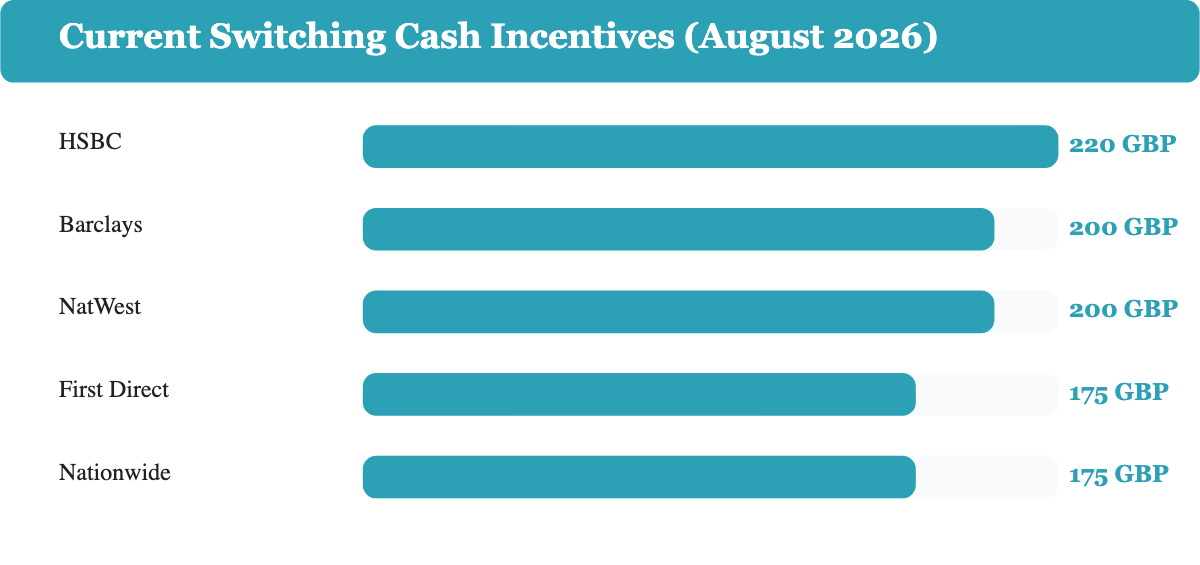
- Best for a cash switching bonus: HSBC (£220) currently pays the most of the accounts compared here, followed by Barclays and NatWest at £200 each; all three require a full CASS switch with a minimum deposit and, for Barclays and NatWest, active direct debits.
- Best for avoiding overdraft debt: Chase UK and Revolut don't offer a traditional overdraft at all, so you simply can't spend money you don't have.
- Best for digital-only banking: Starling Bank and Monzo combine a fully free standard account with strong app-based budgeting tools and no branch network to maintain.
- Best for branch and phone banking: Barclays, Lloyds, NatWest and HSBC all retain large UK branch networks, useful if you want in-person support or handle cash regularly.
- Best for joint accounts: most providers compared here offer a joint version at no extra cost; Nationwide's mutual, member-owned structure adds an annual profit-share payout on top.
- Best for spending abroad: Starling and First Direct both offer fee-free card spending overseas with no foreign exchange markup on weekdays.
Is my money protected in a current account?
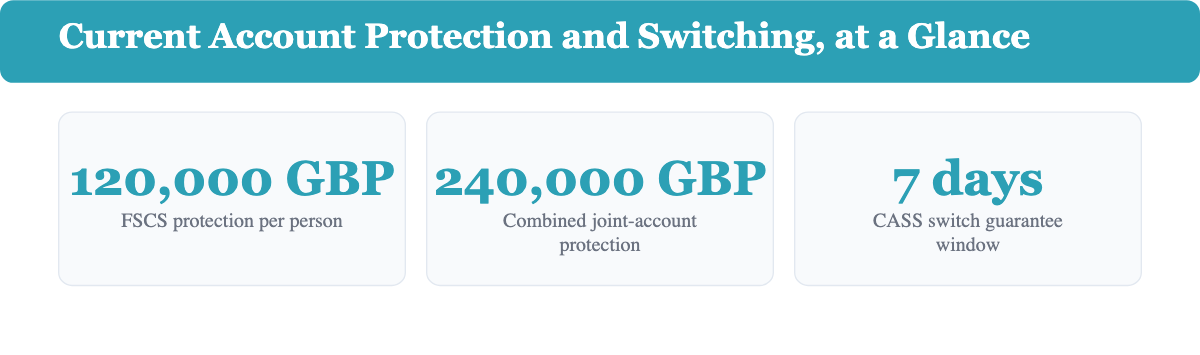
Yes. Money held in a UK current account with an authorised bank is protected by the Financial Services Compensation Scheme (FSCS) up to £120,000 per person, per authorised institution. This limit rose from £85,000 on 1 December 2025. All 10 providers compared on this page are FSCS-protected licensed banks.
On a joint account, protection applies per person rather than per account, so a joint account effectively carries £240,000 of combined FSCS cover. If you hold accounts with two brands that share the same banking licence (for example NatWest and Royal Bank of Scotland, or Halifax and Bank of Scotland), your combined balance across both counts toward a single £120,000 limit, not two separate ones, so it's worth checking which licence each of your accounts actually sits under if you keep large balances.
How do I switch current accounts?
Most UK current account switches complete within 7 working days using the Current Account Switch Service (CASS); see our full guide to switching bank accounts for a step-by-step walkthrough. CASS is free to use and automatically moves your balance, incoming payments, direct debits and standing orders to your new account, then closes the old one. It's covered by the Current Account Switch Guarantee, so if anything goes wrong, any resulting fees or interest charges must be refunded within 3 working days.
- Open your new current account and confirm it supports CASS (nearly all UK banks and most digital challengers do)
- Request the switch through your new bank's app or online banking
- Sign the Current Account Switch Agreement, which authorises the closure of your old account
- Your new bank moves your balance, direct debits, standing orders and incoming payments within 7 working days
- Your old account closes automatically once the switch completes
Do I need to pay for a current account?
No. Every provider in this comparison offers at least one current account with no monthly fee, and for most people a free standard account covers everything they need: a debit card, an app and an arranged overdraft if one is offered. A packaged or paid-tier account only makes financial sense if you would otherwise pay separately for what's bundled in.
- Packaged accounts (Club Lloyds, NatWest Reward, Nationwide FlexPlus) typically bundle travel insurance, mobile insurance, breakdown cover or lifestyle perks and cashback
- Paid digital-challenger tiers (Monzo Extra/Perks/Max, Revolut Plus/Premium/Metal/Ultra) typically bundle extra savings pot interest, better exchange rates, metal cards or purchase protection
- Fee-refund accounts like Club Lloyds waive the monthly charge entirely if you pay in enough each month, so check the qualifying deposit before assuming the fee applies to you
Frequently asked questions
What is the best current account in the UK right now?
There isn't one single best account for everyone. Starling Bank and Monzo suit people who want a fully free, app-first account with no branch network. Barclays, HSBC and NatWest suit people who want branch access and a cash switching bonus. First Direct is a strong all-rounder with a 7.00% regular saver for new customers. Compare all 10 in the table above against how you actually bank before deciding.
How much does a UK current account cost?
Most current accounts are free, including Monzo, Starling, Chase, Revolut's standard tier, Barclays, First Direct's 1st Account and Nationwide's FlexAccount. Packaged accounts with bundled perks cost between £2 and £18 a month, and paid digital-challenger tiers range from roughly £4 to £45 a month depending on the provider and plan.
What are the alternatives to a traditional bank current account?
Digital challenger banks such as Monzo, Starling, Chase UK and Revolut offer full current accounts through an app rather than branches, with the same FSCS protection as high-street banks provided they hold a UK banking licence. Basic bank accounts are the main alternative for anyone who has been declined a standard account.
Which current account is best for switching bonuses?
As of August 2026, HSBC offers the largest switching incentive among the accounts compared here at £220, followed by Barclays and NatWest at £200 each. All three require a full switch through the Current Account Switch Service plus a minimum deposit, so check the exact conditions on the provider's own switch-offer page, since these deals expire or change often.
Can I have more than one current account?
Yes. There's no legal limit on how many UK current accounts you can hold, and many people keep one for bills and salary and another, often a digital-challenger account, for budgeting or spending abroad. Just be aware that FSCS protection is per banking licence, so balances held with brands that share a licence count toward the same £120,000 limit.