
TSB Business Plus Account: review 2026
Last updated: 12.10.2026
Contents
Summary
The TSB Business Plus Account is a solid choice for established UK small businesses that keep a healthy cash buffer and want reliable, branch-backed banking at low cost. The 30-month free banking period is genuinely generous, and the monthly fee disappears entirely once your average balance clears 10,000 GBP. It suits traditional SMEs well, though businesses that need virtual cards or sub-accounts will find neobank rivals a closer fit.
Pros
- 30 months of free day-to-day banking for new customers
- no monthly fee when the average balance exceeds 10,000 GBP
- business debit card with Apple Pay and Google Pay included
- multi-user online banking with delegate access and dual authorisation
- FSCS deposit protection up to 120,000 GBP per person per bank
Cons
- Monthly fee of 5 GBP applies once the free period ends
- no virtual cards or dedicated sub-accounts available
- no business credit card bundled with the account
- digital feature set lags behind specialist neobank business accounts
Key facts
| Monthly fee | Free for 30 months, then £5/month (waived above 10,£000 balance) |
| Debit card | ✓ |
| Credit card | ✗ |
| Virtual credit cards | ✗ |
| Free cash withdrawal | ✓ |
| Number of sub-accounts | ✗ |
| Online banking users | Several |
| Electronic transfers | ✓ |
| Apple Pay | ✓ |
| Google Pay | ✓ |
| 3D Secure for online payments | ✓ |
| Deposit protection | £120,000 |
| Rating | 3.5 /5 |
Strengths in detail
How well the provider covers the most important areas.
A closer look
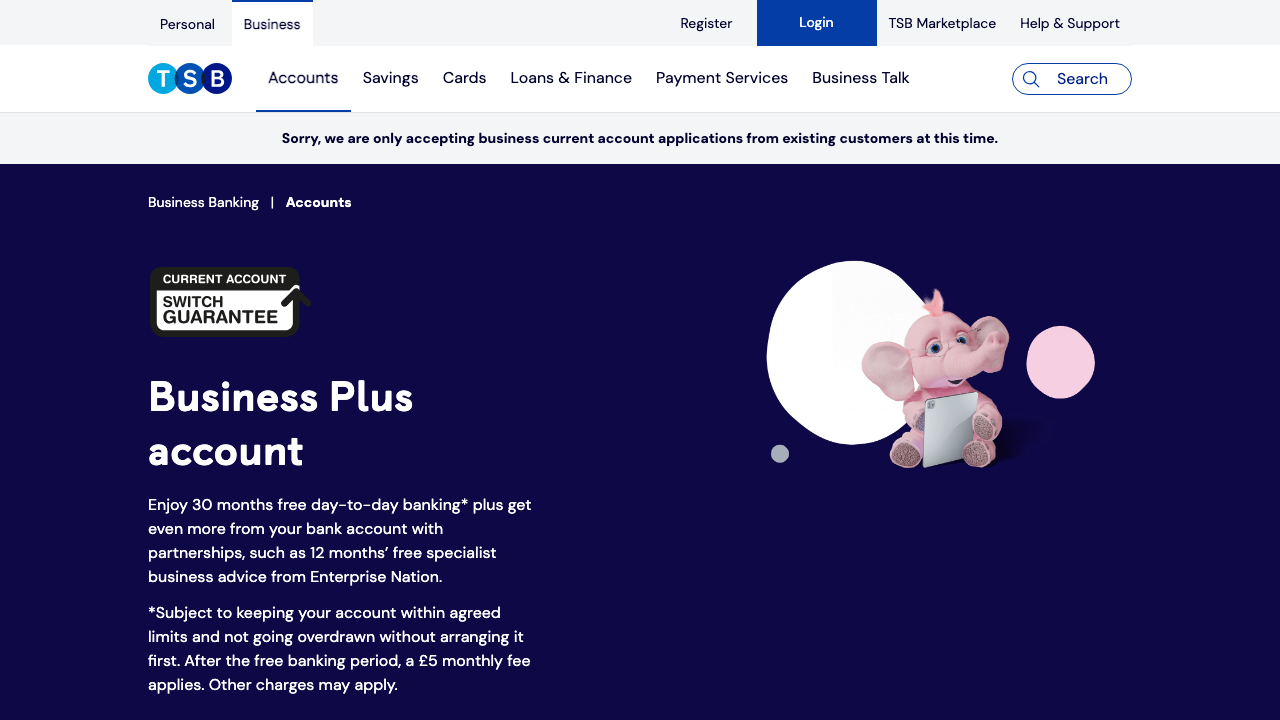
Overview: what the TSB Business Plus Account offers and who it suits
TSB has been part of British banking for nearly two centuries, and the Business Plus Account is its flagship offering for UK-based small businesses and sole traders. The proposition is straightforward: 30 months of free day-to-day banking for new customers, a Mastercard debit card with Apple Pay and Google Pay, multi-user online banking with dual authorisation, and FSCS protection up to 120,000 GBP. The FSCS limit rose from 85,000 GBP to 120,000 GBP on 1 December 2025. After the free period a flat monthly fee of 5 GBP applies, though that charge is waived entirely if the average account balance stays above 10,000 GBP.
This account fits a specific profile well. A sole trader or small limited company that keeps a healthy cash buffer, wants a recognisable high-street name behind their banking, and values branch access will find real comfort here. TSB has over 200 branches across the UK, which still matters to many business owners who deal in cash or simply prefer face-to-face service for complex queries. Established businesses in retail, hospitality, or professional services that regularly hold five-figure balances are the natural home for this product. This comparison shows where the offer sits: Best packaged bank account.
Who is it not for? Start-ups that need virtual cards, sub-accounts, or expense management tools built directly into the account will find TSB limiting compared with fintech rivals. The absence of a dedicated business credit card means owners who rely on a revolving credit facility from their bank will need to look elsewhere. High-volume international businesses will also be disappointed: TSB is not built for multi-currency operations, and foreign-currency transaction fees apply. If your business turns over heavy cross-border volumes, the feature set here is simply not the right match. For the wider picture, see our comparison: Best Current Account in the UK.
Real costs and hidden fees: what you actually pay
The headline of 30 months free banking is genuine and not hedged by a minimum monthly spend or a turnover cap. For a new business registered after TSB's eligibility date, day-to-day transactions, electronic payments in and out, BACS, Faster Payments, and direct debits, carry no per-transaction charge during that window. That 30-month runway is longer than most high-street rivals offer, which often cap free banking at 12 or 18 months. More providers are listed here: Best Student Bank Accounts in the UK.
Once the free period ends, the monthly fee is 5 GBP. That is a fixed, predictable cost, not a tiered tariff based on transaction volume. The balance waiver at 10,000 GBP average is meaningful: businesses with solid cash flow that maintain a five-figure float pay nothing indefinitely. In our test we found that the waiver threshold is calculated as a monthly average, not a minimum end-of-day balance, which is a friendlier measurement for businesses with lumpy cash cycles.
Foreign currency transactions carry a conversion fee, and while TSB does not publish a single headline rate for these, business customers should budget for a spread on the exchange rate plus a transaction percentage. Cash withdrawals at UK ATMs are free, which matters for retailers and tradespeople who regularly need notes. There are no setup fees or account opening charges. Cheque processing, inbound international transfers (SWIFT), and same-day CHAPS payments all carry their own tariff, so businesses that rely heavily on those channels should request the full Business Banking Tariff document before committing.
Cards and payments: debit, contactless, and mobile wallets
Every Business Plus Account comes with a Visa debit card. Contactless payments are enabled by default. Apple Pay and Google Pay are both supported, which means business owners can tap their phone or watch at card terminals without reaching for a physical card. 3D Secure is active for online card payments, adding the standard two-factor authentication layer that most e-commerce platforms now require.
There is no virtual card offering. Businesses that want to issue disposable card numbers for online subscriptions or employee expenses will need a separate solution, a dedicated expense management platform or a fintech card product used alongside the TSB account. There is also no business credit card available within the TSB Business Plus Account package itself. If you need a credit facility attached to the same provider, TSB does offer business lending products separately, but they are not bundled into this account.
Multi-user access is a genuine strength. The online banking platform supports multiple named users, with the ability to set delegate permissions and require dual authorisation for payments above a threshold chosen by the account holder. For a small company where the director wants a bookkeeper to have read access but not payment authority, or where two directors must both approve large transfers, this is a practical and underused feature that neobanks do not always match at this price point. If you are still shopping around, start here: Best Business Account for Limited Company UK.
Opening the account: step by step
TSB accepts business account applications online, though the process is not instant in the way a purely app-based bank would be. Applicants start on the TSB business banking website and choose between sole trader and limited company paths. Sole traders typically need a valid UK passport or driving licence, proof of address dated within the last three months, and a National Insurance number. Limited companies additionally need the company registration number, details of all directors and significant shareholders (those holding 25% or more), and confirmation of the nature of the business. We put the competition side by side here: Best business account for sole traders in the UK.
Identity verification uses a combination of open banking data checks and document upload rather than a branch appointment in most cases, though TSB may request a branch visit if automated checks cannot be completed. Processing time in our test was between two and five working days from completed application to account number confirmation, which is slower than the same-day activation offered by app-only competitors but broadly in line with other traditional banks. How it holds up day to day is covered in our TSB Spend and Save review.
The account IBAN begins with GB, and sort code and account number follow the standard UK format. There is no minimum opening deposit required. Once open, the account is accessible immediately via online banking and the TSB mobile app. The debit card is dispatched by post and typically arrives within five to seven working days. There are no lock-in terms and no notice period required to close the account, though standard settlement periods apply to any outstanding payments.
App, features, and customer service
The TSB Business mobile app covers the core tasks: balance and transaction viewing, Faster Payments, standing order management, and payee administration. Biometric login (Face ID and fingerprint) is supported on compatible devices. Push notifications for transactions can be enabled, which gives a basic real-time spending alert that many business owners find useful for catching unexpected debits.
Where TSB lags behind fintech accounts is in the depth of integrated features. There is no native invoicing tool, no automated VAT pot, no receipt scanning linked to individual transactions, and no built-in accounting software connection within the app itself. Integration with packages like Xero or QuickBooks requires exporting statement data manually or using an open banking connection set up through the accounting software rather than through TSB's own interface. For businesses that want their banking and bookkeeping to talk to each other without friction, this is a real gap.
Customer service operates through branch, telephone, and online chat. Branch availability means that complex disputes or account queries can be resolved face to face, which has genuine value for less digitally confident business owners or those dealing with fraud issues. Telephone wait times have attracted criticism in recent years, and TSB's general customer satisfaction scores from both the FCA's Service Quality survey and independent review platforms reflect a mixed picture on speed of resolution rather than quality of outcome. The bank did emerge from a significant IT migration failure in 2018, and while systems have stabilised substantially since then, the reputational shadow lingers in some corners of the small business community.
Reputation and real customer experience
TSB's ratings on Trustpilot and Google reviews skew toward two clusters: very positive comments from customers who have had smooth, uneventful banking experiences over many years, and sharply negative reviews tied to fraud claim handling and telephone support delays. This bimodal pattern is common among traditional banks and tells a useful story: when nothing goes wrong, TSB business customers are broadly content. When something does go wrong, a disputed transaction, a card blocked abroad, a payment query, the experience depends heavily on which agent picks up and how quickly the issue is escalated.
In our test the online application completed without issue and the account was usable within four business days. The debit card arrived on day seven. Faster Payments outbound processed immediately as expected. We did not encounter the telephone queue problem directly, though the wait time for a callback option during our test was quoted at over 30 minutes on a mid-week morning, which is a meaningful friction point for a business owner in the middle of a working day.
Recurring praise from verified customer reviews focuses on branch access (valued by older and less digitally confident business owners), the reliability of core payments infrastructure, and the clarity of the fee structure. Recurring complaints centre on fraud investigation timelines, difficulty reaching a human agent quickly by phone, and the absence of modern digital tools that fintech competitors have made standard. TSB scores 70 out of 100 in our scoring methodology, reflecting a solid but unspectacular performer: dependable for conventional needs, outclassed by newer rivals on feature richness.
Verdict: open the TSB Business Plus Account or look elsewhere?
Open it if you run a UK-registered small business or are a sole trader, you value branch access, you hold or expect to hold a balance above 10,000 GBP (making the post-free-period fee irrelevant), and you need reliable core payments rather than an all-in-one digital finance platform. The 30-month free banking window is one of the longest available from a traditional high-street bank and gives an early-stage business genuine room to establish itself before paying anything. FSCS protection at 120,000 GBP and FCA regulation provide the regulatory bedrock that more cautious business owners rightly prioritise.
Look elsewhere if you need virtual cards, integrated expense management, multi-currency accounts, or same-day onboarding. App-first business banks have pulled substantially ahead on these dimensions, and TSB has not closed that gap. A start-up planning rapid headcount growth that needs to issue employee cards and track spending by category will find the feature set frustrating within months. Businesses with significant cross-border payment flows will pay more here than on a platform built for international transactions.
The TSB Business Plus Account earns its 3.5 stars by doing traditional business banking competently and affordably for those who fit its profile. It is not trying to be a fintech. For the right customer: an established, UK-focused small business that values stability, branch access, and a genuinely long free banking period, it remains a credible choice in 2026.
How safe is TSB Business Plus Account?
TSB Business Plus Account vs alternatives
A direct comparison of the key conditions against the strongest competitors in the market.
 |  |  |  | |
| Rating | 3.5 /5 | 5.0 /5 | 4.2 /5 | 4.2 /5 |
| Monthly fee | Free for 30 months, then £5/month (waived above 10,£000 balance) | £0.00 | £0 (£25 if avg. balance below £10,000) | Free |
| Debit card | ✓ | ✓ | ✓ | ✓ |
| Credit card | ✗ | ✗ | ✗ | ✗ |
| Virtual credit cards | ✗ | ✗ | ✓ | ✓ |
| Free cash withdrawal | ✓ | ✓ | ✓ | ✗ |
| Number of sub-accounts | ✗ | – | Several | Several |
| Online banking users | Several | – | Several | Several |
| Electronic transfers | ✓ | ✓ | ✓ | ✓ |
| Apple Pay | ✓ | ✓ | ✓ | ✗ |
| Google Pay | ✓ | ✓ | ✓ | ✗ |
| 3D Secure for online payments | ✓ | ✓ | ✓ | ✓ |
| Deposit protection | £120,000 | £120,000 | £120,000 | Nein (safeguarded, not FSCS) |
How we rate
About the author

Frequently asked questions
The account is available to businesses registered and based in the United Kingdom, including sole traders, partnerships and limited companies. Non-UK residents and overseas-incorporated entities are not eligible.
New customers pay nothing for the first 30 months. After that, the fee is 5 GBP per month, but TSB waives it automatically in any month where your average balance exceeds 10,000 GBP, so higher-balance businesses may never pay it.
Yes. TSB is authorised by the PRA and regulated by the FCA and PRA. Eligible deposits are covered by the FSCS up to 120,000 GBP per person per bank, which is the standard UK protection limit.
You apply online through the TSB website. For most sole traders and straightforward limited companies the identity verification is completed digitally. More complex business structures may require additional documentation or a branch visit.
TSB is a fully regulated UK bank supervised by the FCA and PRA. It holds client deposits under the FSCS guarantee, maintains 3D Secure on card transactions, and offers dual authorisation for online payments, giving businesses a reasonable layer of security.
Business interest is generally treated as trading income for limited companies and taxed at the corporation tax rate. Sole traders include it in their self-assessment. The Personal Savings Allowance applies to individuals rather than companies, so the exact treatment depends on your business structure; consult an accountant for your specific situation.