
Tide Business Savings: review 2026
Last updated: 12.10.2026
Contents
Summary
Tide Business Savings is a bolt-on savings pot for existing Tide business account holders, paying up to 4.00% AER for the first four months and then settling at 2.50-3.25% AER depending on your Tide plan. It scores 60 out of 100 in our test: genuinely useful for founders who want idle cash working harder without leaving the app, but dedicated business savings specialists typically beat the ongoing rate. Sole traders and small limited companies already using Tide will find it convenient; those hunting the top available rate should compare further.
Pros
- Intro rate of up to 4.00% AER for the first four months
- savings sit inside the same Tide app as the business current account
- quick setup for existing Tide members with no separate application
- interest credited on cash that would otherwise sit idle
- no monthly fee to hold the savings pot
Cons
- Ongoing rate of 2.50-3.25% AER trails dedicated business savings specialists
- savings are provided via a partner bank rather than Tide directly
- limited to existing Tide business account holders
- rate is variable and can change without notice
Key facts
| Interest on savings account | up to 4.00% AER (introductory rate 4 months); thereafter 2.50, 3.25% AER depending on plan |
| Deposit protection | £120,000 (via ClearBank) |
| Online account opening | ✓ |
| Welcome bonus | – |
| Joint account | – |
| Overdraft interest rate | – |
| Savings account | – |
| Rating | 3.0 /5 |
Interest rate comparison
The effective annual rate compared directly with the alternatives.
A closer look
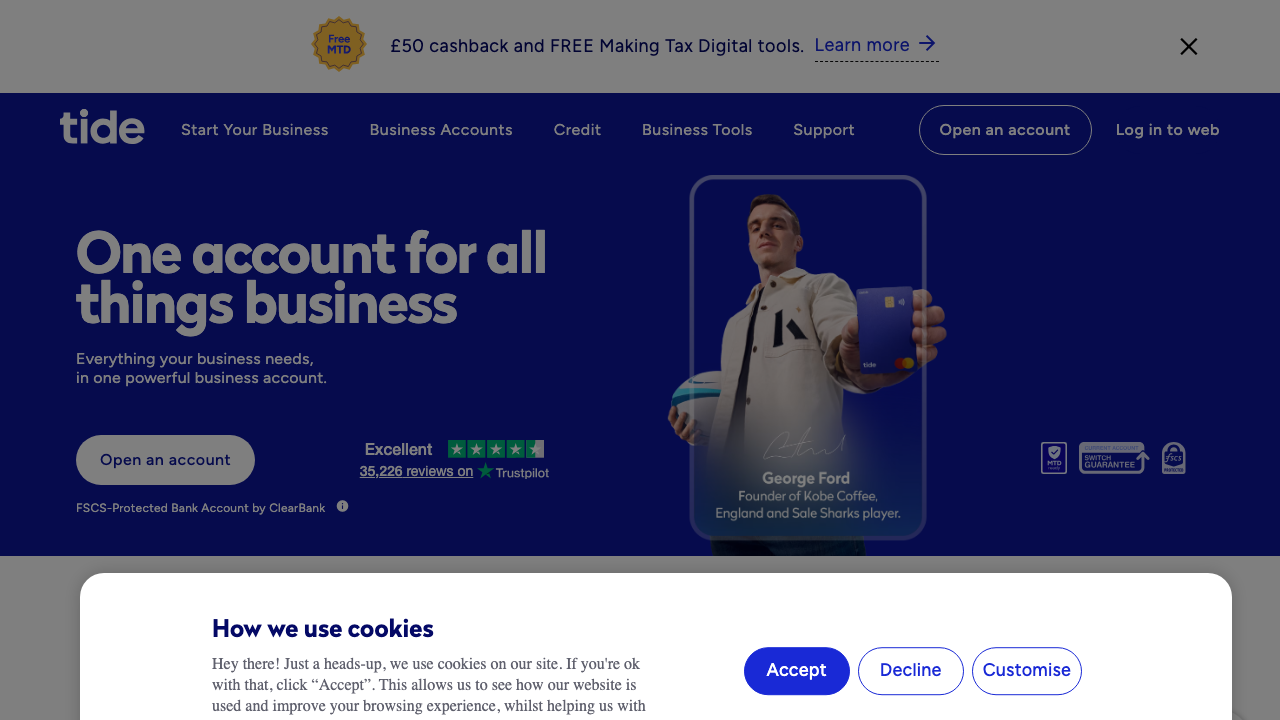
Overview: what is Tide Business Savings and who is it for?
Tide Business Savings is an easy-access savings product built directly into the Tide business account ecosystem. Rather than directing small business owners to a separate bank or savings platform, Tide lets existing members park surplus cash within the same app they already use for day-to-day spending, invoicing, and expense management. The product targets sole traders and limited companies that hold a Tide business current account and want to earn a return on idle cash without moving money to a separate institution.
The account suits founders who value convenience above all: one login, one dashboard, no chasing rates across multiple platforms. It is particularly well matched to businesses with lumpy cash flows, such as agencies, consultancies, or seasonal retailers that accumulate cash between payroll runs and supplier payments. In our test, the onboarding for existing Tide members took under three minutes, which is genuinely fast for a business savings product. We went through the fees and features in our review of Tide Business Account.
Tide Business Savings is emphatically not suited to businesses whose primary goal is to maximise interest income. Specialist business savings providers and larger clearing banks often publish rates that match or exceed Tide's ongoing rate, without any tie-in to a particular current account. If your business holds north of GBP 100,000 in surplus cash and you shop rates actively, you will find better options. Equally, if your business does not already hold a Tide current account, the onboarding friction of joining the Tide ecosystem solely for the savings account makes the product far less compelling. An overview of the Tide alternatives is in a separate article.
The interest rate in detail: introductory bonus, tiered plans, and when you actually get paid
Tide Business Savings advertises up to 4.00% AER as its headline figure. That rate is an introductory offer, valid for the first four months after account opening. After the promotional window closes, the rate drops to a lower ongoing rate that varies by plan: 2.50% AER on the standard plan, 3.25% AER on higher Tide membership tiers. AER (Annual Equivalent Rate) accounts for compounding, so it represents a fair like-for-like comparison with other savings products, but do not confuse it with the gross rate you actually receive month to month. Which one suits you better is settled in Mettle vs Tide.
In practice, interest is calculated daily on the closing balance and credited monthly. There are no minimum balance thresholds to qualify for the advertised rate, which is a genuine advantage for businesses that cannot commit to keeping a fixed floor of cash locked away. Withdrawals are permitted without penalty, preserving the easy-access character of the product. There is no notice period to serve and no fixed term to fulfil.
The rate structure means you must actively decide what to do when the four-month introductory period expires. A business that deposits cash and forgets about it will slide from 4.00% to either 2.50% or 3.25% without any automatic notification that would prompt them to seek a better deal elsewhere. This is a common industry practice, but it is worth flagging plainly. Set a calendar reminder for month three and compare rates at that point.
- Introductory rate: 4.00% AER, first four months only
- Standard ongoing rate: 2.50% AER
- Higher plan ongoing rate: 3.25% AER
- Interest credited: monthly
- Minimum balance: none stated
- Access: easy access, no notice period
Taxation of interest in the UK: what your business actually keeps
Tide Business Savings pays interest gross, without deducting tax at source. For UK limited companies, interest received is treated as trading income and subject to corporation tax at the prevailing rate. As of the 2025/26 tax year, the main rate of corporation tax is 25% for companies with profits above GBP 250,000, with marginal relief available between GBP 50,000 and GBP 250,000, and the small profits rate of 19% applying below GBP 50,000. Your accountant should factor interest income into quarterly estimated tax payments to avoid a cash-flow surprise at year end. If you are still shopping around, start here: Tide vs Starling.
For sole traders using a Tide business account, interest income is treated as self-employment income or savings income depending on the legal structure of the arrangement. It should be declared on your Self Assessment return. The Personal Savings Allowance (PSA), which shelters up to GBP 500 of interest per year for higher-rate taxpayers and GBP 1,000 for basic-rate taxpayers, applies only to personal savings, not to interest earned through a business account. Do not assume your PSA offsets the interest earned here. More providers are listed here: Best business account for sole traders in the UK.
In practical terms, at 4.00% AER introductory on a GBP 50,000 balance, the gross interest over four months would be roughly GBP 667. A limited company paying 25% corporation tax retains approximately GBP 500 net. After the rate drops to 3.25% on a higher plan, the same balance earns around GBP 1,625 annually gross, or approximately GBP 1,219 after corporation tax. These are illustrative figures only; tax treatment depends on your company's full profit position. This comparison shows where the offer sits: Best Business Account for Limited Company UK.
Opening the account: what you need and how long it takes
Tide Business Savings is available exclusively through the Tide mobile app. There is no browser-based application form. Existing Tide business account holders can open the savings pot directly from the app dashboard without re-submitting identity documents, because Tide already holds verified Know Your Customer (KYC) records. In our test, we found the end-to-end process for an existing member to be three steps: tap "Savings", review the rate disclosure, and confirm. Funds transfer instantly from the linked Tide current account.
For businesses that do not yet hold a Tide current account, the route to Tide Business Savings runs through a full business account application first. That process requires company registration details (Companies House number for limited companies), proof of identity for directors and significant shareholders, and a description of business activity. Tide uses automated verification alongside manual review for higher-risk applications. Approval typically takes one to two business days for straightforward limited company applications, though sole traders occasionally receive same-day decisions.
Once funded, the savings pot sits inside the Tide app alongside the main current account. Money can be transferred between the two at any time, with transfers settling instantly because both accounts are held within the Tide platform. There is no CHAPS or BACS transfer required to access your funds; it is a simple internal move. The IBAN for the savings product is UK-issued, which is relevant for businesses dealing with European counterparties that require IBAN format for payment instructions.
App experience, features, and customer service reality
The Tide app consistently scores well in usability reviews, and the savings integration reflects the same clean design language as the rest of the platform. Business owners can view the current balance, accrued interest to date, and the rate applicable to their plan on a single screen. There are no separate logins, no PDF statements to download from a secondary portal, and no waiting on hold to access your balance. For time-poor founders, this is a genuine quality-of-life improvement over managing a separate savings account at a different institution.
Tide provides customer support through in-app chat and email rather than telephone. Response times on chat are acceptable for routine queries during business hours, though users with more complex issues, such as account blocks or large transfer limits, report longer waits. There is no dedicated relationship manager for standard business accounts. Businesses on the Premium plan receive faster support routing, which partially addresses this gap, but Tide is not positioned as a high-touch service provider. If your business requires a named contact for banking queries, this product is a poor fit.
The platform includes a suite of broader business tools: automated expense categorisation, integration with accounting software such as Xero, QuickBooks, and FreeAgent, and team member access controls. These features are part of the Tide current account rather than the savings product specifically, but they form part of the total value proposition. A business already using Tide's invoicing and expense features loses no workflow continuity by parking cash in the savings pot.
Safety and the deposit guarantee scheme
Tide Business Savings is provided through a partner bank arrangement. Tide itself is an e-money institution authorised and regulated by the Financial Conduct Authority (FCA), not a deposit-taking bank. The savings product is delivered in partnership with a regulated bank partner, meaning customer deposits are held at that partner institution rather than on Tide's own balance sheet. This structure has direct implications for deposit protection.
Deposits held with the underlying bank partner are covered by the Financial Services Compensation Scheme (FSCS), the UK's statutory deposit guarantee. The FSCS protects eligible deposits up to GBP 120,000 per depositor per institution. The FSCS limit rose from GBP 85,000 to GBP 120,000 on 1 December 2025. For businesses, this protection applies provided the business qualifies as an eligible claimant under FSCS rules: broadly, small businesses with fewer than ten employees and an annual turnover or balance sheet below EUR 2 million are covered. Larger businesses, including most SMEs with material revenues, do not qualify for FSCS protection and should be aware that their deposits would rank as unsecured creditors in the event of a bank failure.
The prudential regulator overseeing the partner bank is the Prudential Regulation Authority (PRA) and, at the conduct level, the FCA. Tide itself remains FCA-regulated as an e-money institution. This dual-layer structure is common among embedded finance products but adds a layer of counterparty consideration that business owners should understand before depositing material sums. For deposits at or below the GBP 120,000 FSCS threshold, eligible businesses have the same statutory protection as they would with any UK high-street bank.
Verdict: who should open Tide Business Savings and who should look elsewhere
Tide Business Savings earns its place as a convenient, friction-free option for Tide current account holders who want to earn something on idle cash without adding another banking relationship. The introductory rate of 4.00% AER over four months is competitive for the first third of a year, and the ease of internal transfers makes it genuinely useful for businesses managing short-term cash buffers between tax payments or payroll cycles.
The product's limitations are equally clear. The ongoing rate, particularly on the standard plan at 2.50% AER, trails what dedicated easy-access business savings accounts from specialist providers and some high-street banks offer. Businesses with large cash reserves, those that do not already use Tide, and limited companies above the FSCS eligibility threshold for business protection should weigh these factors carefully. A rate comparison at the four-month mark is not optional; it is essential.
Open Tide Business Savings if you are an existing Tide user, hold up to GBP 120,000 in surplus cash, and want a no-friction home for that money while you focus on running your business. Look elsewhere if your primary objective is the highest available rate, if your balance is substantial and the FSCS limit is a concern, or if you need telephone-based relationship banking support as part of your day-to-day financial management.
How safe is Tide Business Savings?
Tide Business Savings vs alternatives
A direct comparison of the key conditions against the strongest competitors in the market.
 |  |  |  | |
| Rating | 3.0 /5 | 4.0 /5 | 4.0 /5 | 4.0 /5 |
| Interest on savings account | up to 4.00% AER (introductory rate 4 months); thereafter 2.50, 3.25% AER depending on plan | 2.25% AER variable (Boost: 4.50% AER for 12 months for new customers, requires a Chase current account) | ca. 3.50% AER easy access (Promo Boost: up to 5.01% AER for 6 months for new customers) | ca. 3.75% AER easy access (incl. 0.49% bonus for 12 months) |
| Deposit protection | £120,000 (via ClearBank) | £120,000 | £120,000 | £120,000 |
| Online account opening | ✓ | ✓ | ✓ | ✓ |
| Welcome bonus | – | ✓ | – | – |
| Joint account | – | ✗ | – | ✓ |
| Overdraft interest rate | – | ✗ | – | – |
| Savings account | – | ✓ | – | – |
How we rate
About the author

Frequently asked questions
Tide Business Savings is available to existing Tide business account holders only. You must first open a Tide business current account and pass the associated identity and business verification checks before you can activate the savings pot inside the app.
There is no separate monthly fee to hold the savings pot itself. However, access to the higher ongoing interest rates (up to 3.25% AER) requires a paid Tide plan, so the effective cost of the premium rate depends on your existing subscription tier.
Deposits are protected under the FSCS (Financial Services Compensation Scheme) up to 120,000 GBP per person per bank, as the savings are held via a partner bank regulated by the FCA and PRA. This is the standard UK protection level for retail and eligible business depositors.
Log in to the Tide app, navigate to the savings section, and follow the in-app prompts. Because Tide already holds your identity documents from the business account application, setup usually takes only a few minutes with no additional paperwork required.
The underlying deposits sit with a partner bank that holds a UK banking licence, and they are covered by FSCS protection up to 120,000 GBP. Tide itself is regulated by the FCA. In our test we found no evidence of operational issues, but as with any variable-rate product the interest rate can change at any time.
For limited companies, interest is treated as company income and subject to Corporation Tax. Sole traders typically declare it as trading income on Self Assessment. The Personal Savings Allowance applies to personal accounts; most business savings arrangements fall outside its scope, so check with a tax adviser if you are unsure how it applies to your specific situation.