
Santander Business Current Account: review
Last updated: 12.10.2026

3.0 /5 ★★★☆☆Fair
Rank 12 of 21 in our comparison
Contents
Summary
The Santander Business Current Account Classic is a traditional full-service option for UK-based businesses that value branch access, lending facilities and an established banking relationship. At £9.99 per month after a 12-month start-up/switcher waiver, most ordinary activity (Faster Payments, UK debit card purchases, Santander ATM cash in/out up to the free allowance) costs nothing extra; the real costs are CHAPS/international payments, counter-based cash handling and carrying an overdraft. Businesses already banking with Santander personally, or those needing overdraft support and face-to-face service, will find it a workable fit.
Pros
- Nationwide branch network for in-person business banking
- Free cash deposits and withdrawals at Santander/LINK cash machines up to the monthly allowance
- Access to an arranged overdraft (£500-£25,000, subject to status)
- Ordinary Faster Payments and debit card purchases are free
- Apple Pay and Google Pay supported
- FSCS protection up to £120,000
Cons
- Monthly fee of £9.99 applies after the 12-month start-up/switcher waiver
- CHAPS and international payments cost £25 each
- Counter-based cash deposits/withdrawals carry a £1.25-per-£100 fee with no free allowance
- No virtual cards available
- Credit card is a separate product, not bundled with the account
Key facts
| Monthly fee | £9.99 |
| Debit card | ✓ |
| Credit card | ✓ |
| Virtual credit cards | ✗ |
| Free cash withdrawal | ✓ |
| Number of sub-accounts | – |
| Online banking users | – |
| Electronic transfers | ✓ |
| Apple Pay | ✓ |
| Google Pay | ✓ |
| 3D Secure for online payments | ✓ |
| Deposit protection | £120,000 |
| Rating | 3.0 /5 |
Strengths in detail
How well the provider covers the most important areas.
A closer look
Overview: what this account offers and who it suits
Santander Business Current Account Classic is a traditional, full-service business bank account aimed at UK-registered sole traders, partnerships and limited companies that want the reassurance of a high-street branch alongside everyday digital banking. The account's monthly fee is £9.99, and it's backed by Santander UK plc, authorised by the Prudential Regulation Authority and regulated by the Financial Conduct Authority. Deposits are protected up to £120,000 under the Financial Services Compensation Scheme, the same limit that applies to personal accounts. The limit rose from £85,000 on 1 December 2025, and eligible businesses are covered on the same basis as individuals. The account doesn't pay credit interest on balances.
Start-ups and switchers both get the first 12 months without the monthly fee. A start-up qualifies if the business has been trading for under 12 months and this is its first business current account. A switcher qualifies by moving an existing business current account to Santander through the Current Account Switch Service, and it doesn't matter how long the business has traded. Once that 12-month window ends, it's £9.99 a month for everyone. Santander also sells a separate 1|2|3 Business Account at a higher monthly price, so if a comparison table or search result mentions a different fee for a Santander business account, check which of the two products it's about before assuming the numbers conflict.
The account appeals to business owners who deal regularly in cash, need face-to-face relationship banking or want optional access to lending products such as an overdraft. Santander's branch network is one of the larger remaining high-street presences in the UK, which genuinely matters if you're a retail business, hospitality operator or tradesperson depositing cash weekly. If your business needs someone at a branch counter on a Thursday afternoon, Santander can still deliver that. We went through the fees and features in our review of Santander Edge Current Account.
Santander Business Current Account Classic is not the right fit for freelancers or micro-businesses that want zero monthly fees and instant mobile-only setup. Digital challengers such as Starling and Mettle have made fee-free business banking a realistic baseline, and Santander doesn't compete on that dimension once the waiver ends, though it still wins on branch access. Businesses processing only card payments and invoices entirely online will pay £9.99 a month here for branch and overdraft access they may never use. That monthly overhead compounds over a year, so it's £119.88 before anything else is spent. It doesn't have to be this provider: we lined up the best Starling alternatives.
Santander folded several older business account tariffs into this Classic account from October 2025, as part of a wider product simplification. That change affected two different groups of existing customers in opposite ways. Customers who held the old £40-a-month Business Current Account moved onto the £9.99 fee, a straightforward reduction, along with revised cash, cheque and overdraft charges confirmed in Santander's own migration notice. A separate group of customers, holding legacy accounts opened before 2011 under a "Free Banking Forever" promise and migrated into a Business Every Day account in 2015, lost that fee-free status and moved onto the standard £9.99 charge instead, which is what prompted press coverage in mid-2025. Neither change affects a new applicant opening the account today: the £9.99 fee and the 12-month waiver described above are the current, clearly disclosed terms for anyone applying now.
Real costs and fees in detail
The £9.99 monthly fee covers account maintenance, and most routine payment activity on this account isn't charged separately. Ordinary Faster Payments and SEPA payments, in either direction, carry no charge. A same-day CHAPS payment costs £25, and an international payment (to an account outside the UK, or in a currency other than pounds sterling) also costs £25. Debit card purchases in the UK are free. Figures correct as of 28 April 2026, per Santander's own Key Facts Document and General Terms and Conditions.
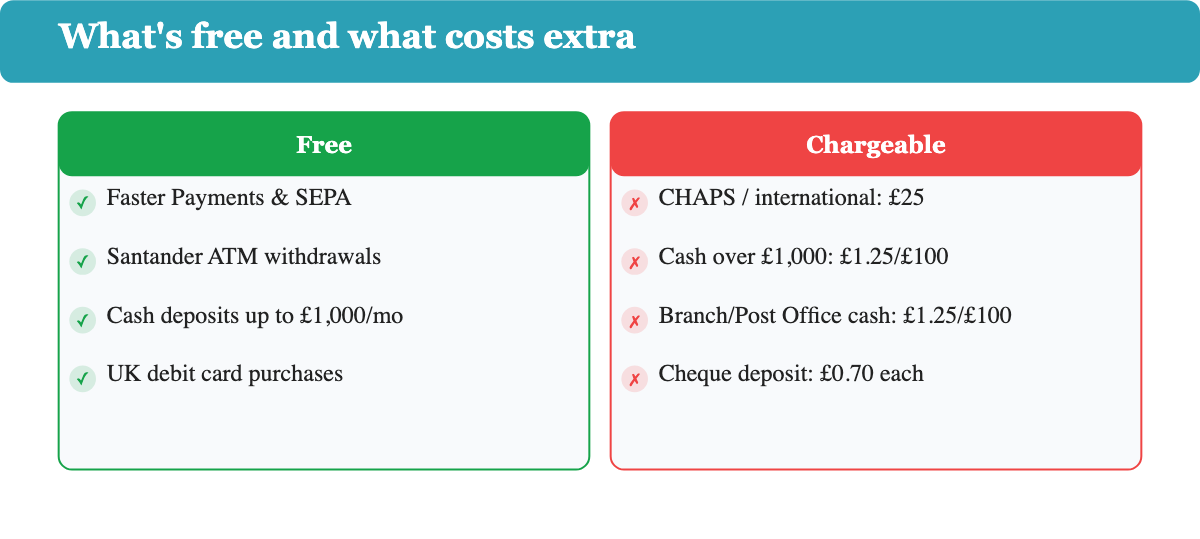
Cash handling has a genuinely free allowance that the account's marketing doesn't spell out in full. Paying cash in at a Santander cash machine is free up to £1,000 in each monthly billing period, then £1.25 for every £100 over that limit. Paying cash in at a Santander branch counter or a Post Office counter costs £1.25 per £100 from the first pound, with no free allowance. Withdrawing cash from a Santander or LINK cash machine is free, and there's no monthly limit stated in the tariff. Withdrawing cash at a Santander branch counter or a Post Office counter costs £1.25 per £100. A card payment or cash withdrawal in a foreign currency, or at a cash machine outside Santander's own network abroad, carries a 2.95% conversion fee (Santander's own cash machines in Spain are the one exception, where withdrawals stay free). Depositing a cheque costs £0.70, whichever channel you use to pay it in.
An arranged overdraft is available from £500 up to £25,000, subject to status, at a representative rate of 14.94% EAR (variable). Setting one up or renewing it costs an annual fee of 1.75% of the agreed limit, with a minimum charge of £100. Going over an agreed limit, or going overdrawn without one in place, is charged at the same 14.94% EAR (variable) as an unarranged overdraft, though Santander doesn't charge a separate fee for simply refusing a payment when there isn't enough money in the account.
Put together, a business that pays in cash under £1,000 a month, withdraws from Santander machines and sends ordinary Faster Payments will pay close to just the £9.99 base fee. But the costs that add up quickly are the ones outside that pattern: regular CHAPS or international payments at £25 each, cash deposits or withdrawals routed through a branch or Post Office counter instead of a Santander cash machine, and an overdraft carried at 14.94% EAR. Our verdict on Santander Everyday Current Account runs through a different Santander tariff for comparison.
Cards and payment methods
The Business Current Account Classic comes with a debit card as standard, and that debit card is free to use for UK purchases. A credit card isn't bundled with the current account, even though the application flow cross-sells it right alongside the debit card. Santander sells a separate Business Cashback Credit Card, offering 1% cashback on business spending, at a representative rate of 23.7% APR (variable) with an annual fee and a separate credit application subject to status. Treat the two as different products with different approval criteria, rather than one package. Apple Pay and Google Pay are both supported on the debit card through Santander's Mobile Payments service, and 3D Secure applies to online card transactions as standard across UK-regulated card issuers.
Virtual cards are not available on this account. That is a meaningful gap for businesses that issue cards to multiple team members or that want to assign cards to specific vendor relationships and control spending by card. Fintech competitors typically offer virtual card creation at no extra cost as a core feature. For businesses managing subscriptions across multiple software tools, the absence of virtual cards is a genuine operational limitation.
Cheque payments are accepted and can be paid in at a branch, Santander cash machine, through the Mobile Banking app's cheque imaging function, by post, or at a Post Office, each at the £0.70-per-cheque rate covered above. For certain sectors such as legal services, accountancy or property, cheque handling still matters, even if it's become rare elsewhere. Santander's ability to process cheques remains a differentiator over purely digital providers that have removed cheque support entirely.
Opening the account step by step
You can start an application online through Santander's business banking portal, or digitally if you're an eligible sole trader. The process requires standard Know Your Customer documentation: proof of identity (a valid passport or driving licence), proof of residential address and proof of what the business does, such as a business insurance policy, a recent supplier invoice or the business's last tax return. Limited companies and partnerships go through a separate eligibility and application route, while sole traders can usually check their digital eligibility directly, and it's worth doing that check before gathering documents.
To switch an existing business account to Santander, you use the Current Account Switch Service: Santander handles closing your old account and moving your payments, and the move completes within 7 working days, as long as your current bank is also part of the switch guarantee. Opening a brand new account instead generally takes longer than a mobile-only challenger bank's automated sign-up. Unlike Starling or Mettle's instant decisions, the process can involve a follow-up call or document review for some business structures. If you'd rather compare how a faster digital rival handles the same decision, this comparison shows where the offer sits: Mettle vs Tide.
Once approved, the account receives a UK sort code and account number, with an IBAN formatted to the GB standard. The IBAN matters for receiving international transfers and for connecting to accounting software through Open Banking, which Santander supports for Xero, QuickBooks, Sage and FreeAgent. New Xero customers can currently get 6 months free plus a £200 gift card, and the account also comes with free access to BrightHR lite plus other partner discounts, though Santander can withdraw these offers at any time. You can cancel the account free of charge at any point, including after the standard 14-day cancellation window, and Santander will return any remaining balance within 30 days.
App, features and customer service
The Santander Business app covers the core banking functions: balance checking, transaction history, Faster Payments, standing orders and direct debit management. The interface is functional without being particularly modern, and it still lacks the spending categorisation and real-time notifications that have become standard on challenger bank apps.
Customer service is available by phone, in branch and through online chat, with a dedicated relationship manager route for some business customers. Santander has committed to make no further business branch closures before 2028, which matters if a reliable local counter is part of why you'd choose this account over a branchless challenger. Speaking to a person for a complex query, such as a disputed transaction, tends to suit businesses that would rather talk something through than resolve it entirely through an app.
Business lending sits alongside the current account relationship in a way that pure digital accounts can't match. Santander can discuss an arranged overdraft, a business loan or trade finance in the same conversation as the current account, though all credit's subject to status, and it's a full review rather than an automated instant decision.
Reputation and real customer experience
Santander Business banking receives mixed reviews across Trustpilot and Google. Recurring praise centres on branch availability, the ability to speak to local relationship managers and the sense of security that comes from dealing with a well-established institution. Business owners in sectors that handle cash, deal with trade suppliers, or operate in regulated industries tend to rate the experience more positively because those sectors genuinely need the services Santander provides.
Recurring complaints focus on three themes. First, account-opening delays, particularly for limited companies or businesses where the automated checks raise queries. Second, transaction fees that surprise customers who did not read the tariff schedule carefully before opening, especially around CHAPS, international payments and counter-based cash handling. Third, responsiveness, with a number of reviewers noting that resolving a disputed transaction or fraud case took longer than expected through Santander's business banking channels.
Santander also publishes its results from an independent, CMA-mandated service quality survey (run by BVA BDRC, most recently in August 2026) that asks around 1,200 customers of each of the UK's 17 largest business current account providers, Santander included, whether they would recommend their bank. It's worth a look alongside Trustpilot, since it's run the same way across every major provider and gets updated every six months.
The £120,000 FSCS protection ceiling is consistently cited as a reassurance by existing customers, and Santander's financial stability as a subsidiary of Banco Santander S.A., one of Europe's largest banking groups by assets, provides an additional layer of institutional confidence. Complaints about app functionality compared to competitors appear regularly, though Santander has updated the business app interface in recent years and the gap has narrowed somewhat.
Verdict: open it or look elsewhere
Santander Business Current Account Classic earns its place for a specific type of business. If you run a bricks-and-mortar business that deposits cash regularly, value branch access, might need an overdraft, or operate in a sector where face-to-face banking builds commercial relationships, this account delivers what it promises, and most day-to-day activity within the free allowances costs nothing beyond the £9.99 monthly fee.
Look elsewhere if you are a freelancer, a sole trader with simple payment flows, or a small limited company that lives entirely in the cloud. The digital challengers offer free or near-free business accounts with more modern apps, faster onboarding and virtual card features that Santander doesn't provide. For those businesses, paying £9.99 a month for branch access and overdraft eligibility they are unlikely to use is a straightforward waste of margin.
The £120,000 FSCS protection ceiling is a genuine advantage over the old personal-account limit and is worth weighing into any decision involving significant business cash reserves. Combined with Santander UK's FCA regulation and the backing of a major European banking group, the safety credentials are solid. But safety and branch access alone don't justify the cost for every business type. Match the account to your actual operating model, and the answer becomes clear.
How safe is Santander UK Santander Business Current Account?
Santander UK Santander Business Current Account vs alternatives
A direct comparison of the key conditions against the strongest competitors in the market.
|  |  |  | |
| Rating | 3.0 /5 | 5.0 /5 | 4.0 /5 | 4.2 /5 |
| Monthly fee | £9.99 | £0.00 | £0.00 | £0 (£25 if avg. balance below £10,000) |
| Debit card | ✓ | ✓ | ✓ | ✓ |
| Credit card | ✓ | ✗ | ✗ | ✗ |
| Virtual credit cards | ✗ | ✗ | ✗ | ✓ |
| Free cash withdrawal | ✓ | ✓ | ✗ | ✓ |
| Number of sub-accounts | – | – | – | Several |
| Online banking users | – | – | – | Several |
| Electronic transfers | ✓ | ✓ | ✓ | ✓ |
| Apple Pay | ✓ | ✓ | ✓ | ✓ |
| Google Pay | ✓ | ✓ | ✓ | ✓ |
| 3D Secure for online payments | ✓ | ✓ | ✓ | ✓ |
| Deposit protection | £120,000 | £120,000 | ✗ | £120,000 |
How we rate
About the author

Frequently asked questions
The account is available to sole traders, partnerships and limited companies registered in the UK, with a maximum of two directors, owners or partners, who must be 18 or over and live in the UK. Santander carries out standard checks on business activity, director identity and creditworthiness as part of the application, so not all applicants will be approved automatically.
The standard monthly fee is £9.99. Start-ups and switchers both get the first 12 months without that fee, a standing offer rather than an occasional promotion, and the full £9.99 charge applies from month 13. Per-transaction fees for cash handling, cheques, CHAPS and international payments are charged separately on top of this, though ordinary Faster Payments and debit card purchases are free.
Santander UK is covered by the FSCS (Financial Services Compensation Scheme), which protects eligible deposits up to £120,000 per person per bank. For business accounts the business itself is the depositor, so the limit applies to the business entity as a whole rather than to each individual director.
You can start an application online or visit a Santander branch. You will need to provide proof of identity for all directors, company registration documents and details of your business activity. Approval for a sole trader can often be done digitally, while other business structures may involve a follow-up call or document review, which generally takes longer than a mobile-only challenger bank's automated sign-up.
Yes, the account supports 3D Secure authentication for online card transactions, and the mobile app uses biometric login. Santander's fraud detection is backed by a long track record in UK business banking, and the FCA and PRA both regulate the bank.
Business current accounts do not generally pay credit interest, and this account specifically pays none, so tax on interest is unlikely to be a primary concern. Any interest received on other balances would form part of trading income subject to Corporation Tax for limited companies, or Income Tax for sole traders. The Personal Savings Allowance applies only to individuals rather than companies, so limited companies should account for any interest through their standard Corporation Tax return.