
Metro Bank Business Current Account: review 2026
Last updated: 12.10.2026
Contents
Summary
The Metro Bank Business Current Account earns 70 out of 100 in our scoring, making it a solid mid-range option for UK businesses that value branch access and a named relationship manager over cutting-edge app features. The standout offer is 31 months of completely fee-free banking for businesses switching via CASS, the longest introductory period available from any UK high-street bank. It suits established SMEs carrying a balance above £6,000, though leaner startups may find the conditional fee structure a reason to look elsewhere.
Pros
- 31 months fee-free banking via CASS switch, the longest high-street offer in the UK
- Monthly fee waived whenever the balance stays above £6,000
- 76 branches open seven days a week including bank holidays
- Dedicated Local Business Manager as a named contact
- Visa debit card with Apple Pay and Google Pay support
Cons
- £8 monthly fee applies if the balance falls below £6,000 after the introductory period
- Per-transaction charges of 30p kick in below the £6,000 balance threshold
- No virtual cards or sub-accounts on the standard plan
- No native QuickBooks or Sage accounting integration included
Key facts
| Monthly fee | £0 (balance above £6,000 or first 31 months via CASS switch); otherwise £8/month |
| Debit card | ✓ |
| Credit card | ✓ |
| Virtual credit cards | ✗ |
| Free cash withdrawal | ✓ |
| Number of sub-accounts | ✗ |
| Online banking users | Several |
| Electronic transfers | ✓ |
| Apple Pay | ✓ |
| Google Pay | ✓ |
| 3D Secure for online payments | ✓ |
| Deposit protection | £120,000 |
| Rating | 3.5 /5 |
Strengths in detail
How well the provider covers the most important areas.
A closer look
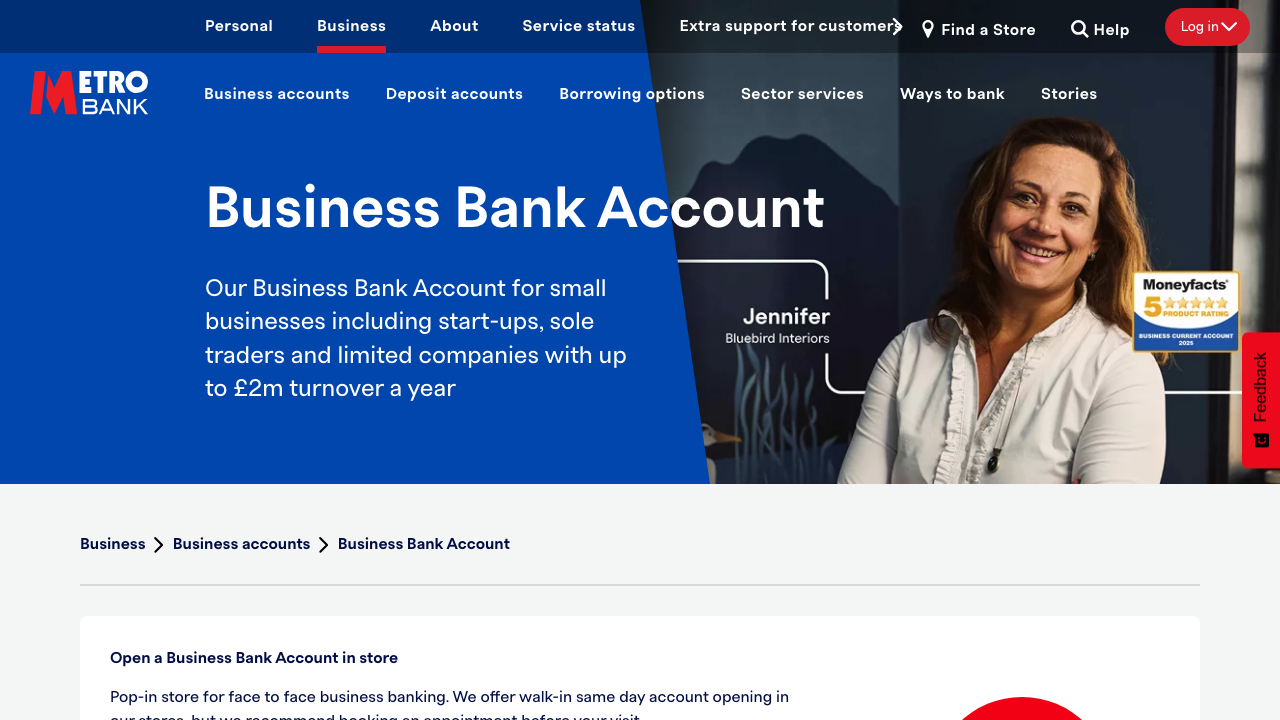
Overview: what the Metro Bank Business Current Account offers and who it suits
Metro Bank is one of the few genuine challengers to the traditional UK high-street giants, built on a branch-first philosophy at a time when everyone else was closing branches as fast as they could. Its Business Current Account carries that same identity forward: a physical banking proposition dressed up with modern payment features, aimed squarely at owner-managed businesses that still value walking into a branch and talking to an actual person.
The account makes most sense for established businesses in England that keep a reasonably healthy float. Hold a balance above £6,000 and the monthly fee drops to zero and per-transaction charges disappear entirely. Factor in the 31-month fee-free introductory period available to switchers using the Current Account Switch Service (CASS), and the total cost of ownership for the first two-and-a-half years is genuinely zero. That is the longest fee-free window any UK high-street bank currently offers switchers. If it is not the right fit, we compared the strongest Tide alternatives.
Who should not apply? Businesses that regularly run lean balances will pay £8 per month plus 30p per transaction once the introductory period ends. Sole traders or micro-businesses that need multiple team members managing money across virtual cards or sub-accounts will find Metro Bank's standard offering thin. Equally, if your workflow depends on a direct, native Sage or QuickBooks sync baked into the dashboard, you will not find it here. We place the providers in context in this comparison: Tide vs Starling.
Real costs and less obvious fees
The headline pricing is simple enough. During the 31-month CASS switch window, or whenever your end-of-day balance sits at or above £6,000, the account is free: no monthly charge, no per-transaction fee for standard UK payments. Drop below that £6,000 threshold after the introductory period ends and two charges activate simultaneously: a £8 monthly account fee and a 30p fee on each individual payment or receipt. For a business processing, say, 80 transactions a month at that point, the monthly bill reaches £32. That is not ruinous, but it is material and worth building into a cash-flow model before switching. Anyone thinking about switching will find options among the Starling alternatives.
Cash withdrawals from ATMs in the UK are included at no additional charge. Foreign currency spending on the Visa debit card carries the standard Metro Bank exchange rate loading; the bank does not publish a precise FX margin figure for business accounts, so treat it as a card best used domestically. Faster Payments and CHAPS are available; CHAPS carries a per-transaction fee consistent with Metro Bank's published tariff, which you should download and review before making regular large outbound payments. Instant transfers within the Faster Payments network are covered under the main transaction fee structure. Our verdict on Metro Bank Current Account runs through the strengths and the drawbacks.
There are no tiered plan upgrades on the standard business account in the way neobank competitors structure their products. Metro Bank keeps it binary: above £6,000 balance or inside the switch window equals free banking; below equals flat fee plus per transaction. For businesses with predictable, healthy reserves, this model is transparent and cheap. For businesses with volatile cash positions, it can generate unexpected monthly bills.
Cards and payments in practice
The account comes with a Visa debit card as standard and a business credit card is also available through Metro Bank separately. The debit card is contactless and supports both Apple Pay and Google Pay, which means day-to-day payments at terminals work exactly as you would expect in 2026. 3D Secure is active for online card payments, adding the standard authentication layer for e-commerce transactions.
In our test, card setup in both Apple Wallet and Google Wallet completed without friction. Contactless limits follow the standard UK £100 per tap threshold. What Metro Bank does not offer on the standard account are virtual cards: you cannot spin up a temporary card number for a one-off supplier payment or issue separate virtual cards to team members. Sub-accounts are also absent. If you need either of those features, competitors such as Starling or Allica Bank provide them as part of their business offerings. How it holds up day to day is covered in our Allica Bank Business Rewards Account review.
Multiple users can be granted online banking access, which covers day-to-day payment approvals and account monitoring. The permissions structure is suitable for a business with a bookkeeper or accounts assistant who needs read or payment access without full admin rights. The specifics of permission tiers are worth clarifying with Metro Bank before onboarding a second user, as the granularity differs from dedicated multi-user platforms.
Opening the account step by step
Metro Bank offers both in-branch and online application routes for its business account. For most straightforward limited companies and sole traders, the online application is the faster path. You will need to provide your Companies House registration number for a limited company, a government-issued photo ID (passport or driving licence), proof of business address, and basic financial information about your trading activity. Sole traders need proof of identity and address plus details of their business. For the wider picture, see our comparison: Current account switch offers.
Verification is handled through a combination of automated checks against public registries and, where needed, document upload. Metro Bank does conduct manual review for some applications, which means approval is not always instant. The bank is transparent that complex structures, such as businesses with foreign directors or multi-layered ownership, may require additional documentation and a longer timeline.
Once approved, a UK sort code and account number are issued. Your IBAN begins with GB, reflecting the UK banking infrastructure Metro Bank operates on. If you are switching an existing business account using CASS, Metro Bank manages the redirect of incoming payments and direct debits on your behalf. The CASS switch window is what triggers the 31-month fee-free period, so it is worth using the formal switch service rather than simply opening a new account and manually moving everything across. Debit cards arrive by post; in-branch collection is also possible at one of the 76 open branches.
App, platform features and customer service
Metro Bank's mobile and online banking platforms cover the core business banking tasks: viewing balances and transactions, making and authorising payments, and managing payees. The app is available for both iOS and Android. It is functional rather than cutting-edge; the interface has improved over recent years but does not match the UX polish of newer pure-digital competitors. Notifications, basic spend categorisation, and statement downloads are all present.
The integration story is the biggest gap on the digital side. There is no native accounting software sync built into the account. You can export statements in formats compatible with most bookkeeping tools, but the automated feed that QuickBooks, Xero, or Sage users expect from neobank competitors requires a third-party connection via Open Banking rather than a built-in toggle. For many small businesses this is a workflow friction point that adds a few minutes per reconciliation cycle.
Where Metro Bank genuinely differentiates is human access. Each business customer is assigned a named Local Business Manager, a dedicated point of contact rather than a rotating call-centre queue. The 76 branches operate seven days a week, including bank holidays, which is unique among UK business banks of Metro Bank's size. For businesses that need occasional face-to-face support, loan discussions, or simply prefer not to resolve problems via live chat, this is a structural advantage that no app-only competitor can replicate.
Safety: FSCS protection and the regulatory picture
Metro Bank is authorised and regulated by the Financial Conduct Authority (FCA) and the Prudential Regulation Authority (PRA). Business deposits held with Metro Bank are protected by the Financial Services Compensation Scheme (FSCS) up to £120,000 per eligible business. The FSCS limit rose from £85,000 to £120,000 on 1 December 2025. Not all businesses qualify for FSCS protection; the scheme covers small businesses that meet specific criteria, so it is worth verifying your eligibility if you are a larger trading entity.
Metro Bank was founded in 2010 as the first new high-street bank to launch in the UK in over a century. It is listed on the London Stock Exchange. The bank went through a period of significant financial difficulty in 2023 following an accounting error that required a capital raise and resulted in a majority stake being acquired by Colombian billionaire Jaime Gilinski Bacal. Since then, Metro Bank has undergone management restructuring and cost reduction. The bank continues to operate as a fully licensed UK bank under normal FCA and PRA supervision. Depositors with balances within the FSCS limit remain fully protected throughout any corporate change of control.
What real customers say
Across Trustpilot reviews and business banking forums, Metro Bank's branch availability and staff quality appear repeatedly as the primary reason customers stay. Business owners particularly mention the value of having a named relationship manager who knows their account, contrasting this with impersonal experiences at larger banks where every call starts from scratch. Weekend branch access draws consistent positive comments from sole traders and small business owners who cannot take time away from the business during the week.
The recurring criticisms cluster around two areas. First, the balance-linked fee structure catches businesses that experience a cash-flow dip: an unexpected month below £6,000 triggers both the monthly fee and per-transaction charges simultaneously, and some reviewers describe feeling surprised by bills they did not anticipate. Second, the digital experience draws repeated comparisons to Starling or Tide, with reviewers noting slower feature development and the absence of accounting integrations. A minority of reviews mention delays in complaint resolution through remote channels, though in-branch resolution is generally reported as faster.
The pattern suggests Metro Bank works well for businesses that use it as a complementary account alongside their existing relationship, or as a primary account for those who genuinely value physical banking and maintain a comfortable buffer above £6,000. It performs less well as a sole banking solution for lean, fast-moving businesses that live in their accounting software.
Verdict: open it or look elsewhere
Metro Bank's Business Current Account earns its place for a specific type of UK business: one that keeps a balance reliably above £6,000, operates primarily in the UK, values face-to-face banking, and is switching from an existing bank account. For that profile, 31 months of completely free banking via CASS, combined with 76 seven-day branches and a named Local Business Manager, is a compelling package that larger banks cannot match on service access and that digital banks cannot match on physical presence.
Look elsewhere if your balance fluctuates below £6,000 regularly, if you need virtual cards or sub-accounts for team expense management, or if a tight accounting software integration is non-negotiable in your day-to-day workflow. Starling Bank's business account offers no monthly fee regardless of balance and native Xero integration. Allica Bank suits businesses with larger deposit volumes. The Metro Bank account is not for every business, but for the right business it remains one of the better-value full-service options on the UK high street.
How safe is Metro Bank Business Current Account?
Metro Bank Business Current Account vs alternatives
A direct comparison of the key conditions against the strongest competitors in the market.
 |  |  |  | |
| Rating | 3.5 /5 | 5.0 /5 | 4.2 /5 | 4.2 /5 |
| Monthly fee | £0 (balance above £6,000 or first 31 months via CASS switch); otherwise £8/month | £0.00 | £0 (£25 if avg. balance below £10,000) | Free |
| Debit card | ✓ | ✓ | ✓ | ✓ |
| Credit card | ✓ | ✗ | ✗ | ✗ |
| Virtual credit cards | ✗ | ✗ | ✓ | ✓ |
| Free cash withdrawal | ✓ | ✓ | ✓ | ✗ |
| Number of sub-accounts | ✗ | – | Several | Several |
| Online banking users | Several | – | Several | Several |
| Electronic transfers | ✓ | ✓ | ✓ | ✓ |
| Apple Pay | ✓ | ✓ | ✓ | ✗ |
| Google Pay | ✓ | ✓ | ✓ | ✗ |
| 3D Secure for online payments | ✓ | ✓ | ✓ | ✓ |
| Deposit protection | £120,000 | £120,000 | £120,000 | Nein (safeguarded, not FSCS) |
How we rate
About the author

Frequently asked questions
The account is open to UK-registered businesses including sole traders, partnerships, and limited companies. Applicants must pass Metro Bank's KYB and KYC checks, which means providing identification for directors and beneficial owners. Non-UK residents or businesses registered outside the UK are generally not eligible.
Businesses switching via CASS get 31 months completely fee-free. After that introductory period, the monthly fee is £8, but only applies if the account balance falls below £6,000. A per-transaction charge of 30p also applies when the balance is below that threshold.
Yes. Metro Bank is authorised by the PRA and regulated by the FCA and PRA. Business deposits are covered by the FSCS (Financial Services Compensation Scheme) up to £120,000 per person per bank. This is the standard UK statutory protection and applies automatically.
You can apply online or visit one of Metro Bank's 76 branches, which are open seven days a week including bank holidays. The process involves standard business and identity verification. Most straightforward applications are completed within a few business days, though more complex structures may take longer.
The account is regulated by the FCA and PRA, two of the UK's main financial regulators. Payments are protected by 3D Secure for online transactions. FSCS deposit protection covers balances up to £120,000. Metro Bank also provides a dedicated Local Business Manager as an additional point of contact for account-related concerns.
Interest earned on a UK business current account is treated as trading income or savings income depending on the business structure, and is subject to standard UK tax rules. Individual business owners benefit from the Personal Savings Allowance where applicable. Businesses should consult a UK accountant for their specific tax position, as the treatment varies between sole traders, partnerships, and limited companies.