
HSBC Business Current Account: review 2026
Last updated: 07.10.2026
Contents
Summary
The HSBC Business Current Account scores 60 out of 100 in our evaluation, reflecting a solid but traditional offering that costs £10 per month once any introductory period ends. It suits established businesses that value branch access, relationship managers and a full suite of lending products, but growing startups wanting fast digital onboarding and lower fees will find sharper alternatives.
Pros
- Established UK bank with branch network and dedicated relationship support
- Choice of Small Business and larger Business tariffs to match company size
- Access to overdrafts, trade finance and business lending under one roof
- Introductory fee-free period available for eligible new startups
- Debit and credit cards included with Apple Pay and Google Pay support
Cons
- Monthly fee of £10 applies once the introductory period expires
- Per-transaction charges on the standard tariff add cost for high-volume users
- Onboarding is slower than digital challengers such as Starling or Mettle
- No virtual cards available for online expense management
Key facts
| Monthly fee | £10.00 |
| Debit card | ✓ |
| Credit card | ✓ |
| Virtual credit cards | ✗ |
| Free cash withdrawal | ✗ |
| Number of sub-accounts | – |
| Online banking users | – |
| Electronic transfers | ✓ |
| Apple Pay | ✓ |
| Google Pay | ✓ |
| 3D Secure for online payments | ✓ |
| Deposit protection | £120,000 |
| Rating | 3.0 /5 |
Strengths in detail
How well the provider covers the most important areas.
A closer look
The HSBC Business Banking Account suits established UK businesses that want a branch network, a named relationship manager and access to borrowing. It costs nothing for the first 12 months on your first primary account, then £10 a month. If all you need is a free account for everyday payments, you'll probably do better with a digital account that charges no monthly fee. The rest of this review explains who the account is for, what it costs in practice, and where the charges are changing on 14 December 2026.
Is the HSBC Business Banking Account worth opening?
Open it if your business is established, has UK tax residency, and will use HSBC for lending, international payments or cash handling. HSBC says its Relationship Managers work with businesses that want to borrow over £100,000, both in the UK and internationally, and the account supports international payments in most currencies. But skip it if you only need a low-cost account for card payments and transfers, because digital accounts from other providers may cost you less each month.
The price is the main question. After the first 12 months, the account costs £10 a month before any transaction charges. Cash and cheque handling adds to that cost, and CHAPS or international payments cost more again, so a business that moves money this way should model its own figures before deciding. The worked example later in this review shows how a typical month adds up.
Which HSBC business account fits your business?
HSBC runs two business current accounts, aimed at different types of customer. The Business Banking Account is for established businesses with UK tax residency, and it's the account this review covers. The Small Business Banking Account is for start-ups, small businesses and businesses switching their bank. It has no monthly account fee, and HSBC lists borrowing of up to £100,000 on it, subject to eligibility, affordability and credit checks.
| Account | Monthly account fee | Who HSBC says it is for | Borrowing |
|---|---|---|---|
| Business Banking Account | Free for 12 months on the first primary account, then £10 a month | Established businesses with UK tax residency | Businesses borrowing over £100,000 are handled by Relationship Managers |
| Small Business Banking Account | No monthly account fee | Start-ups, small businesses and businesses switching their bank, with UK tax residency | Up to £100,000, subject to eligibility, affordability and credit checks |
Deposits are protected by the Financial Services Compensation Scheme (FSCS) up to £120,000 per person per banking licence, according to the FSCS. First direct shares HSBC's banking licence, so deposits held with both count toward the same limit. That matters if you keep business reserves across HSBC brands.
Check the eligibility wording before you apply. A company that has only just been set up will usually be pointed to the Small Business Banking Account instead. If you're switching from another bank, the Current Account Switch Guarantee covers both accounts, which is covered in the closing and switching section below.
What does the HSBC business account cost?
During the free period, HSBC says standard day-to-day transactions listed on pages 6 to 15 of its price list are free, and that some other transactions and services still carry charges. The cash, cheque and payment charges in the next three subsections therefore apply once the free period ends, or to a second account from day one. The Business Banking Account costs £10 a month after the first 12 months. The introductory free period covers your first primary account only. Any additional Business Banking Account isn't eligible for the free period, so it pays the monthly fee from the start. Standard electronic transfers, including Direct Debits, standing orders and Bill Payments made through Business Internet Banking, are free on both HSBC business accounts.
If you want a no-fee option, compare the alternatives in our guide to the best free business bank accounts in the UK.
Monthly account fee
The monthly fee is free for the first 12 months on your first primary account. After that, the Business Banking Account charges £10 a month. Keep that date in mind when you open the account, because the fee starts automatically once the free period ends, and it's easy to miss if you're not watching for it.
Cash and branch transactions
Cash is where most businesses pay more than they expect, and HSBC is restructuring how it charges for it. Under the current Business Price List, a branch or self-service cash deposit is charged in two parts: a flat £1.50 credit charge, plus 1.5% of the value you pay in. From 14 December 2026, HSBC drops the flat charge for pure cash deposits and replaces both parts with one percentage rate, though it prices a self-service deposit separately from a branch deposit for the first time, at a lower rate than the counter. Withdrawals follow the same pattern: a flat per-withdrawal charge plus a percentage today, one all-in percentage from 14 December 2026.
| Charge | Current rate (until 13 December 2026) | From 14 December 2026 |
|---|---|---|
| Branch cash in (paying cash in at the counter) | £1.50 per credit, plus 1.5% of the value deposited | 2% of the value deposited, no separate credit charge |
| Self-service cash in (self-service machine or Multi-bank ATM) | Charged the same as branch cash in: £1.50 per credit, plus 1.5% | Priced separately from branch for the first time: 1.5% of the value deposited, no credit charge |
| Post Office cash in | £1.50 per credit, plus 1.5% of the value deposited | 1.5% of the value deposited, no separate credit charge |
| Branch cash out (withdrawing cash at the counter) | £1.50 per withdrawal, plus 1.5% of the value withdrawn | 2% of the value withdrawn, no separate withdrawal charge |
| Cash machine withdrawal (UK only) | 25p per withdrawal, plus 0.6% of the value withdrawn | Free |
The practical effect depends on how you bank cash. A business making small, frequent branch deposits loses the flat £1.50 charge but pays a higher percentage, which is roughly break-even around the £150 to £300 mark and gets worse for larger deposits. A business that switches frequent small deposits to a self-service machine instead of the counter benefits most from the December 2026 change, since self-service becomes the only lane still priced below 2%. Non-HSBC cash machines may still charge their own fees on top of HSBC's rate, so a free HSBC cash-out rate doesn't guarantee a free withdrawal everywhere.
Cheques
Cheques are cheaper through the app than at the counter, although this part of the price list isn't changing on 14 December 2026. A mobile cheque deposit costs 50p per cheque under the current list, and HSBC keeps that charge in its 2026 list unchanged. A branch cheque credit costs £1.50 per credit plus 50p per cheque both before and after the change, so unlike cash, HSBC isn't merging the flat and percentage-style charges for cheques.
CHAPS, international and other payments outside the free list
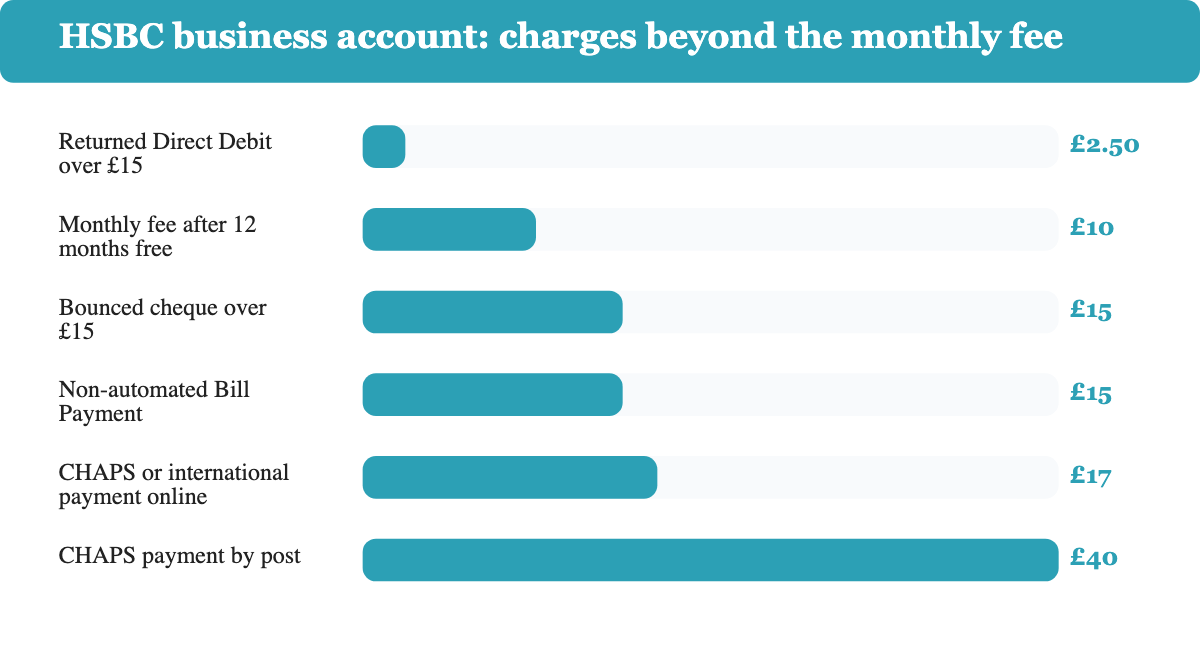
Business Internet Banking excludes CHAPS, international, SEPA and mobile cheque payments from its free standard digital transactions, and HSBC prices each of them separately. A CHAPS payment costs £17 by Business Internet Banking, £20 by phone or in branch to another HSBC UK account (£30 to an account at another bank), or £40 by post. An international payment by Business Internet Banking costs £17, and HSBC says it supports most currencies. None of these charges are among the items changing on 14 December 2026.
Two charges catch businesses out when cash flow is tight. A standing order, Direct Debit or forward-dated Bill Payment that HSBC returns for insufficient funds is free up to £15 and costs £2.50 over £15. A cheque that bounces for the same reason is free up to £15 and costs £15.00 over £15. A non-automated Bill Payment made by phone, in branch or by post costs £15.00 per payment, against a free Bill Payment made through Business Internet Banking or automated telephone banking, so routing payments through the app or online rather than the branch avoids that charge entirely.
What does a typical month cost?
A business that pays in cheques and cash most weeks, and makes an occasional CHAPS payment, will pay more than the £10 fee alone. The example below uses one month after the free period ends, with 10 mobile cheque deposits, one £500 branch cash deposit, and one CHAPS payment sent by Business Internet Banking. It is built from HSBC's published charges, not from a test account.
| Item in the month | Current charges (£) | From 14 December 2026 (£) |
|---|---|---|
| 10 mobile cheque deposits at 50p each | 5.00 | 5.00 |
| One branch deposit of £500 cash | 9.00 (£1.50 per credit plus 1.5% of £500) | 10.00 (2% of £500, no credit charge) |
| One CHAPS payment by Business Internet Banking | 17.00 | 17.00 |
| Monthly account fee | 10.00 | 10.00 |
| Total | 41.00 | 42.00 |
In this example the 14 December 2026 change adds £1 to the monthly total, because dropping the flat £1.50 credit charge on a £500 deposit saves less than the extra 0.5 percentage points costs. The gap grows with deposit size: a business paying in £5,000 at the branch each month would pay £76.50 under the current rate (£1.50 plus 1.5% of £5,000) and £100 under the 2026 rate (2% of £5,000), an increase of £23.50 before the monthly fee, cheques or any CHAPS and international payments. The CHAPS and Bill Payment charges above are often the biggest single line in a business's HSBC bill, and they don't change on 14 December 2026, so routing payments through free channels matters more here than the cash-fee update.
How long does it take to open an HSBC business account?
HSBC states that 65% of accounts were opened within 24 hours, based on March to May 2026 data. That figure is given in a footnote on the Small Business Banking Account page, so it describes that account, not the Business Banking Account. Treat it as an indication of how quickly applications can move, not as a promise for your own application.
Plan for the possibility that an application takes longer, or isn't approved at all. Eligibility depends on your business profile, and HSBC reviews each application against its own criteria. If you're a start-up, check the Small Business Banking Account first, because the Business Banking Account is for established businesses. A business that needs to borrow more than £100,000, or that trades internationally and needs multi-currency payments, is more likely to be the profile HSBC built the Business Banking Account for.
What is the app and card set like?
What the app and Business Internet Banking let you do
The HSBC UK Business Banking app and Business Internet Banking let you manage payments, view balances and transactions, deposit cheques securely, manage standing orders and Direct Debits, and control your cards. Open banking technology lets you top up from an external account, and a connected-accounts view shows linked UK business or personal accounts in one place. The free digital transactions covered earlier don't include CHAPS, international, SEPA or mobile cheque payments, which is why those sit in a separate pricing section rather than inside the free standard transfers.
The Commercial Card
The Commercial Card is a separate product for business spending, distinct from the Business Debit Card that comes with the account. It carries a representative 22% APR (variable) and a £32 annual fee per card, which is waived for the first year. Compare it with the credit card you already use before you decide whether the annual fee and 22% APR suit how you spend. If you only need a debit card, the Business Debit Card is the simpler choice, and debit card payments are free under the current Business Price List.
Getting help from HSBC
Support runs through three channels: a Telephone Banking Team for discussing your banking in detail, a Live Chat function available to Business Internet Banking customers, and 24/7 online assistants for everyday queries. There is no published guarantee on how quickly a Telephone Banking query is resolved, so for anything urgent, use whichever channel you've found fastest in practice with your own relationship team.
What do customers report?
We haven't turned customer opinion into a score for this review. No primary source gives a usable, comparable measure of customer satisfaction, and review platforms show a mix of positive and negative experiences that depend on the business type and the branch involved. Read recent reviews on several platforms before you decide, and pay particular attention to comments about account opening, cash handling and how quickly problems are resolved, because those are the areas where HSBC's charges and processes matter most to a business.
How do you close or switch away from the account?
HSBC lists the Current Account Switch Guarantee on its business account pages. Switching to a Business Banking Account through the Current Account Switch Service normally takes seven working days. If something goes wrong during the switch, HSBC says it will refund any interest or charges you incur as a result. Check the terms of the service before you start, especially if you've got standing orders, Direct Debits or incoming payments that need to move at a specific time.
If you're leaving rather than joining, ask HSBC for its closing process in writing, and keep a record of when the account was closed. A monthly fee that continues after you've stopped using the account is a common problem, so confirm the closing date before you open a new account elsewhere.
Frequently asked questions
Is the HSBC Business Banking Account free?
The HSBC Business Banking Account is free for the first 12 months on your first primary account. After that, it costs £10 a month. Additional Business Banking Accounts don't get the free period.
Can a start-up open a Business Banking Account?
HSBC describes the Business Banking Account as being for established businesses with UK tax residency. Start-ups and businesses switching their bank are pointed to the Small Business Banking Account, which has no monthly account fee.
Does HSBC charge for debit card payments?
No, debit card payments are listed as free in the current Business Price List, unlike CHAPS and international payments, which carry their own separate charges.
Does HSBC charge for CHAPS or international payments?
Yes, a CHAPS payment costs £17 by Business Internet Banking, rising to £20 to £40 by phone, branch or post, and an international payment by Business Internet Banking costs £17. Neither charge is among the items changing on 14 December 2026.
Are HSBC business banking charges changing?
Yes. From 14 December 2026, HSBC is restructuring its cash charges. A branch cash deposit or withdrawal moves from a flat fee plus a percentage to one all-in percentage, Post Office and self-service cash deposits each get their own flat-free percentage rate, and cash machine withdrawals become free. Cheque, CHAPS and international charges stay the same. HSBC states it'll notify existing customers about the changes.
Sources
- HSBC UK, Business Banking Account (accessed 7 October 2026): eligibility, the free period, the £10 monthly fee, Relationship Manager borrowing, international payment availability, Switch Guarantee, Commercial Card terms, app and Business Internet Banking features, support channels.
- HSBC UK, Small Business Banking Account (accessed 6 October 2026): eligibility, no monthly account fee, the 24-hour opening figure and its footnote.
- HSBC UK, Business Price List (current): cash, cheque, CHAPS, international, Bill Payment and returned-payment charges.
- HSBC UK, Business Price List (from 14 December 2026): the changed cash charges.
How safe is HSBC UK HSBC Business Current Account?
HSBC UK HSBC Business Current Account vs alternatives
A direct comparison of the key conditions against the strongest competitors in the market.
 |  |  |  | |
| Rating | 3.0 /5 | 5.0 /5 | 4.0 /5 | 4.2 /5 |
| Monthly fee | £10.00 | £0.00 | £0.00 | £0 (£25 if avg. balance below £10,000) |
| Debit card | ✓ | ✓ | ✓ | ✓ |
| Credit card | ✓ | ✗ | ✗ | ✗ |
| Virtual credit cards | ✗ | ✗ | ✗ | ✓ |
| Free cash withdrawal | ✗ | ✓ | ✗ | ✓ |
| Number of sub-accounts | – | – | – | Several |
| Online banking users | – | – | – | Several |
| Electronic transfers | ✓ | ✓ | ✓ | ✓ |
| Apple Pay | ✓ | ✓ | ✓ | ✓ |
| Google Pay | ✓ | ✓ | ✓ | ✓ |
| 3D Secure for online payments | ✓ | ✓ | ✓ | ✓ |
| Deposit protection | £120,000 | £120,000 | ✗ | £120,000 |
How we rate
More comparisons
About the author

Frequently asked questions
The account is open to UK-registered businesses including sole traders, partnerships and limited companies. HSBC applies standard eligibility checks covering business type, industry sector and the identity of directors and beneficial owners, so some business categories may not qualify.
The monthly fee is £10 after any introductory period. The standard tariff also applies per-transaction charges for payments in and out, so total monthly cost depends on how many transactions the business processes.
Deposits with HSBC UK are covered by the FSCS up to £120,000 per person per bank. HSBC UK is authorised by the PRA and regulated by the FCA and PRA, giving customers access to this statutory protection scheme.
You can start an application online through the HSBC business banking website. Depending on your business structure, HSBC may ask you to complete further identity and business verification steps, which can include speaking with a representative or providing additional documentation.
Yes. HSBC UK operates under FCA and PRA oversight and uses 3D Secure for online card payments, biometric login on the mobile app, and time-sensitive authentication codes for high-value transactions. Standard bank-grade fraud monitoring runs continuously in the background.
Business accounts do not typically generate savings interest, so the Personal Savings Allowance is less directly relevant here than for personal accounts. Any interest earned on credit balances is subject to normal UK tax rules, and businesses should account for bank charges as a deductible business expense in their tax returns.