
Halifax Current Account: review 2026
Last updated: 25.09.2026
Contents
Summary
The Halifax Current Account is a fee-free current account from one of the UK's largest high-street banks, backed by FSCS protection up to 120,000 GBP per person per bank. It suits everyday banking customers who value branch access and the option to earn a monthly reward, though challengers like Monzo and Starling now outperform it on app features and international spending. In our test it works well as a no-frills main account, but only if you are prepared to meet the Reward conditions to get anything back from it.
Pros
- No monthly fee on the standard account
- Reward account pays a cash incentive when monthly conditions are met
- Extensive branch network across the UK for in-person support
- Apple Pay and Google Pay fully supported
- Established brand with a full product range including overdrafts and savings
Cons
- Reward cash-back requires meeting spending and payment conditions each month
- No in-credit interest on the standard account balance
- Overdraft interest rates can be high compared with challengers
- Weaker app functionality than Monzo, Starling or Chase
Key facts
| Monthly fee | £0/month |
| Debit card | ✓ |
| Credit card | ✗ |
| Apple Pay | ✓ |
| Google Pay | ✓ |
| Cash withdrawal abroad | Free (no Halifax foreign currency fee on standard debit card) |
| Online account opening | ✓ |
| Deposit protection | 120.000 |
| iOS app | ✓ |
| Branches | ✓ |
| Rating | 3.0 /5 |
Strengths in detail
How well the provider covers the most important areas.
What is the Halifax Current Account and who is it for?
Halifax is one of the UK's largest retail banks, tracing its roots back to 1853 as a building society in West Yorkshire before demutualising and eventually becoming part of Lloyds Banking Group. The Halifax Current Account sits at the entry level of that long history: a free, straightforward everyday account aimed at people who want a recognisable high-street name, a physical branch nearby, and a debit card that works everywhere without a monthly fee. We went through the fees and features in our review of Yorkshire Building Society Savings Account.
The core appeal is simplicity. There are no tiered subscription plans, no minimum balance thresholds to avoid charges, and no complicated onboarding for residents who can verify their identity in a local branch. For someone making their first switch away from another legacy bank, or for a parent wanting a secondary account to separate household spending, the proposition is clean and uncomplicated. Anyone thinking about switching will find options among the Chase alternatives.
That said, this account is not well matched to people who travel frequently and need multi-currency wallets, nor to those who want in-credit interest on their balance. Tech-first users who expect instant payment notifications, savings pots, or budgeting tools baked into the app will also find the experience underwhelming compared with challenger banks. The Halifax Current Account rewards loyalty to the high street, not innovation.
Real costs and hidden fees
The headline figure is clear: £0 per month. Halifax charges no standard monthly fee, which is the first thing most people ask about. Beneath that headline, the picture is more nuanced. Using your debit card abroad attracts no Halifax foreign-currency fee, which is a genuine plus for occasional overseas trips. That means the bank itself doesn't layer on a conversion surcharge, though Visa's own wholesale exchange rate still applies and the ATM operator may charge a local fee. Which accounts else are worth a look is covered here: Monzo vs Starling.
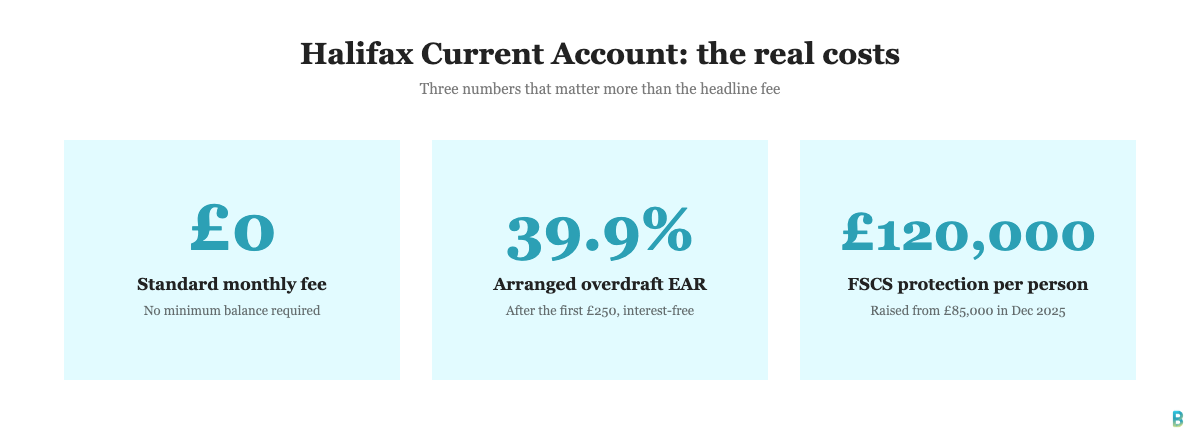
Overdrafts are where the cost picture shifts significantly. The arranged overdraft is interest-free on the first £250, then charged at 39.9% EAR variable on anything beyond that (representative 30.5% APR variable, based on an assumed £1,200 overdraft), which is genuinely steep next to what you'd expect from a no-fee account. If you regularly dip past the £250 buffer, the monthly interest can quickly outweigh any savings made from avoiding a monthly fee. Going into an unarranged overdraft adds a separate £5 daily fee, so this isn't an account to rely on as informal short-term credit. We place the providers in context in this comparison: Best Business Account for Limited Company UK.
Instant Faster Payments, standing orders, and Direct Debits all come free of charge, as does accessing your balance via any Halifax or Bank of Scotland ATM. CHAPS payments for larger same-day transfers carry a fee, as they do across virtually every UK retail bank. There are no charges for paper statements if you require them, though Halifax encourages paperless communication.
Cards and payments
Halifax issues a Visa debit card as standard. There is no credit card bundled into the account, and the bank's own credit card products are separate applications entirely. The Visa debit card is accepted everywhere the network is recognised, which in practice covers the overwhelming majority of UK and international merchants.
Both Apple Pay and Google Pay are supported, which means contactless payments via smartphone or smartwatch work out of the box once you add the card in the respective wallet. Contactless limits follow the UK standard, currently £100 per tap. Halifax does not issue virtual-only card numbers for online shopping, so if you want a disposable card for subscriptions, you will need a separate service.
In our test, adding the Halifax debit card to Apple Pay took under two minutes and the first contactless payment cleared instantly. That part of the experience is polished. Where Halifax lags behind challengers is the absence of any spending categorisation or real-time push notifications for each transaction; the app updates balances promptly, but the granularity of spend data is basic by 2026 standards. We went through the fees and features in our review of Halifax.
Opening the account step by step
Halifax accepts applications online, through its mobile app, by telephone, or in a branch. The online route is the fastest for most people. You will need to provide your full name, date of birth, current address history covering the past three years, National Insurance number, and contact details. Halifax performs a credit check as part of the application, which will leave a footprint on your credit file even for a basic current account.
Identity verification is handled digitally for most applicants using a soft biometric check against documents such as a passport or UK driving licence. If the automated check cannot match your documents, Halifax may ask you to visit a branch with original ID, which is straightforward given the branch network. For applicants with a complex address history or those who have recently arrived in the UK, the in-branch route tends to be smoother and faster.
Once approved, Halifax typically dispatches the debit card and PIN separately for security, so allow up to seven working days before you have both in hand. Your UK sort code and account number are provided immediately on approval, meaning you can start receiving payments or setting up a salary redirect before the physical card arrives. The IBAN follows the standard GB format required for international incoming transfers.
App, features and customer service
The Halifax mobile app is available on iOS and Android and covers the core functions: balance check, transaction history, transfers, bill payments, and statements. Halifax has progressively updated the app over the past two years, adding biometric login and improved navigation, though it still feels more conservative than fintech alternatives. The interface is clean and accessible, particularly for older users who find busier app designs confusing.
Standout features include the ability to freeze and unfreeze your card instantly within the app, set spending limits for online card use, and access your credit score through a partnership with a credit reference agency. These are functional rather than exciting additions, but they address genuine everyday needs without requiring you to use a separate app.
Customer service operates via telephone, in-branch, and secure messaging within the app. Halifax maintains one of the larger branch and ATM networks among UK retail banks, which matters to customers who still want face-to-face help for complex queries. Wait times on the telephone lines have attracted criticism during busy periods, and the in-app chat response times can run to several hours for non-urgent issues. Lloyds Banking Group's broader back-office infrastructure means major technical outages are relatively rare, but they do occur; the 2023 and 2024 intermittent outages affecting online banking received significant press coverage.
Reputation and real customer experience
Halifax sits in a crowded middle tier of UK current account providers. On consumer review platforms the feedback is mixed in predictable ways. Customers who value the branch network and long-standing brand trust tend to leave positive reviews, citing reassurance during disputes, ease of resolving fraud cases in person, and the familiarity of a bank that has been on the high street for generations. The Reward account variant charges a £3 monthly fee, waived if you pay in £1,500 or more each month, and pays a £5 monthly reward plus 3% AER on balances up to £5,000 once you also keep two active Direct Debits running; it generates particular loyalty among those who meet the criteria consistently.
Recurring complaints cluster around a handful of themes. Telephone hold times are mentioned repeatedly, especially for callers trying to dispute transactions or report lost cards outside of branch hours. The mobile app's notification system draws criticism for delayed or missing alerts, which is a real functional gap compared with Monzo or Starling. A smaller but persistent thread of complaints relates to the overdraft interest rate, with some customers expressing surprise at the effective cost after an unexpected dip into arranged overdraft territory.
The bank's fraud handling and FSCS-backed security reputation are consistently cited as strengths. Chargeback processes are seen as reliable, and Halifax's integration with the Lloyds Group infrastructure gives it access to anti-fraud tools that smaller banks cannot match at scale. For the specific customer segment that Halifax targets, these operational qualities often matter more than app features.
Verdict: open it or look elsewhere?
The Halifax Current Account makes sense for a specific type of UK banking customer. If you want a fully licensed UK bank with branches you can walk into, a Visa debit card that works abroad without foreign-currency fees, Apple and Google Pay support, and FSCS protection up to £120,000 per person, all for nothing per month, this account delivers on those promises without complication. It is also a reasonable second account for someone who already banks elsewhere and wants a backup with a recognisable name behind it.
The FSCS guarantee is underwritten by the Financial Services Compensation Scheme and supervised by the Financial Conduct Authority and Prudential Regulation Authority, which provides the same regulatory framework as any other UK authorised bank. Your money up to the £120,000 limit, raised from £85,000 in December 2025, is protected even in an insolvency scenario.
Look elsewhere if you want in-credit interest on your balance: the standard account pays none. Look elsewhere if you rely on an overdraft regularly, because that 39.9% rate will cost you meaningfully over a year, no question. And if instant notifications, savings pots, foreign currency accounts, or a genuinely modern app experience are important to your daily routine, Monzo, Starling, and Chase UK all offer those features with comparable or lower running costs. Halifax earns its place, flat out, as a dependable, unexciting current account for people who value stability and accessibility over innovation.
How safe is Halifax Current Account?
Halifax Current Account vs alternatives
A direct comparison of the key conditions against the strongest competitors in the market.
 Halifax Current AccountReviewed Halifax Current AccountReviewed | Monzo Current Account | Starling Current Account | Chase Current Account | |
| Rating | 3.0 /5 | 5.0 /5 | 5.0 /5 | 5.0 /5 |
| Monthly fee | £0/month | £0/month | £0/month | £0/month |
| Debit card | ✓ | ✓ | ✓ | ✓ |
| Credit card | ✗ | ✗ | ✗ | ✗ |
| Apple Pay | ✓ | ✓ | ✓ | ✓ |
| Google Pay | ✓ | ✓ | ✓ | ✓ |
| Cash withdrawal abroad | Free (no Halifax foreign currency fee on standard debit card) | Free up to £400/30 days; then 3% (outside EEA) | Free (no Starling fees) | Free up to £500/month; then 1.5% |
| Online account opening | ✓ | ✓ | ✓ | ✓ |
| Deposit protection | 120.000 | 120.000 | 120.000 | 120.000 |
| iOS app | ✓ | ✓ | ✓ | ✓ |
| Branches | ✓ | ✗ | ✗ | ✗ |
How we rate
About the author

Frequently asked questions
The account is available to UK residents aged 18 or over. You will need a UK address, a valid form of ID such as a passport or driving licence, and a National Insurance number. Non-UK nationals with the right to reside in the UK can also apply.
The standard Halifax Current Account has a monthly fee of 0 GBP with no minimum deposit or salary condition attached. The Reward account variant charges a monthly fee but pays a higher cash reward when activity conditions are met.
Halifax is covered by the FSCS, which protects eligible deposits up to 120,000 GBP per person per bank. Note that Halifax and Bank of Scotland share one banking licence under Lloyds Banking Group, so the 120,000 GBP limit applies across both brands combined, not separately.
You can apply online in around 10 to 15 minutes using the Halifax website or app, or visit a branch in person. You will need proof of identity and your address details. Most online applications receive an instant or same-day decision.
Yes. Halifax is authorised by the PRA and regulated by the FCA and PRA, the two main UK banking regulators. It is part of Lloyds Banking Group, one of the largest and most established banking groups in the UK, and customer deposits are protected by the FSCS.
The Halifax Current Account does not pay in-credit interest, so there is normally no tax implication from the account itself. If you hold a linked Halifax savings product, interest falls under the Personal Savings Allowance: up to 1,000 GBP tax-free for basic-rate taxpayers and up to 500 GBP for higher-rate taxpayers in each tax year.