
Co-operative Bank Business Account: review 2026
Last updated: 12.10.2026

3.0 /5 ★★★☆☆Fair
Rank 12 of 21 in our comparison
Contents
Summary
The Co-operative Bank Business Account scores 60 out of 100 in our analysis, earning three stars. It is a credible option for small businesses that prioritise ethical banking principles and want branch access alongside online tools, but free day-to-day banking depends on meeting balance and turnover conditions that not every new business will satisfy. Faster digital challengers such as Starling or Mettle are worth comparing if a slick app experience matters more than branch availability.
Pros
- Free day-to-day banking available for eligible small businesses with no monthly fee
- Ethical, values-led positioning that appeals to purpose-driven business owners
- Branch and online access in one proposition
- Debit card with Apple Pay and Google Pay support
- 3D Secure protection included for online card payments
Cons
- Free banking is conditional on balance and turnover thresholds, so costs can apply
- No credit card or virtual card option available
- Cash withdrawals are not free as standard
- Transaction charges apply outside the free-banking tier
Key facts
| Monthly fee | £0.00 |
| Debit card | ✓ |
| Credit card | ✗ |
| Virtual credit cards | ✗ |
| Free cash withdrawal | ✗ |
| Number of sub-accounts | – |
| Online banking users | – |
| Electronic transfers | ✓ |
| Apple Pay | ✓ |
| Google Pay | ✓ |
| 3D Secure for online payments | ✓ |
| Deposit protection | £120,000 |
| Rating | 3.0 /5 |
Strengths in detail
How well the provider covers the most important areas.
A closer look
Overview: who this account suits and who should look elsewhere
The Co-operative Bank Business Account occupies a distinctive corner of the UK business banking market. It pitches itself not purely on price or technology but on values: the bank has maintained an ethical policy since 1992, refusing to lend to sectors such as fossil fuel extraction, arms manufacture, or any organisation with a poor record on human rights. For sole traders and small limited companies whose founders care about where their money sits overnight, that positioning carries genuine weight.
The account is regulated by the Financial Conduct Authority and authorised by the Prudential Regulation Authority, so it sits within the mainstream UK banking framework rather than the e-money space occupied by newer challengers. Deposits are covered by the Financial Services Compensation Scheme up to £120,000 per eligible business (the Co-operative Bank is a separate legal entity from The Co-operative Group, and the FSCS limit applies per authorised institution, not per brand). One development worth flagging before you apply: the Co-operative Bank is proposing to transfer its business to Coventry Building Society, its owner since January 2025, on 1 January 2027, subject to court approval. The bank's own guidance is blunt that some money may no longer be covered by the FSCS in the way it was before, since the £120,000 limit would then apply across the Co-operative Bank, smile and Coventry Building Society combined rather than separately to each.
Who is it clearly not for? Businesses that process high transaction volumes will quickly hit fee thresholds outside the free tier. Companies that travel regularly and need zero foreign-transaction fees will find better options among the newer digital banks. Any business that relies heavily on cash deposits or needs an extensive ATM cash-back network should also look elsewhere: the free tier does not cover cash withdrawals without charge, and the branch footprint is modest compared with the legacy high-street names. If none of that matches your business, our best business accounts for limited companies comparison lines up faster digital alternatives.
Real costs and fees in detail
The headline figure is attractive: the core Business Bank Account carries no monthly fee. Day-to-day banking is free for eligible small businesses, which the Co-operative Bank defines largely by turnover and account behaviour. Automated credits and debits, standing orders, and direct debits processed electronically fall within the free tier. This suits a business that runs primarily on BACS payments, invoices clients who pay via bank transfer, and keeps staff payroll on a BACS file. Digital-first competitors such as Tide build their whole proposition around this kind of transaction profile, so it is worth comparing before committing.
The word "eligible" does real work in that sentence. Outside the free tier, transaction charges apply. Cash withdrawals at the counter or at ATMs are not free, which is an important distinction from some digital competitors. Foreign-currency transactions carry an exchange-rate margin that the bank does not always make prominent in its headline marketing. Businesses that regularly pay overseas suppliers or receive payments in euros or dollars should model their monthly foreign-exchange spend carefully before committing.
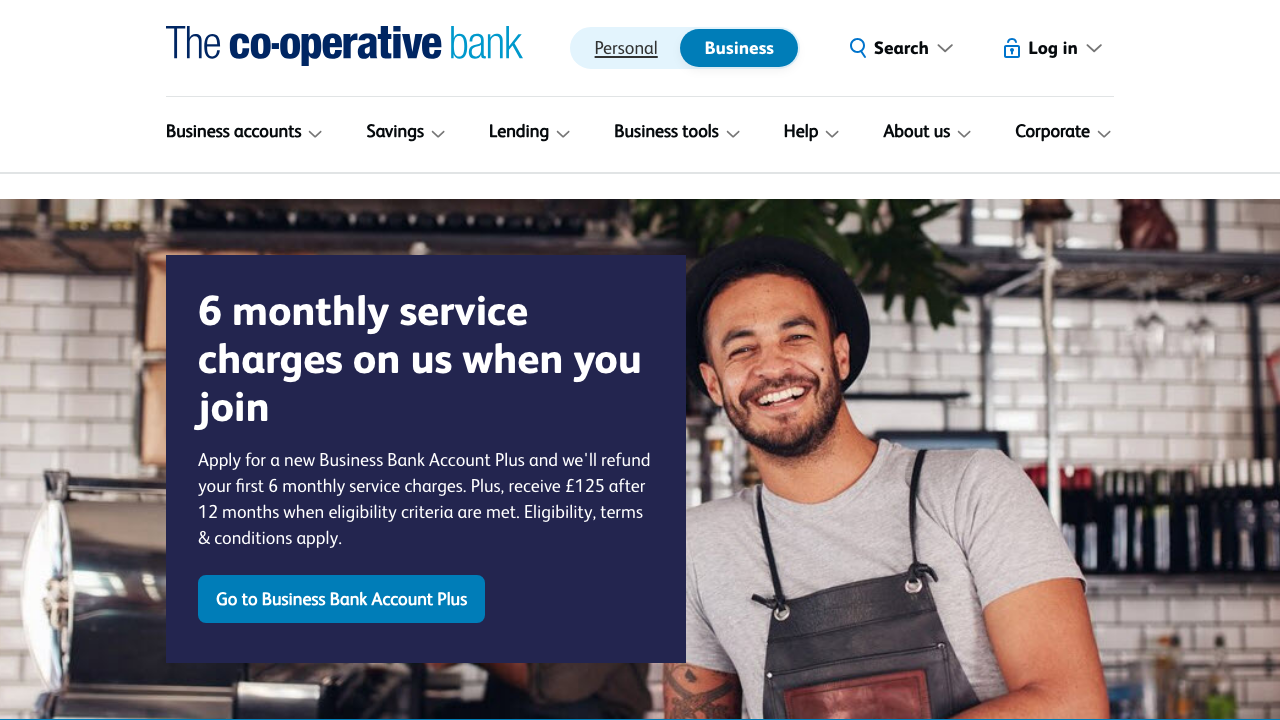
The Co-operative Bank does publish tiered plans, even if they are marketed less prominently than Starling's or Tide's fee menus. The core Business Bank Account has no monthly fee and suits straightforward, low-volume operations. Business Bank Account Plus costs £10 a month and adds an exclusive savings rate plus overdraft arrangement fee waivers up to £25,000; new customers applying from 4 May 2026 have that monthly fee refunded for the first six months. Business DirectPlus is free for the first 30 months before settling at £7 a month, aimed at businesses of any size or entity type that want a simple flat fee once the introductory period ends. Which tier makes sense depends on transaction volume and whether the extras, such as savings access or overdraft terms, are worth paying for.
Cards and payments
Account holders receive a Visa debit card. There is no credit card attached to the business current account itself. Virtual cards are also not offered, which rules out the kind of per-project or per-employee card stacks that some finance teams now use for expense control.
Apple Pay and Google Pay are both supported, which means contactless payments via a business owner's iPhone or Android handset work without friction at the point of sale. 3D Secure is enabled for online card payments, providing the standard two-factor authentication layer for card-not-present transactions. In our test, adding the debit card to Apple Wallet took under two minutes and worked first time.
What the card range does not offer: multi-currency cards, instant virtual card issuance, or Mastercard as an alternative network. For a company that needs to pay international invoices quickly or issue spending cards to employees without going through a lengthy request process, this card suite will feel limited compared with challengers such as Wise Business.
Opening the account step by step
Applications for the Co-operative Bank Business Account are handled online. The process requires standard Know Your Customer documentation: proof of identity for each director or significant shareholder (passport or driving licence), proof of business address, and Companies House registration details for limited companies. Sole traders need proof of identity and evidence of trading activity.
The bank verifies identity electronically where possible, though some applications trigger a manual review that can extend the timeline. The IBAN issued will carry a GB sort code and account number in the standard UK format; there is no European IBAN, so businesses paying or receiving funds across the eurozone will rely on SWIFT transfers rather than the cheaper SEPA rails. That matters for cost if your business trades regularly with EU counterparties.
Opening timescales are not publicly fixed. Digital challengers often quote same-day or next-day activation; the Co-operative Bank is more conservative, with some applications taking several business days if additional documentation is requested. There is no branch requirement for most applicants, but the option to visit a branch for identity verification exists, which some founders find reassuring when first establishing a banking relationship.
App, features, and customer service
The mobile app covers the core tasks: balance checks, transaction history, making payments, and managing standing orders. Online banking provides a fuller view and is where bulk payment files and more complex account management sit. The digital experience is functional rather than forward-looking. There is no built-in invoicing tool, no direct accounting software integration of the kind that Starling and Mettle have made standard, and no spend categorisation dashboard.
Customer service runs through telephone and secure messaging; there is no in-app chat with a human agent available around the clock. Branch access exists but the network is small and not uniformly distributed across the UK, so most business customers manage everything remotely. The bank has invested in its online banking portal over recent years, and the interface is clean and reasonably intuitive, but it lacks the real-time notifications and instant payment confirmation that digital-native banks now deliver as table stakes. That gap shows up in the independent numbers too. The UK's official CMA-mandated service quality survey, published by Ipsos and BVA BDRC in February 2026 covering the January to December 2025 period, ranked the Co-operative Bank last, 17th out of 17 providers, for online and mobile banking services, with just 47% of customers willing to recommend it to other SMEs, the widest shortfall to the sector leaders (Monzo at 90%, Starling Bank at 86%) of any category the survey measures.
For businesses that bank during office hours, deal with a predictable range of transactions, and value the ability to occasionally walk into a branch, the service model is adequate. For founders who expect the same instant, always-on experience they have from consumer fintech apps, there will be moments of friction.
Reputation and real customer experience
The Co-operative Bank scores around 3 out of 5 in our assessment, reflecting a provider that delivers on its core promise without excelling on breadth of features. That assessment lines up with the UK's official CMA-mandated service quality survey: in results published by Ipsos and BVA BDRC in February 2026, covering January to December 2025, the Co-operative Bank ranked joint 14th of the 17 largest business current account providers for overall service quality, with 54% of customers saying they would recommend it to other SMEs, roughly on a par with Santander and well behind category leaders Monzo (85%) and Mettle (83%). Recurring themes in customer feedback divide into two clear camps.
On the positive side, long-standing customers frequently cite the ethical stance as a genuine reason for loyalty. There is a sense among some small business owners that their bank shares their values, and that matters to them beyond pure utility. The free day-to-day banking, when it applies, is genuinely free and not subject to the creeping monthly fees that some high-street banks reintroduce after promotional periods.
Recurring complaints centre on customer service response times, particularly by telephone. Some business customers report extended hold times and inconsistent advice between agents. The more serious pattern is around account reviews: a subset of customers report unexpected account closures or requests for additional documentation at short notice, which creates operational disruption for small businesses that depend on the account for payroll or supplier payments. This is not unique to the Co-operative Bank, but it appears more frequently in its customer feedback than the sector average. The smaller branch network also draws criticism from businesses outside major cities who cannot easily access in-person support.
Verdict: open it or look elsewhere?
The Co-operative Bank Business Account earns its place for a specific type of small business: one that runs a relatively simple, UK-centric operation, transacts mainly by electronic transfer, and actively wants to bank with an institution that screens its lending against ethical criteria. The zero monthly fee is a real benefit for early-stage companies watching their outgoings closely, provided they stay within the conditions that define the free tier.
Look elsewhere if your business involves regular cash handling, overseas payments, or a need for multi-user expense cards. Starling Bank Business gives you real-time notifications, Xero integration, and a Mastercard debit card with no monthly fee for most users. Mettle, backed by NatWest, targets sole traders and offers FreeAgent accounting as standard. Wise Business suits companies with international payment needs. None of those three carry the ethical lending policy that defines the Co-operative Bank's identity.
In our test, the account opened smoothly and the Apple Pay setup was immediate. What we missed was the depth of functionality that has become standard among the newer challengers. If ethical positioning is a priority and your transaction profile is straightforward, this account does what it says. If you need breadth of features alongside the fee-free headline, the market has moved on considerably.
How safe is The Co-operative Bank Co-operative Bank Business Account?
The Co-operative Bank Co-operative Bank Business Account vs alternatives
A direct comparison of the key conditions against the strongest competitors in the market.
|  |  |  | |
| Rating | 3.0 /5 | 5.0 /5 | 4.0 /5 | 4.2 /5 |
| Monthly fee | £0.00 | £0.00 | £0.00 | £0 (£25 if avg. balance below £10,000) |
| Debit card | ✓ | ✓ | ✓ | ✓ |
| Credit card | ✗ | ✗ | ✗ | ✗ |
| Virtual credit cards | ✗ | ✗ | ✗ | ✓ |
| Free cash withdrawal | ✗ | ✓ | ✗ | ✓ |
| Number of sub-accounts | – | – | – | Several |
| Online banking users | – | – | – | Several |
| Electronic transfers | ✓ | ✓ | ✓ | ✓ |
| Apple Pay | ✓ | ✓ | ✓ | ✓ |
| Google Pay | ✓ | ✓ | ✓ | ✓ |
| 3D Secure for online payments | ✓ | ✓ | ✓ | ✓ |
| Deposit protection | £120,000 | £120,000 | ✗ | £120,000 |
How we rate
About the author

Frequently asked questions
The account is available to sole traders, partnerships and limited companies registered in the UK. Eligibility for the free day-to-day banking tier depends on meeting the bank's balance and turnover conditions, which should be confirmed directly before applying.
The core Business Bank Account has no monthly fee, though transaction charges may apply outside the free tier. The bank also offers paid tiers for businesses that want more: Business Bank Account Plus costs £10 a month (refunded for the first six months for new customers applying from 4 May 2026), and Business DirectPlus is free for 30 months before settling at £7 a month. Which tier suits you depends on transaction volume and whether the added perks are worth the fee.
Eligible deposits are covered by the Financial Services Compensation Scheme (FSCS) up to 120,000 GBP per person per bank. The Co-operative Bank is authorised by the PRA, so the standard UK protection scheme applies. The bank has proposed transferring its business to Coventry Building Society, its owner, on 1 January 2027, subject to court approval; once complete, this 120,000 GBP limit would apply across the Co-operative Bank, smile and Coventry Building Society combined rather than separately to each.
Applications can be started online through the bank's website. Identity and business verification follow standard UK Know Your Customer procedures, and the bank also has physical branches for businesses that prefer in-person support during the process.
The bank is regulated by the FCA and the PRA, two of the UK's principal financial regulators. Online payments are protected by 3D Secure, and the account operates within the standard UK banking security framework. Deposits up to 120,000 GBP are covered by the FSCS.
Business interest income is subject to Corporation Tax for limited companies, or Income Tax for sole traders and partnerships, under normal UK rules. The Personal Savings Allowance applies only to personal accounts, not business ones, so all interest received in a business account is taxable income. Businesses should consult their accountant for advice specific to their structure.