
Yorkshire Building Society Savings Account: review 2026
Last updated: 17.09.2026

4.2 /5 ★★★★☆Very good
Rank 10 of 50 in our comparison
Contents
Summary
Yorkshire Building Society offers a strong range of savings accounts, with the Triple Access eSaver paying 4.20% AER variable and the Regular Saver reaching a market-leading 7.50% AER for disciplined monthly savers. All deposits up to 120,000 GBP are protected under the FSCS, making YBS a dependable choice for UK savers who already hold a current account elsewhere. It suits people who want a dedicated savings provider with competitive rates, provided they can live within the withdrawal restrictions.
Pros
- Triple Access eSaver pays 4.20% AER variable
- Regular Saver offers 7.50% AER for monthly depositors
- FSCS protection up to 120,000 GBP per person
- 93% of surveyed customers in 2026 would recommend YBS
- wide range of account types including easy access, fixed-rate bonds, ISAs and regular savers
Cons
- Easy access account limits withdrawals to only 3 days per year
- best rates typically reserved for new customers or introductory periods
- no current account or debit card, so an external bank account is required
- headline rates on some products require online-only management
Key facts
| Interest on savings account | 4.20% AER variable (Triple Access eSaver) |
| Deposit protection | £120,000 |
| Online account opening | ✓ |
| Welcome bonus | ✗ |
| Joint account | ✓ |
| Overdraft interest rate | ✗ |
| Savings account | ✓ |
| Rating | 4.2 /5 |
Interest rate comparison
The effective annual rate compared directly with the alternatives.
A closer look
Overview: what Yorkshire Building Society offers and who it suits
Yorkshire Building Society (YBS) has been a fixture of British savings since 1864. It's a mutual, meaning it's owned by its members rather than shareholders, and that structure shapes everything from how profits are reinvested to how customer service is staffed. In our test, the savings range felt genuinely broad: easy-access accounts, fixed-rate bonds, cash ISAs and a Regular Saver all sit under one login.
For a UK saver who wants a dedicated savings institution with real branch coverage and a track record stretching back more than 150 years, YBS is a compelling choice, though it won't suit everyone.
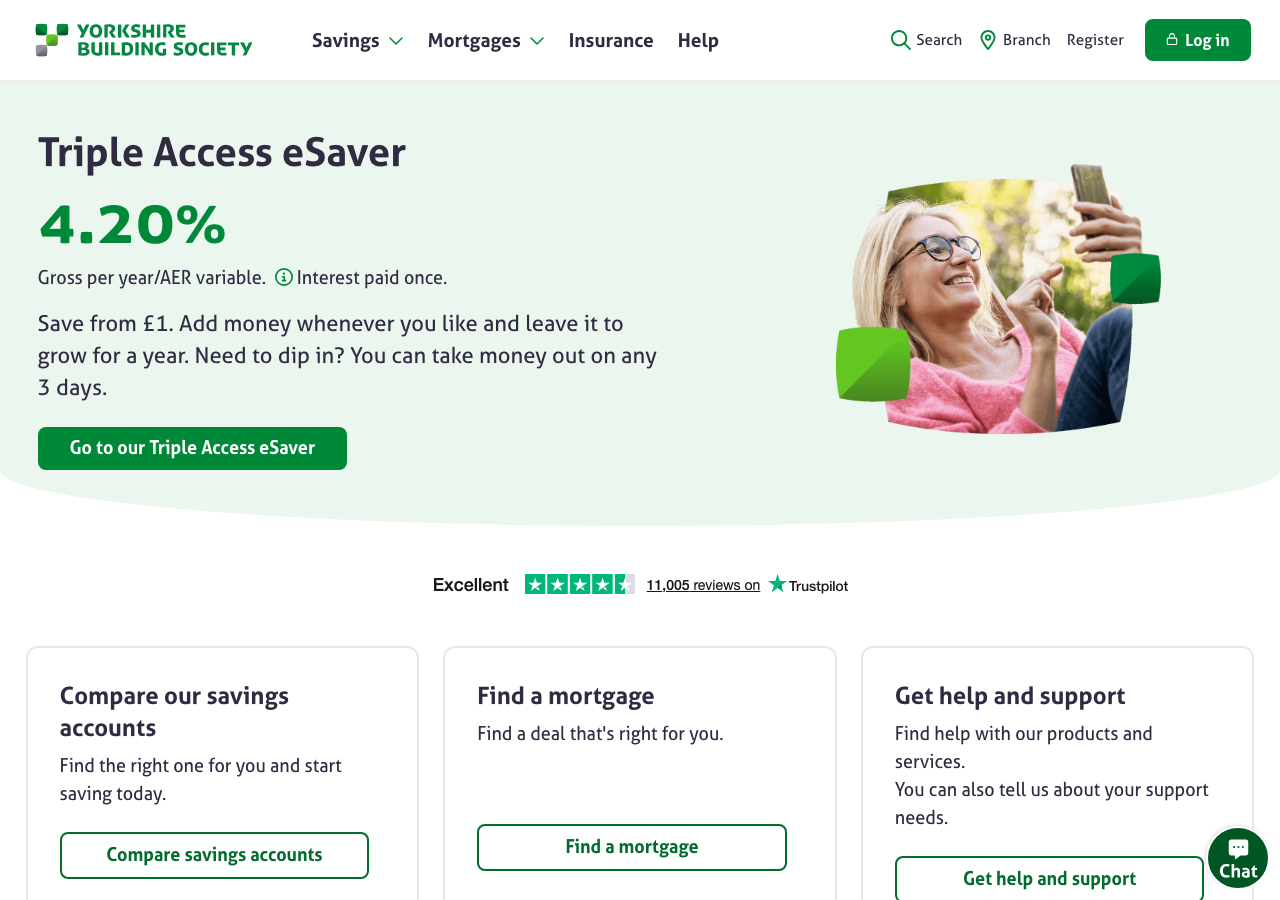
The account that most people land on first is the Triple Access eSaver, which pays 4.20% AER variable. The name signals the main constraint: you may only make withdrawals on up to three separate days per calendar year, and that's meaningfully different from a fully unrestricted easy-access account. Alongside it, the standard Regular Saver pays 4.25% AER for savers who can commit a fixed monthly deposit of between £1 and £250. It's not the flashiest rate on the market, but existing members who've held a YBS savings account or mortgage for at least 12 months can instead apply for the Loyalty Regular Saver, which pays a higher 4.85% AER on the same style of monthly deposit. This comparison shows where the offer sits: Best joint savings account.
YBS is a poor fit for anyone who needs to dip in and out of savings constantly, those who want a current account bundled with their savings, or people building an emergency fund that must remain instantly liquid at all times. It's also savings-only: there's no debit card, no overdraft, no payment features, so you'll need to link an external current account just to move money in and out. Which accounts else are worth a look is covered here: Best Joint Account.
The interest rate explained: what 4.20% AER actually means for your money
The Triple Access eSaver rate of 4.20% AER is variable, which means YBS can adjust it in line with Bank of England base rate movements or competitive pressures. AER (Annual Equivalent Rate) shows what the return would be if interest were compounded over a full year, so it is the most useful figure for comparing accounts. The actual interest is typically credited annually or monthly depending on the specific product variant chosen at opening. For the wider picture, see our comparison: Best children's savings account. The three-withdrawal-day restriction is the rate's primary condition, and it's worth taking seriously. If you exceed three withdrawal days in a calendar year the account may revert to a lower rate, or you may need to close and reopen it. Read the specific product terms before depositing a large sum, particularly if your financial situation could require occasional access.
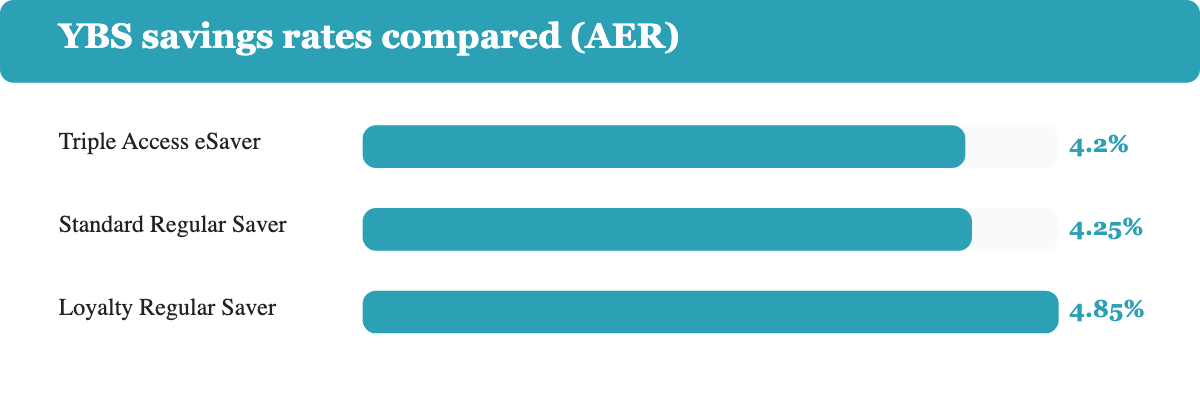
The standard Regular Saver pays 4.25% AER and is open to new and existing members alike, while the Loyalty Regular Saver pays 4.85% AER for anyone who already banks or has a mortgage with YBS. Neither rate is fixed for a term the way a bond is, though both require a consistent monthly deposit within set limits to earn the full return. (Stand: September 2026.)
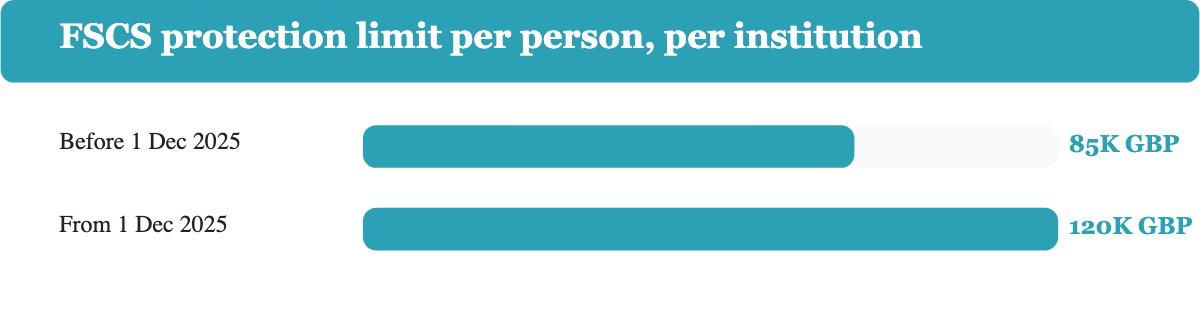
There is no welcome bonus on the savings accounts, and that's a non-negotiable across the range. The FSCS-protected deposit limit is £120,000 per person, per authorised institution, following the increase from £85,000 that took effect on 1 December 2025. Joint accounts double that protection to £240,000 for two holders, and YBS does offer joint savings accounts. Best rates are generally available to those managing the account online rather than exclusively in branch.
Taxation of savings interest in the UK: what you will actually keep
UK savers benefit from the Personal Savings Allowance (PSA), introduced in 2016 by HMRC. Basic-rate taxpayers (20%) receive a GBP 1,000 PSA each tax year, while higher-rate taxpayers (40%) receive GBP 500. Additional-rate taxpayers earning over GBP 125,140 receive no PSA at all. Interest earned within those thresholds is received free of income tax; anything above is taxable at your marginal rate and must be declared via Self Assessment or will be collected through an adjustment to your PAYE tax code.
On a balance of GBP 20,000 earning 4.20% AER, annual interest would be approximately GBP 840. That falls within the GBP 1,000 allowance for basic-rate taxpayers, so the full amount would be tax-free. A higher-rate taxpayer with the same balance would have GBP 340 above their GBP 500 PSA, meaning GBP 136 of additional tax would be owed. YBS reports interest paid to HMRC automatically via the standard reporting system, so the tax authority typically adjusts PAYE codes rather than requiring savers to file manually themselves.
Cash ISAs, which YBS also offers, sit entirely outside the PSA calculation. Interest earned inside an ISA doesn't count toward your allowance and is never taxed, regardless of your income. That's a clear-cut advantage for higher earners who've already used their PSA through other savings accounts; switching to a YBS Cash ISA is often the more efficient route. A broader selection is in this overview: Current account switch offers.
Opening an account: the process, identification and what to expect
Online account opening is available and takes most applicants between ten and twenty minutes. You'll need a UK current account to link for transfers, a valid email address and a mobile number for verification.
YBS doesn't currently support biometric or video-based identity checks of the kind used by newer app-only banks. Instead, identity verification relies on credit reference agency checks using your name, address and date of birth matched against electoral roll and credit file data. In our test, the online application asked for National Insurance number alongside standard personal details. If the automated check cannot verify identity, YBS may request a certified copy of a passport or driving licence, which adds time to the process. Existing members who already hold a YBS mortgage or another savings product can open additional accounts from within the online banking portal without repeating the full identity check.
Once opened, you receive a UK IBAN beginning with GB. There's no lock-in for the easy-access product beyond the withdrawal day restriction, but fixed-rate bonds are different: they have a defined term, and early access is generally not permitted or is subject to a penalty, so confirm the term before committing. The account is managed online or via YBS branches, of which there are around 200 across the UK, predominantly concentrated in Yorkshire, the Midlands and the South East.
Safety: FSCS protection and the institution behind your deposit
Yorkshire Building Society is authorised and regulated by the Prudential Regulation Authority (PRA) and the Financial Conduct Authority (FCA). Deposits held with YBS are protected by the Financial Services Compensation Scheme (FSCS) up to £120,000 per person, the standard deposit protection limit since it rose from £85,000 on 1 December 2025. This isn't a discretionary protection; it's a statutory guarantee backed by UK law, and that's true outright regardless of the institution's own financial health. In the unlikely event that YBS failed, FSCS would aim to return protected deposits within seven working days.
As a building society, YBS is subject to the Building Societies Act 1986 and subsequent amendments, which require it to derive the majority of its funding from member deposits rather than wholesale money markets. That structural constraint is often cited as a reason building societies proved more resilient than some shareholder-owned banks during the 2008 financial crisis.
YBS itself has never required a government bailout and holds robust capital ratios above regulatory minimums.
For savers who hold accounts with multiple YBS-branded products, it's worth noting that Chelsea Building Society merged into YBS in 2010. Chelsea accounts are now YBS accounts under the same banking licence, so the £120,000 FSCS limit applies across both brands combined, not separately, and if you hold savings across both legacy brands your total FSCS protection doesn't double.
Reputation and real customer experience: what members consistently report
According to YBS's own 2026 member survey, 93% of respondents said they'd recommend the society. That's a high figure, but it comes from a YBS-administered survey rather than an independent platform. Third-party review aggregators tell a similar story overall, though with some recurring friction points worth understanding before you open an account.
Praise clusters around three themes: the competitive rate on the Loyalty Regular Saver for existing members, the helpfulness of branch staff for members who prefer face-to-face service, and the straightforward online application process.
Long-standing members frequently mention a sense of loyalty and trust built over years or even decades, and the mutual structure resonates with savers who are sceptical of profit-driven banks.
Recurring complaints centre on the online banking interface, which some customers describe as dated compared to app-first competitors. The three-withdrawal restriction on the Triple Access eSaver catches savers who didn't fully register the condition at opening, particularly when urgent financial needs arise mid-year. There are also occasional reports of slower-than-expected identity verification for new applicants who don't match automated checks, and customer service telephone wait times have drawn criticism during peak periods, though branch visits are consistently rated more positively. None of these issues represent systemic failure; they reflect the trade-offs of a traditional mutual operating at scale.
Verdict: open a YBS account if this fits your situation
Yorkshire Building Society earns its 4.2-star rating through a combination of competitive rates for existing members, genuine FSCS safety and institutional stability that newer digital-only providers can't yet match on history alone. The Triple Access eSaver at 4.20% AER is attractive for savers who can honestly say they won't need to access funds more than three times a year.
The standard Regular Saver at 4.25% AER is a reasonable choice for disciplined monthly savers, but it's not outstanding on its own; the Loyalty Regular Saver at 4.85% AER is the clearly stronger option once you already hold another YBS product.
Open a YBS account if: you want a trusted UK mutual with branch access; your savings balance is meaningful enough that the £120,000 FSCS limit and institutional solidity genuinely matter to you; you're a higher earner who'd benefit from pairing the easy-access account with a YBS Cash ISA to shelter interest from tax; or you already bank with YBS and want to step up from the standard Regular Saver to the Loyalty Regular Saver's 4.85% rate.
Look elsewhere if: you need unrestricted daily access to your savings; you want everything managed through a slick mobile app without branch infrastructure; you're looking for a current account, debit card or any payment functionality alongside your savings; or you already hold a Chelsea Building Society account and assumed your FSCS protection was separate. Skipton Building Society, Moneybox and Trading 212 Cash ISA are each worth comparing for specific use cases where YBS falls short on flexibility or digital experience.
How safe is Yorkshire Building Society Savings Account?
Yorkshire Building Society Savings Account vs alternatives
A direct comparison of the key conditions against the strongest competitors in the market.
|  |  |  | |
| Rating | 4.2 /5 | 4.5 /5 | 4.3 /5 | 4.2 /5 |
| Interest on savings account | 4.20% AER variable (Triple Access eSaver) | 4.71% AER variable (incl. 1.11% bonus for 12 months; standard rate 3.60% AER) | 4.70% AER variable (incl. 1.25% bonus for 12 months; standard rate 3.45% AER) | ca. 3.85% AER variable (Easy Access Saver); up to 7.50% AER (Member Regular Saver, 12 months) |
| Deposit protection | £120,000 | £120,000 | £120,000 | £120,000 |
| Online account opening | ✓ | ✓ | ✓ | ✓ |
| Welcome bonus | ✗ | ✓ | ✗ | ✗ |
| Joint account | ✓ | ✗ | ✗ | ✓ |
| Overdraft interest rate | ✗ | ✗ | ✗ | ✗ |
| Savings account | ✓ | ✓ | ✓ | ✓ |
How we rate
More comparisons
About the author

Frequently asked questions
UK residents aged 16 or over with a UK address and a linked UK current account can apply for most YBS savings products. Some junior accounts are available for children under 16, managed by a parent or guardian.
There are no monthly account fees for standard savings accounts such as the Triple Access eSaver or the Regular Saver. YBS is a straightforward savings provider; costs are built into the rate rather than charged separately.
Deposits are protected under the FSCS up to 120,000 GBP per person per bank. For joint accounts the combined limit is 240,000 GBP. YBS is authorised by the PRA and regulated by the FCA and PRA.
You can apply online at ybs.co.uk in around 10 to 15 minutes. You will need your National Insurance number, a UK address and the sort code and account number of your linked current account. Most applications are verified digitally on the same day.
Yes. YBS is a long-established mutual building society regulated by the FCA and PRA in the UK. Deposits up to 120,000 GBP are covered by the FSCS, and 93% of customers surveyed in 2026 said they would recommend YBS to others.
Interest is paid gross and falls under the Personal Savings Allowance. Basic-rate taxpayers can receive up to 1,000 GBP in savings interest tax-free each year; higher-rate taxpayers receive a 500 GBP allowance. Any tax owed above the allowance is collected by HMRC through PAYE or self-assessment.