
Halifax Everyday Saver: review 2026
Last updated: 13.10.2026
Contents
Summary
The Halifax Everyday Saver is an easy-access savings account paying up to 1.00% AER variable, a rate that sits well behind the best deals available in the UK market right now. It opens with just £1 and gives you unlimited withdrawals, which makes it convenient for short-term cash parking, but savers who want their money to actually grow should look elsewhere.
The account suits people who already bank with Halifax and want a no-fuss place to keep an emergency fund, rather than anyone chasing a competitive return.
Pros
- Unlimited withdrawals with instant easy access at any time
- open with just £1 minimum deposit
- manage via app, online, in branch or by phone
- FSCS-protected up to £120,000 per person per bank
- can open up to five separately named Everyday Saver accounts
Cons
- Interest rate of up to 1.00% AER variable is well below market-leading easy-access rates above 4% available in 2026
- tiered structure means smaller balances earn even less
- no introductory rate or welcome bonus
- variable rate can be reduced at any time without notice
Key facts
| Interest on savings account | up to 1.00% AER variable |
| Deposit protection | £120,000 |
| Online account opening | ✓ |
| Welcome bonus | ✗ |
| Joint account | ✓ |
| Overdraft interest rate | ✗ |
| Savings account | ✓ |
| Rating | 2.5 /5 |
Interest rate comparison
The effective annual rate compared directly with the alternatives.
What the Halifax Everyday Saver is, and who should consider it
The Halifax Everyday Saver is an easy-access variable-rate savings account offered by Halifax, one of the UK's oldest and most recognisable high-street banks. It sits firmly in the mainstream retail savings market: no lock-in periods, no minimum monthly deposits, no complex eligibility requirements. You open it, drop money in, and withdraw whenever you like. That simplicity is its defining characteristic.
The account suits people who are completely new to saving, who want a designated pot separate from their current account, or who need a low-friction holding place for money they may need at short notice. First-time savers putting aside a first emergency fund will find the account approachable. Existing Halifax current account holders may also appreciate being able to manage everything in one app, or pop into a branch to ask questions face to face.
Who it's decidedly not for: anyone focused on growing their savings meaningfully. The rate of up to 1.00% AER variable sits roughly three to four percentage points below the best easy-access accounts available in the UK in 2026. On a balance of £10,000, that gap costs around £300 to £400 in foregone interest every year. Financially active savers, ISA-holders chasing tax-efficient returns, and anyone who's taken even a brief look at the current savings market will almost certainly find better options elsewhere. How it stacks up against the rest of the market is shown here: Best children's savings account.
The interest rate in detail: what you actually earn
The headline figure is "up to 1.00% AER variable". That phrase carries a lot of weight. AER (Annual Equivalent Rate) shows what you'd earn if interest were compounded and credited over a full year, which makes it the standard yardstick for comparing savings accounts in the UK. Variable means Halifax can reduce the rate at any point, subject to providing notice as required by FCA rules. There's no introductory bonus or promotional rate attached to this account. What you see is what you get from day one, and that rate can only go down.
The 1.00% ceiling only applies to balances of £100,000 or more. Below that, the account is tiered: 0.75% AER on balances from £1 to £24,999, and 0.90% AER from £25,000 to £99,999, with the applicable rate paid on the whole balance rather than just the slice above each threshold. Most Everyday Saver customers, whose balances sit well under £25,000, are earning 0.75%, not the "up to 1.00%" figure the account is marketed on. Our verdict on Halifax runs through the strengths and the drawbacks.
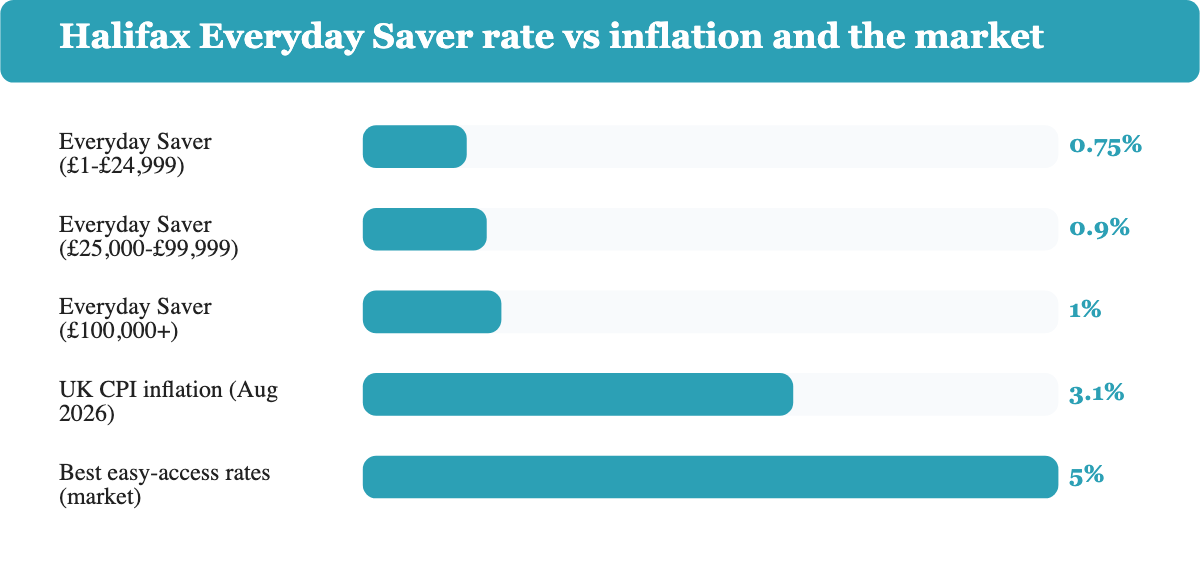
That gap between the advertised ceiling and what most people actually receive is worth knowing before you open one.
Interest is calculated daily and credited to the account once a year, or when you close the account. There's no option to have monthly interest credited, which some savers prefer for cash-flow reasons or to reinvest more frequently, and there's no welcome bonus or introductory period either. UK CPI inflation stood at 3.1% in the 12 months to August 2026, according to the Office for National Statistics, so even the top 1.00% tier leaves a saver losing purchasing power in real terms. The 0.75% tier most customers actually sit in loses considerably more. Challenger banks and building societies currently pay in the region of 4% to 5% AER on unrestricted easy-access accounts, and that's the gap worth weighing against the convenience of staying with a familiar high-street name.
Tax on your interest: the UK Personal Savings Allowance
In the UK, savings interest is subject to Income Tax, but most people won't pay any tax on interest from an account like this thanks to the Personal Savings Allowance (PSA). Basic-rate taxpayers (20%) can earn up to £1,000 in savings interest per tax year before tax applies. Higher-rate taxpayers (40%) have a £500 allowance. Additional-rate taxpayers (45%) receive no PSA and pay tax on all savings interest.
At 1.00% AER, a basic-rate taxpayer would need a balance above £100,000 before the PSA is even at risk of being breached, so in practice the vast majority of Everyday Saver customers won't owe any tax on the interest they earn here. If you do breach your PSA, HMRC typically collects the tax through an adjustment to your PAYE tax code rather than requiring a self-assessment return, unless you already file one. Halifax reports interest paid to HMRC as required, so the process is largely automatic for most savers.
If tax efficiency is a priority and your savings are larger, Cash ISAs let you shelter interest entirely from Income Tax. The Halifax Everyday Saver doesn't carry ISA status, so every penny of interest counts towards your PSA. Savers near or above the PSA thresholds should consider a Cash ISA from Halifax or another provider before defaulting to this account.
Opening the account: identification, timing and what to expect
Opening a Halifax Everyday Saver is straightforward. Existing Halifax customers can open it directly in the Halifax mobile app or via online banking in a matter of minutes, and no additional identity verification is typically required because Halifax already holds your details. New customers need to apply online or visit a branch instead, where standard UK KYC checks apply: proof of identity (passport or driving licence) and proof of address.
The minimum opening deposit is just £1, which removes any financial barrier to getting started. You can also open a joint account, making this suitable for couples who want a shared savings pot without needing to maintain separate accounts. Halifax allows up to five Everyday Saver accounts per customer, and each one can be named separately. That's useful for keeping a house deposit, an emergency fund and a holiday pot apart, without opening a different type of product for each. There's no maximum initial deposit stipulated on the product page, although the FSCS protection limit applies as a practical ceiling for those concerned about compensation coverage.
Once open, the account issues a UK sort code and account number. There's no waiting period and no notice period for withdrawals, so you can take money out at any time without penalty.
But the account doesn't stay the same forever. After 12 months, Halifax automatically converts the Everyday Saver into an Instant Saver account, so a saver who opens this account today isn't holding the same product a year from now, and should check the Instant Saver's own rate at that point rather than assume continuity. The account can be managed via the Halifax app, Halifax Online Banking, by telephone, or in any Halifax branch, giving it genuine multi-channel access that more digitally focused providers can't match. For savers who value in-person service, that branch network is a genuine differentiator.
Safety and the FSCS: how your money is protected
Halifax is a trading name of Bank of Scotland plc, part of Lloyds Banking Group, one of the largest banking groups in the UK. It's authorised by the Prudential Regulation Authority (PRA) and regulated by both the PRA and the Financial Conduct Authority (FCA). This isn't a challenger bank or a fintech operating under an e-money licence. Halifax holds a full UK banking licence, which matters for deposit protection purposes.
Deposits with Halifax are covered by the Financial Services Compensation Scheme (FSCS) up to £120,000 per person, or £240,000 for joint accounts. This is the standard protection limit that took effect on 1 December 2025, up from the previous £85,000 ceiling. A separate, higher temporary high balance scheme also exists for specific life events, such as house sale proceeds, redundancy payments, or personal injury compensation, covering up to £1.4 million for up to six months. That's a distinct, time-limited scheme, whereas the everyday limit is the one that applies that applies to a savings balance like this one.
Crucially, the FSCS compensation limit applies across all accounts you hold with Halifax and Bank of Scotland combined, because they share a banking licence under Lloyds Banking Group. If you also hold a Halifax current account or a Bank of Scotland account, only the combined total up to £120,000 is protected, so savers with larger balances should spread funds across separately licensed institutions to maximise coverage.
One more current-affairs point worth knowing before you open an account under the Halifax name: Lloyds Banking Group is retiring the Halifax brand, with accounts and digital banking being migrated to Lloyds over 2026 and 2027. Halifax has confirmed that existing account numbers, sort codes, card details and product terms aren't affected, and that it's closing its own app and online banking in stages while inviting customers across to the Lloyds app instead. FSCS protection doesn't change because of this. The compensation limit sits with the shared Bank of Scotland plc banking licence, not with the Halifax brand name, so the £120,000 figure above holds regardless of which app or logo you end up using.
Reputation and real customer experience
Halifax holds a Trustpilot score of 1.7 out of 5, rated "Bad", from more than 6,400 reviews, a harsher picture than the account's convenience features alone would suggest. Review-platform scores like this skew toward dissatisfied customers, however, since people are far more likely to leave a review after a problem than after an unremarkable transaction, so the number is a useful warning sign rather than a precise measure of the typical customer's experience. The recurring positives that do appear centre on individual branch and phone staff praised by name, and effective handling of fraud and scam cases once a complaint actually reaches a person. Customers who've used Halifax for decades tend to stay, despite the low rate, because of familiarity and the reassurance of a physical branch nearby. The older Savers Prize Draw, a monthly draw some reviews still mention, was discontinued in September 2025 and its registration page doesn't work anymore. Halifax has since replaced it with a Super Prize Draw that's running automatically, with no registration needed, from August to November 2026 for Lloyds and Halifax current account or savings account customers, with a £1 million jackpot and five £50,000 prizes in the final November draw. An Everyday Saver qualifies as a savings account for entry, though the promotion itself is time-limited and it's worth checking directly on Halifax's site rather than relying on this figure after November 2026.
The recurring complaints cluster around three things: long phone wait times, frustration that the savings rate hasn't kept pace with Bank of England base rate movements, and, more recently, login failures and lost account access reported during the ongoing move to the Lloyds app. Complaints about in-branch wait times and the difficulty of reaching customer service by phone during busy periods appear regularly too. Digital-only users occasionally report friction when they need to carry out tasks that can't be completed in the app and require a branch or phone call instead.
There's no widespread pattern of complaints about account security, fraudulent transactions, or processing errors, which reflects positively on Halifax's operational reliability. The brand's reputation for being slow to pass on rate increases is nonetheless well-established, a criticism levelled at large incumbent banks generally, not Halifax alone, and it's worth factoring into any decision to park significant savings here for the long term.
Verdict: who should open this account and who should look elsewhere
The Halifax Everyday Saver earns its place as a first savings account for people who've never saved before and want the simplest possible entry point with a trusted high-street name behind it. The £1 minimum deposit, unlimited withdrawals, branch access, joint account option, and FSCS protection make it a low-risk, zero-complexity choice for that specific group.
Beyond that narrow use case, the account is difficult to recommend in 2026. A rate of up to 1.00% AER variable, and in practice 0.75% for most balances, isn't competitive, and it loses value in real terms against current inflation. Any saver with a few hours to spare can open a higher-rate easy-access account online instead, often with the same FSCS protection and similar or better app functionality, and earn considerably more interest without giving up liquidity.
Look elsewhere if you've got more than £1,000 saved and want your money to grow at a meaningful pace, if you're comfortable with digital-first banks or building societies, or if you're already a Halifax customer simply defaulting to this account out of habit rather than informed choice. The market has moved significantly.
Loyalty to a provider shouldn't come at a cost of hundreds of pounds in foregone interest annually.
How safe is Halifax Everyday Saver?
Halifax Everyday Saver vs alternatives
A direct comparison of the key conditions against the strongest competitors in the market.
 |  |  |  | |
| Rating | 2.5 /5 | 4.5 /5 | 4.3 /5 | 4.2 /5 |
| Interest on savings account | up to 1.00% AER variable | 4.71% AER variable (incl. 1.11% bonus for 12 months; standard rate 3.60% AER) | 4.70% AER variable (incl. 1.25% bonus for 12 months; standard rate 3.45% AER) | ca. 3.85% AER variable (Easy Access Saver); up to 7.50% AER (Member Regular Saver, 12 months) |
| Deposit protection | £120,000 | £120,000 | £120,000 | £120,000 |
| Online account opening | ✓ | ✓ | ✓ | ✓ |
| Welcome bonus | ✗ | ✓ | ✗ | ✗ |
| Joint account | ✓ | ✗ | ✗ | ✓ |
| Overdraft interest rate | ✗ | ✗ | ✗ | ✗ |
| Savings account | ✓ | ✓ | ✓ | ✓ |
How we rate
More comparisons
About the author

Frequently asked questions
The account is open to UK residents aged 16 and over. You do not need to be an existing Halifax customer to apply, though existing customers can open it faster from within the app.
No. There is no monthly account fee, no fee for withdrawals and no penalty for accessing your money whenever you need it. The account is entirely free to hold.
Your savings are covered by the FSCS (Financial Services Compensation Scheme) up to £120,000 per person per bank. Halifax is part of Lloyds Banking Group, so any balances held across Halifax, Lloyds and Bank of Scotland count toward a single £120,000 limit.
You can apply online at halifax.co.uk or through the Halifax app. Existing customers complete the process in a few minutes; new customers go through an online identity check. The minimum opening deposit is just £1.
Yes. Halifax is authorised and regulated by the FCA and PRA, and deposits are FSCS-protected. The account itself carries no investment risk; the only risk is that the variable interest rate may fall over time.
Interest is paid gross and counts toward your Personal Savings Allowance: £1,000 per tax year for basic-rate taxpayers, £500 for higher-rate taxpayers. Any interest above your allowance is added to your taxable income and taxed at your marginal rate, which you declare via self-assessment or HMRC adjusts your tax code automatically.