
Virgin Money Business Account: review 2026
Last updated: 12.10.2026
Contents
Summary
The Virgin Money Business Account scores 76 out of 100 in our assessment, making it a solid mid-range choice for UK sole traders and small limited companies that want a recognisable high-street name behind their banking. Twenty-five months of fee-free day-to-day banking is the headline draw, complemented by 0.35% cashback on Mastercard debit spending. Once that introductory period ends, a GBP 6.50 monthly charge applies, so it suits businesses confident they will either switch or generate enough cashback to offset the cost.
Pros
- 25 months free day-to-day banking for new businesses and switchers
- contactless Mastercard debit card with 0.35% cashback capped at GBP 500 per year
- Apple Pay and Google Pay both supported
- native integration with Xero, Sage and QuickBooks
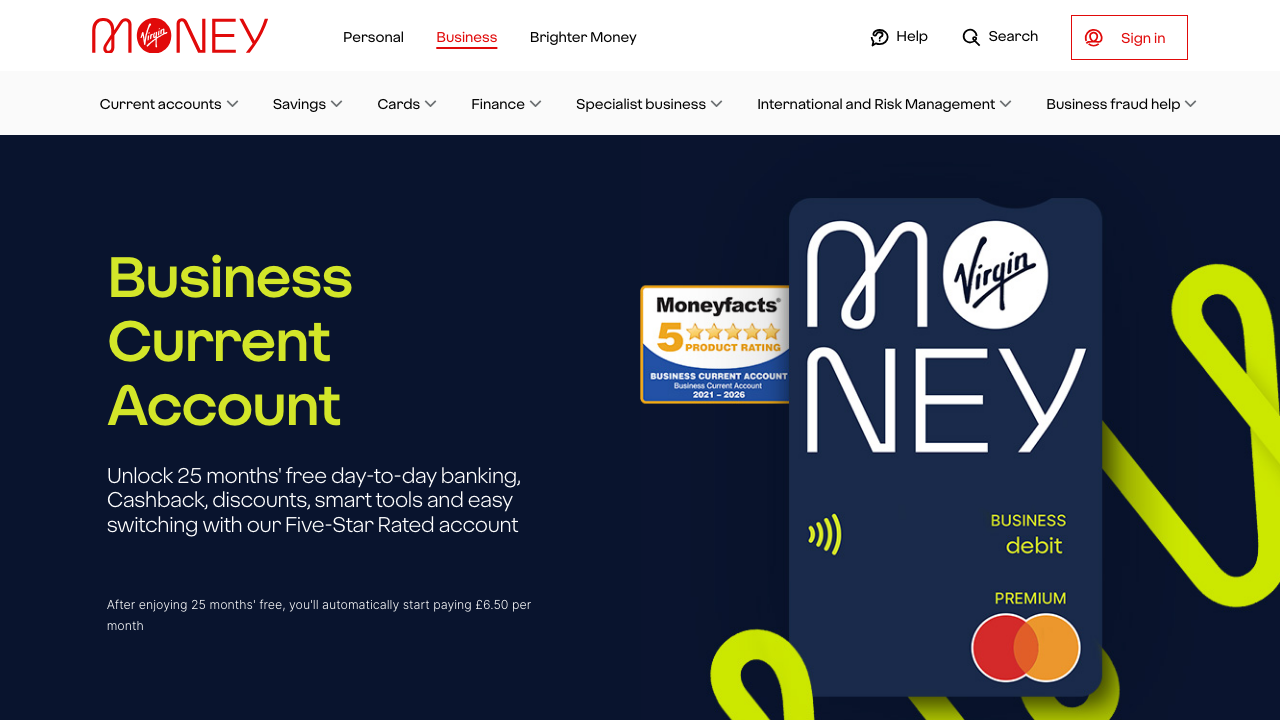
- Five-Star Moneyfacts rating and Best Service from a Business Bank award 2026
Cons
- Monthly fee of GBP 6.50 applies after the 25-month free period
- no credit card or virtual card on offer
- limited branch access as the account is primarily digital
- FSCS protection shared with Nationwide following the April 2026 transfer, meaning the combined GBP 120,000 cap applies across both brands
Key facts
| Monthly fee | Free for 25 months, then GBP 6.50/month |
| Debit card | ✓ |
| Credit card | ✗ |
| Virtual credit cards | ✗ |
| Free cash withdrawal | ✗ |
| Number of sub-accounts | ✗ |
| Online banking users | 1 |
| Electronic transfers | ✓ |
| Apple Pay | ✓ |
| Google Pay | ✓ |
| 3D Secure for online payments | ✓ |
| Deposit protection | £120,000 |
| Rating | 3.8 /5 |
Strengths in detail
How well the provider covers the most important areas.
A closer look
Who the Virgin Money Business Account suits (and who it does not)
Virgin Money has positioned its business current account squarely at sole traders, freelancers, and early-stage limited companies that want a name they recognise behind their banking without paying a monthly fee on day one. The 25-month free banking period is the headline offer, and for a business in its first two years that is genuinely useful. In our test, the account opened smoothly online, the debit card arrived quickly, and the Mastercard cashback of 0.35 per cent added a small but real benefit on everyday card spend.
That said, the account is not for everyone. Businesses that need a credit card will find nothing here; Virgin Money offers no credit card product alongside this account. Companies that rely on cash deposits will also struggle, since branch access is limited and there is no Post Office cash-in facility. High-volume payment businesses should note that the single online banking user limit makes team access impossible unless supplementary workarounds are arranged outside the platform.
Growing companies approaching the end of the free period should plan ahead. At GBP 6.50 a month from month 26, the account becomes a paid product, and at that point a direct comparison against Starling or Allica Bank is worth running. We went through the fees and features in our review of Allica Bank Business Rewards Account.
Real costs and hidden fees in detail
The monthly fee structure is simple: nothing for the first 25 months, then GBP 6.50 per month from month 26. There are no tiered plans. Virgin Money does not publish a detailed transaction tariff on the main product page, so businesses with high cheque or cash volumes should request the full tariff schedule before opening. Standard electronic payments (BACS, Faster Payments) are covered within the account, but ATM withdrawals are not free. The account does not offer a free cash withdrawal allowance, so any ATM use will attract standard network charges. An overview of the best business bank accounts is in a separate article.
Foreign currency transactions carry an exchange-rate margin, which is typical for a GBP-denominated business account. There is no built-in international payment tool, so businesses regularly sending money abroad will need a supplementary service. Instant transfers via Faster Payments are supported at no stated surcharge, which is a reasonable baseline for a UK business account in 2026.
The cashback element partly offsets costs. At 0.35 per cent on eligible Mastercard debit spend, a business putting GBP 10,000 a month through the card would earn GBP 35, capped annually at GBP 500. The cap means very high spenders get a smaller effective return, but for small businesses it is a genuine benefit that most comparable accounts do not match.
Cards and payments: what you actually get
The account comes with a contactless Mastercard debit card. Mastercard acceptance is broad, both domestically and when travelling, which matters for businesses whose owners pay for supplies or client entertaining abroad. Apple Pay and Google Pay are both supported, so contactless mobile payments work without friction. 3D Secure is enabled for online transactions, providing the standard layer of authentication required by UK Payment Services Regulations.
There is no credit card. There are no virtual cards. For subscription management, ad spend, or separating expenses by category, that is a real gap. Businesses accustomed to creating virtual cards per supplier (as Allica Bank allows) will need to accept a single physical card only. Our verdict on Allica Bank Business Savings runs through the strengths and the drawbacks.
The account supports one online banking user. That is workable for a sole trader but becomes a constraint the moment a second director or a bookkeeper needs independent access. Many competitors now offer at least two or three user seats within their standard fee. Virgin Money does not, and that is worth factoring in before committing.
Opening the account: step by step
Applications are completed online at uk.virginmoney.com. The process is digital-first: you will need to provide your Companies House registration number if operating as a limited company, or your self-assessment reference as a sole trader. Identity verification follows the standard UK process, typically using a driving licence or passport scanned via your smartphone camera. In our test the initial application took roughly 15 minutes to complete.
Once approved, the account is opened in GBP. The IBAN follows the standard GB format, and the sort code and account number are provided immediately after approval. The physical Mastercard debit card arrives by post, generally within five working days. There is no in-branch appointment requirement, and the account does not need a minimum opening deposit.
Switchers from another UK business bank can use the Current Account Switch Service (CASS), which handles payment redirection automatically over a seven-working-day period. Virgin Money actively markets to switchers with the same 25-month free period, making switching relatively low-risk administratively.
App, integrations and customer service
Virgin Money's mobile app covers the core functions: balance checking, transaction history, payee management, and card controls such as freezing and unfreezing. The interface is clean and performs competently for day-to-day use. There is no advanced cash-flow forecasting built in, but the app does not feel outdated.
The accounting integrations stand out for a traditional bank. Xero, Sage, and QuickBooks are all supported via direct feed, which removes the manual export-and-import cycle that frustrates small business owners at reconciliation time. For a business already using one of those three platforms, the live bank feed alone is a meaningful time-saver each month.
Customer service is available by phone and through the mobile app's messaging function. Virgin Money does not maintain a large branch network for business customers, so in-person support is limited. Response times via phone are generally acceptable during business hours, though wait times during peak periods have drawn some criticism in user reviews. There is no 24-hour dedicated business banking helpline, which matters if a card block or payment issue arises outside office hours.
Reputation and real customer experience
Virgin Money holds a Moneyfacts Five-Star rating for its business current account and received the Best Service from a Business Bank award in 2026. Those are credible independent marks. The Moneyfacts assessment weighs product features, fee transparency, and service consistency, so the rating reflects more than marketing.
Customer feedback across review platforms is broadly positive on the cashback and the free period, with many reviewers specifically praising the ease of the online application and the speed of card delivery. Recurring praise centres on the accounting integrations: business owners who use Xero consistently highlight that the automatic feed works reliably without manual intervention.
Recurring complaints follow a clear pattern. Several reviewers flag the single-user online banking restriction as a practical obstacle once their business grows. A smaller but consistent thread of complaints relates to the transition from the free period to the paid tier: some customers were not clearly reminded ahead of the change and encountered the GBP 6.50 charge without prior notice. A further concern, more recent, relates to the April 2026 transfer of Virgin Money's banking business to Nationwide Building Society. Deposit protection under the FSCS now stands at GBP 120,000 (raised from GBP 85,000 in December 2025), and for businesses that already hold savings with Nationwide, the combined balance across both institutions counts against that single GBP 120,000 limit. That is a structural point worth verifying with your own circumstances.
Verdict: open it or look elsewhere
The Virgin Money Business Account earns its 3.8-star rating honestly. The 25-month free period is one of the longer no-fee offers in the UK business account market. The Mastercard cashback is straightforward and does not require activation or complex spending categories. Accounting integrations with Xero, Sage, and QuickBooks work. For a sole trader or a new limited company that wants a recognisable bank with a decent digital experience and no upfront cost, this account is a sensible starting point.
Look elsewhere if your business needs a credit card, virtual cards, or multiple online banking users. Look elsewhere if you handle regular cash deposits. Look elsewhere if you expect your monthly card spend to exceed roughly GBP 143,000 per year, at which point the cashback cap means the 0.35 per cent return becomes irrelevant at the margin.
From month 26, benchmark the GBP 6.50 fee against what Starling Business or Allica Bank charge for comparable features. Starling charges nothing for its standard business account and offers more users and a similar app quality. The switch decision at that inflection point is straightforward, and Virgin Money itself supports CASS switching, so the exit is uncomplicated if you choose to move.
How safe is Virgin Money Business Account?
Virgin Money Business Account vs alternatives
A direct comparison of the key conditions against the strongest competitors in the market.
 |  |  |  | |
| Rating | 3.8 /5 | 5.0 /5 | 4.2 /5 | 4.2 /5 |
| Monthly fee | Free for 25 months, then GBP 6.50/month | £0.00 | £0 (£25 if avg. balance below £10,000) | Free |
| Debit card | ✓ | ✓ | ✓ | ✓ |
| Credit card | ✗ | ✗ | ✗ | ✗ |
| Virtual credit cards | ✗ | ✗ | ✓ | ✓ |
| Free cash withdrawal | ✗ | ✓ | ✓ | ✗ |
| Number of sub-accounts | ✗ | – | Several | Several |
| Online banking users | 1 | – | Several | Several |
| Electronic transfers | ✓ | ✓ | ✓ | ✓ |
| Apple Pay | ✓ | ✓ | ✓ | ✗ |
| Google Pay | ✓ | ✓ | ✓ | ✗ |
| 3D Secure for online payments | ✓ | ✓ | ✓ | ✓ |
| Deposit protection | £120,000 | £120,000 | £120,000 | Nein (safeguarded, not FSCS) |
How we rate
About the author

Frequently asked questions
The account is open to UK-registered sole traders, partnerships and limited companies. Applicants must be UK residents and pass standard identity and anti-money-laundering checks. Businesses in certain high-risk sectors may be declined during the application review.
The account is free for the first 25 months for new businesses and switchers. After that introductory period, a flat fee of GBP 6.50 per month applies regardless of the account balance. There is no minimum balance condition that can waive the charge.
Eligible deposits are covered by the FSCS up to GBP 120,000 per person per bank. Since the April 2026 transfer to Nationwide, balances held at both Virgin Money and Nationwide count toward a single combined GBP 120,000 limit, so customers with accounts at both should review their total exposure.
Applications are completed entirely online through the Virgin Money website. You will need to provide personal identification and, for limited companies, your Companies House registration number. Switching from another UK business bank is straightforward via the Current Account Switch Service, which handles payment redirection automatically.
The account is regulated by the FCA and PRA, two of the UK's primary financial regulators. Security features include 3D Secure card authentication, two-factor login and real-time payment notifications. Deposits up to GBP 120,000 per person per bank are protected by the FSCS, the UK's statutory compensation scheme.
Business account holders in the UK benefit from the Personal Savings Allowance on any interest earned, though the standard business current account does not pay interest on credit balances. Cashback earned through the Mastercard debit card may be treated as business income depending on your accounting method, so consulting an accountant on how to classify it is advisable.