
Cynergy Bank Online Easy Access Account: review 2026
Last updated: 13.06.2026

4.0 /5 ★★★★☆Very good
Rank 7 of 31 in our comparison
Contents
Summary
The Cynergy Bank Online Easy Access Account pays 4.05% AER variable, which includes a 2.00% introductory bonus for the first 12 months. It suits savers who want instant access without notice periods, though the rate falls sharply once the bonus expires. FSCS protection up to 85,000 GBP and a joint account option make it a solid short-term choice for cautious UK savers.
Pros
- 4.05% AER variable rate with a 2.00% bonus for the first 12 months
- Unlimited free withdrawals with no notice period required
- FSCS-protected up to 85,000 GBP per person per bank
- Joint account available for up to two account holders
- Fast online application with no branch visit needed
Cons
- Introductory bonus expires after 12 months, leaving a base rate of around 2.05% AER
- No interest rate guarantee once the bonus period ends
- Account managed entirely online with no in-branch support
- Banking app required for authentication, which may not suit all users
Key facts
| Interest on savings account | 4.05% AER variable (incl. 2.00% bonus for 12 months) |
| Deposit protection | 85.000 GBP |
| Online account opening | ✓ |
| Welcome bonus | ✗ |
| Joint account | ✓ |
| Overdraft interest rate | ✗ |
| Savings account | ✓ |
| Rating | 4.0 /5 |
Interest rate comparison
The effective annual rate compared directly with the alternatives.
A closer look
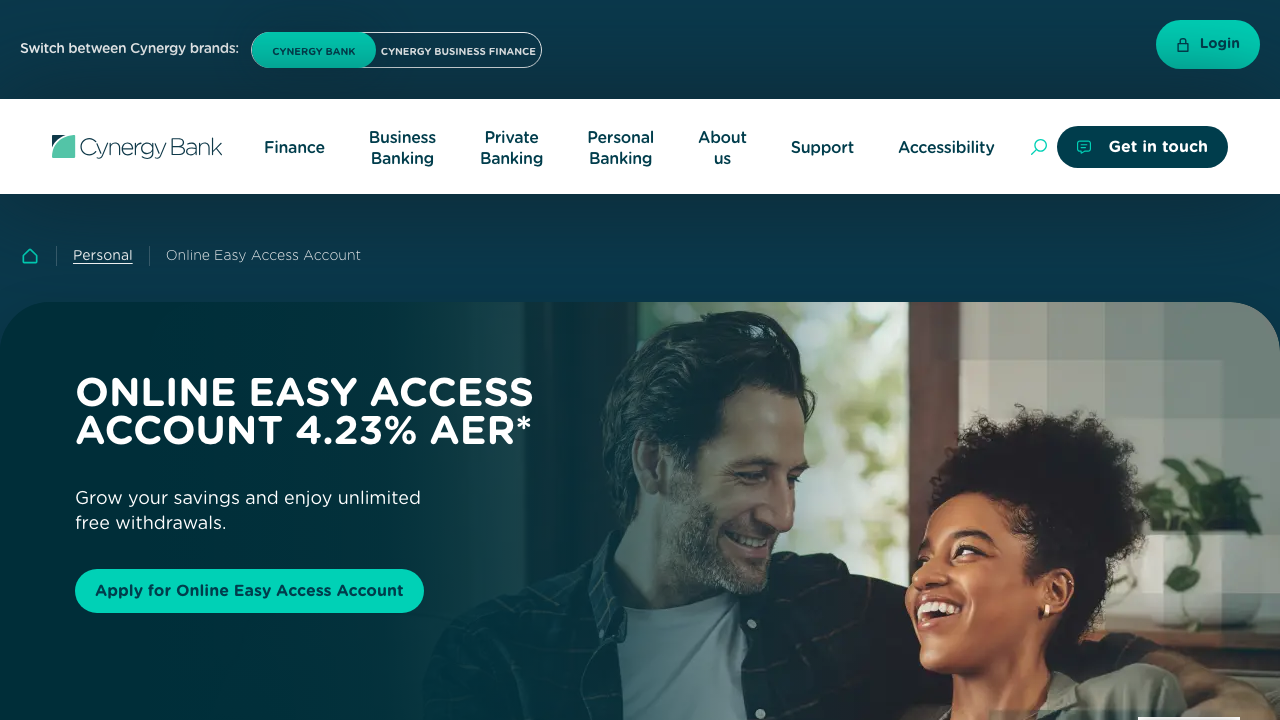
Overview: what the Cynergy Bank Online Easy Access Account actually is, and who it suits
Cynergy Bank sits in an interesting niche. It is a UK-regulated challenger bank with a physical head office but no high-street branch network to speak of, and its Online Easy Access Account is built for savers who want a straightforward variable-rate product without the friction of notice periods or fixed terms. The headline figure is 4.05% AER variable, which includes a 2.00% introductory bonus applied for the first twelve months. After that, the base rate stands at roughly 2.05% AER. Both numbers are variable, meaning Cynergy can change them in line with Bank of England base rate movements.
The account is a genuine fit for people who hold a cash buffer between five hundred and eighty-five thousand pounds and want meaningful interest without locking money away. Joint ownership is permitted for up to two holders, which makes it practical for couples or domestic partners managing shared emergency reserves. The entire relationship is managed online. There is no branch to visit, no paper forms to post, and no relationship manager to call for routine queries.
Who is this account not for? Cash ISA seekers will find nothing here because this is a standard (non-ISA) savings account. Business depositors are not eligible. Anyone who relies on telephone banking or in-branch service will find the experience frustrating. And savers who plan to leave funds untouched for two or more years should compare this against fixed-rate bonds, because the base rate after the bonus period expires is not especially competitive when set against the best two-year fixes currently on the market.
The interest rate in detail: bonus mechanics, payment schedule, and conditions
The 4.05% AER figure deserves careful reading. AER stands for Annual Equivalent Rate and factors in compounding; the gross rate and the AER will differ slightly depending on how often interest is credited. Cynergy pays interest monthly into the account itself, so your balance grows incrementally rather than arriving as a single lump sum at year end. That monthly crediting is genuinely useful because it means each subsequent month earns a marginally higher amount as the interest compounds.
The 2.00% bonus component runs from the date you open the account and expires twelve months later. Cynergy does not require you to keep a minimum balance to retain the bonus, though you do need to make at least one deposit to activate the account. There is no upper limit on the interest-earning balance beyond the FSCS cap of 85,000 GBP per person (170,000 GBP for a joint account, as each holder is protected separately).
In our test, the rate was straightforwardly displayed throughout the application journey with no small-print surprises. The practical risk is well signposted: once month thirteen arrives, the rate falls to approximately 2.05% AER unless Cynergy has adjusted the base rate in the meantime. There is no automatic rollover into a new bonus product. Savers who want to recapture a headline rate will need to take action themselves, either by contacting the bank to ask whether a new bonus deal is available or by switching to a competitor. Setting a calendar reminder for month eleven is sensible housekeeping.
Taxation on your savings interest in the UK
UK residents benefit from the Personal Savings Allowance, introduced in April 2016. Basic-rate taxpayers (20% band) can earn up to 1,000 GBP in savings interest per tax year before paying any tax. Higher-rate taxpayers (40% band) have a 500 GBP allowance. Additional-rate taxpayers who pay 45% receive no allowance at all. The interest from this account counts toward those thresholds and is treated as ordinary income for tax purposes.
Cynergy does not deduct tax at source. The bank reports interest paid to HMRC, and for most savers the adjustment happens automatically through the PAYE tax code or via a self-assessment return. If your total savings interest across all accounts exceeds your allowance, you are responsible for declaring the excess. At 4.05% on a 25,000 GBP balance, annual interest would be approximately 1,012 GBP, which already nudges a basic-rate taxpayer just over their threshold. Savers with larger balances should consider whether a Cash ISA would shelter future interest more efficiently, accepting that the ISA rates currently available may be lower.
There is no withholding tax mechanism here, no offshore structure, and no special wrapper. The simplicity is a virtue for most people, but it does mean you need to be aware of your own position, particularly if you hold significant savings across multiple institutions.
Opening the account: the step-by-step process
The application is completed entirely online via Cynergy Bank’s website. You will need a UK residential address, a valid email address, a UK mobile number capable of receiving SMS codes, and one form of photo ID. Cynergy uses standard digital identity verification, so a passport or driving licence photograph is typically uploaded through the browser rather than posted. The process should take between ten and fifteen minutes for most applicants.
Once approved, a sort code and account number are issued. The IBAN follows UK format (beginning GB), as Cynergy Bank is authorised by the Prudential Regulation Authority and regulated by both the PRA and the Financial Conduct Authority. You fund the account by bank transfer from an existing UK current account. There is no minimum opening deposit specified in the account terms, though depositing at least a nominal amount promptly ensures the account is active and the bonus period clock starts correctly.
Notice periods do not apply. You can withdraw the full balance at any time and the account will simply sit at zero, or you can close it with a short online or written request. There is no penalty for early closure and no lock-in of any kind. The absence of a notice period is one of the account’s clearest practical advantages over competitors that require 30, 60, or even 95 days of notice for full rate access.
Safety, the deposit guarantee scheme, and the institution behind it
Deposits are protected by the Financial Services Compensation Scheme, known as the FSCS, up to 85,000 GBP per eligible depositor. For a joint account, each holder counts separately, raising the effective protection to 170,000 GBP. The FSCS is a statutory body backed by the UK government and has paid out in every case of UK bank failure to date. Protection is automatic; there is no registration required and no claim form to submit in advance.
Cynergy Bank plc is incorporated in England and Wales, authorised by the Prudential Regulation Authority, and regulated by both the PRA and the Financial Conduct Authority. It is not a fintech front-end holding customer funds in pooled e-money accounts. It is a licensed bank in the full regulatory sense, which means deposits sit on Cynergy’s own balance sheet and benefit directly from FSCS cover without any pass-through structure to worry about.
The bank’s roots lie in the former Bank of Cyprus UK, which rebranded as Cynergy Bank in 2018 following a change in ownership. Since then it has focused primarily on property finance and retail savings in the UK market. Its credit ratings and financial disclosures are published annually in accordance with PRA requirements. For savers, the relevant point is straightforward: this is a regulated UK bank, FSCS-covered, with no unusual ownership structure that would complicate a compensation claim.
Reputation and real customer experience
Cynergy Bank’s Trustpilot rating sits in the mid-range for the savings sector. Recurring themes in positive reviews centre on the speed of account opening, the clarity of the online interface, and the absence of complications around withdrawals. Customers who needed to move large sums out at short notice report that the transfers processed within the standard one to two business day window with no unusual friction.
The recurring complaints point in a consistent direction. Several customers have noted that when the introductory bonus expired, the rate drop was more significant than they had mentally budgeted for, even though the terms make it explicit. A second theme concerns customer service response times. Because the account is online-only, phone support queues and email response windows have drawn criticism during periods of high demand, particularly in the months following a Bank of England rate decision when many savers are reassessing their options simultaneously. A third, smaller cluster of feedback relates to the app dependency for online banking authentication; customers who prefer to use a browser alone occasionally find the two-factor process clunky.
What is notably absent from the complaints is anything suggesting problems with actual payment processing or deposit safety. The operational reliability of the account itself appears solid. The frustrations are primarily about rate lifecycle management and service accessibility, not about the bank failing to perform its core function.
Verdict: open it, or look elsewhere?
In our test, the Cynergy Bank Online Easy Access Account delivered on its core promise. The rate credited on time, withdrawals processed without drama, and the application was completed in under twelve minutes. For a UK saver who wants a competitive variable rate on a balance they might need to access within the year, and who is comfortable managing money entirely online, this account earns its four-star rating.
Open it if: you have between roughly 5,000 GBP and 85,000 GBP earning little in a current account; you want genuine flexibility with no notice period; and you are organised enough to review the rate again around month eleven before the bonus expires.
Look elsewhere if: you want a fixed guaranteed return for two or more years (a fixed-rate bond will almost certainly pay more); you need a tax-efficient wrapper (a Cash ISA from a provider like Moneybox or Skipton Building Society would shelter your interest); you manage savings above 85,000 GBP and need to split deposits across multiple FSCS-covered institutions without the administrative overhead of an online-only bank; or you simply prefer having a human being available by phone without a lengthy wait. The account is not broken, and the FSCS protection is unambiguous. The decision hinges largely on whether the post-bonus rate still makes sense for your balance by the time month thirteen arrives.
How safe is Cynergy Bank Online Easy Access Account?
Cynergy Bank Online Easy Access Account vs alternatives
A direct comparison of the key conditions against the strongest competitors in the market.
| Cynergy Bank Online Easy Access AccountReviewed | Trading 212 Cash ISA | Moneybox Cash ISA | Skipton Building Society Savings Account | |
| Rating | 4.0 /5 | 4.5 /5 | 4.3 /5 | 4.2 /5 |
| Interest on savings account | 4.05% AER variable (incl. 2.00% bonus for 12 months) | 4.81% AER variable (incl. 0.71% bonus for 12 months; standard rate 4.10% AER) | 4.75% AER variable (incl. 1.30% bonus for 12 months) | ca. 3.85% AER variable (Easy Access Saver); up to 7.50% AER (Member Regular Saver, 12 months) |
| Deposit protection | 85.000 GBP | 85.000 GBP | 85.000 GBP | 85.000 GBP |
| Online account opening | ✓ | ✓ | ✓ | ✓ |
| Welcome bonus | ✗ | ✓ | ✗ | ✗ |
| Joint account | ✓ | ✗ | ✗ | ✓ |
| Overdraft interest rate | ✗ | ✗ | ✗ | ✗ |
| Savings account | ✓ | ✓ | ✓ | ✓ |
How we rate
About the author

Frequently asked questions
The account is open to UK residents aged 18 and over with a valid UK address and photographic identity. A joint account option is available for up to two holders. Non-UK residents cannot apply for this account.
There are no monthly account fees and no charges for withdrawals. Transfers in and out are made by standard bank transfer to a linked UK current account, and there is no minimum balance requirement to earn the advertised rate.
Deposits are covered by the FSCS (Financial Services Compensation Scheme) up to 85,000 GBP per person per bank. Joint account holders each receive separate FSCS protection, so a joint account can be covered up to 170,000 GBP in total.
The application is completed entirely online through the Cynergy Bank website. In our test, the process took only a few minutes and required standard personal details, a UK address history and photographic ID. No branch visit is needed.
Yes. Cynergy Bank is authorised by the Prudential Regulation Authority (PRA) and regulated by both the FCA and PRA. It is a UK-licensed bank, and its deposit protection is provided by the statutory FSCS scheme.
Interest is paid gross, without tax deducted at source. Most UK savers benefit from the Personal Savings Allowance, which allows basic-rate taxpayers to receive up to 1,000 GBP of savings interest tax-free per year. Higher-rate taxpayers have a 500 GBP allowance. Savers should declare any taxable interest to HMRC through self-assessment if they exceed their allowance.